Loading...
Ezer Weizman vs Julius Caesar
Julius Caesar leads by 25.0 pts · 2 figures compared
…
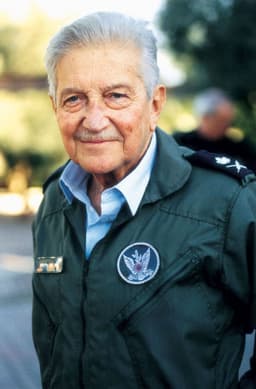
Ezer Weizman
General · Modern
57.8Total

Julius Caesar
General · Ancient
82.8Total
Basic Information
Born
1924
-100
Died
—
-44
Era
Modern
Ancient
Nationality
Israel
Roman Republic
Occupation
General
General
Civilization
Middle Eastern
Western
Score Comparison
Military (10%)
40.0
88.0
Political (20%)
68.0
78.0
Influence (20%)
59.0
85.0
Legacy (20%)
50.0
82.0
Leadership (15%)
72.0
80.0
Strategy (15%)
55.0
85.0
TOTAL
57.8
82.8
Ezer Weizman — Complete Timeline
1958 AD
Appointed Commander of the Israeli Air ForceWar◆ Major
Ezer Weizman was appointed Commander of the Israeli Air Force in 1958. He modernized the force and oversaw the acquisition of French Mirage jets, which were crucial in the Six-Day War.
Air ForceMilitary modernization
Impact: nationalconstructive
1967 AD
Led the Israeli Air Force in the Six-Day WarWar
As Air Force commander, Weizman planned and executed the preemptive airstrikes that destroyed the Egyptian, Jordanian, and Syrian air forces on the ground. This operation secured Israeli air superiority and was decisive in the war.
Six-Day WarAirstrikes
Impact: global
1977 AD
Served as Minister of DefensePolitical Action◆ Major
Weizman served as Minister of Defense from 1977 to 1980 under Prime Minister Menachem Begin. He played a key role in the Camp David Accords and the peace treaty with Egypt.
Defense MinisterCamp David
Impact: globalconstructive
1993 AD
Elected Seventh President of IsraelPolitical Action◆ Major
Weizman was elected as the seventh President of Israel in March 1993. He served two terms until 2000, focusing on promoting peace and reconciliation, including supporting the Oslo Accords.
PresidencyPeace
Impact: nationalconstructive
2000 AD
Resigned as President Amid ScandalPolitical Action◆ Major
Weizman resigned as President in July 2000 after an investigation revealed he had accepted large cash gifts from a French businessman while in office. His resignation ended his political career.
ResignationScandal
Impact: nationaltragic
Julius Caesar — Complete Timeline
58 BC
Gallic WarsWar◆ Major
Caesar, as proconsul of Gaul, launched a series of campaigns that conquered all of Gaul (modern France, Belgium, and parts of Switzerland). He fought numerous battles, including against the Helvetii, the Belgae, and the Gallic chieftain Vercingetorix. The wars brought immense wealth and a loyal army to Caesar.
Gallic WarsConquestRoman Expansion
Impact: regional
49 BC
Crossing the RubiconPolitical Action◆ Major
Caesar led Legio XIII across the Rubicon River into Italy, defying the Roman Senate's order to disband his army. This act triggered a civil war against Pompey and the Optimates, ultimately leading to Caesar's dictatorship and the end of the Roman Republic.
Roman Civil WarEnd of RepublicPower Struggle
Impact: global
48 BC
Battle of PharsalusWar◆ Major
Caesar's outnumbered army defeated the larger forces of Pompey the Great at Pharsalus in Greece. Caesar's tactical use of a reserve line to counter Pompey's cavalry charge proved decisive. Pompey fled to Egypt, where he was assassinated, leaving Caesar as the undisputed master of the Roman world.
Roman Civil WarBattleDecisive Victory
Impact: regional
44 BC
Appointment as Dictator for LifePolitical Action◆ Major
The Roman Senate appointed Caesar dictator perpetuo (dictator for life), granting him unprecedented personal power. This move concentrated military, legislative, and judicial authority in one person, effectively ending the Roman Republic's traditional system of checks and balances and alarming many senators.
DictatorshipEnd of RepublicPower Consolidation
Impact: regionaldestructive
Assassination on the Ides of MarchPolitical Action◆ Major
A group of Roman senators, led by Marcus Junius Brutus and Gaius Cassius Longinus, stabbed Caesar to death at a meeting of the Senate in the Theatre of Pompey. The assassination was intended to restore the Republic, but instead triggered another civil war that led to the rise of the Roman Empire.
AssassinationRoman PoliticsEnd of Republic
Impact: globaldestructive
Expert Analysis
ezer-weizman-vs-julius-caesar
# The General and the Statesman: Caesar and Weizman
In the summer of 1967, as Israeli jets screamed across the Sinai desert in a preemptive strike that would reshape the Middle East, Ezer Weizman watched from a command post, his heart pounding not with the thrill of battle but with the weight of a thousand decisions. Two thousand years earlier, on a muddy bank in northern Italy, Julius Caesar stood before the Rubicon River, knowing that crossing it would mean civil war and the end of the Roman Republic. Both men were generals. Both would reshape their worlds. But the paths they walked, and the destinies they forged, could not have been more different.
Origins
Julius Caesar was born into the chaos of the late Roman Republic, a world of crumbling aristocratic traditions and rising military strongmen. His family, the Julii, claimed descent from the goddess Venus, but they were politically marginal. Caesar grew up in a Rome where the Senate was a theater of assassinations, where generals like Marius and Sulla had already marched on the capital. This was a world that taught him that power flowed from the sword, not the law.
Ezer Weizman was born in 1924 in Tel Aviv, then a dusty Jewish settlement in British Palestine. His uncle, Chaim Weizman, would become Israel’s first president, and the family was steeped in the Zionist dream of a Jewish homeland. But this was no ancient empire—it was a fragile, modern nation fighting for its very existence. Weizman grew up not in marble halls but in a world of sand, barbed wire, and the constant threat of annihilation. His Rome was a tiny strip of land surrounded by enemies.
Rise to Power
Caesar’s rise was a masterclass in calculated ambition. He climbed the political ladder with ruthless precision: military service in Asia, then the priesthood, then the governorship of Spain. But his true springboard was the First Triumvirate, a secret alliance with Pompey and Crassus in 60 BCE. This gave him command of Gaul, where he spent eight years conquering a territory that would make him the richest and most powerful man in Rome. His own account of these campaigns, *The Gallic Wars*, was as much a propaganda masterpiece as a military one.
Weizman’s rise was more direct, forged in the crucible of war. He joined the British Royal Air Force during World War II, then became a founding pilot of the Israeli Air Force in 1948. In 1958, he was appointed its commander—a role that placed him at the heart of Israel’s military revolution. Where Caesar conquered with legions of infantry, Weizman built a force of jets and precision strikes. His moment came in June 1967, when he planned the airstrikes that destroyed the Egyptian air force on the ground in a single morning. The Six-Day War was his Gaul.
Leadership & Governance
Caesar governed as he fought: with audacity and a total disregard for tradition. As dictator, he reformed the calendar, granted citizenship to provincials, and launched massive building projects. But his rule was personal, not institutional. He centralized power in himself, packed the Senate with his supporters, and accepted the title “dictator for life.” This was not governance in the Roman republican tradition—it was a monarchy in all but name. His military genius lay in speed and surprise, in turning his enemies’ strengths into weaknesses. At the Battle of Alesia, he besieged the Gauls while simultaneously defending against a relief army, a feat of strategic brilliance that still stuns military historians.
Weizman governed as a bridge-builder, not a conqueror. As Minister of Defense under Menachem Begin from 1977 to 1980, he played a crucial role in the Camp David Accords that brought peace with Egypt. He understood that military victory was hollow without political settlement. As President from 1993 to 2000, he became a symbol of national unity, using the ceremonial office to push for reconciliation with the Palestinians. His leadership was not about crushing enemies but about finding common ground—a stark contrast to Caesar’s iron fist.
Triumph & Tragedy
Caesar’s triumph was absolute: the conquest of Gaul, the defeat of Pompey, the subjugation of the entire Mediterranean world. But his tragedy was equally absolute. On the Ides of March, 44 BCE, a conspiracy of senators stabbed him to death in the Pompey’s Theatre. His last words—*“Et tu, Brute?”*—became the most famous dying gasp in history. He had destroyed the Republic to save it, and in doing so, ensured his own destruction.
Weizman’s triumph was the Six-Day War, a victory so complete that it seemed to fulfill the biblical prophecies of a restored Israel. But his tragedy came quietly, in the form of a scandal. In 2000, an investigation revealed that he had accepted large cash gifts from a French businessman. He resigned as President in disgrace, his legacy tarnished by a lapse in judgment that seemed almost petty compared to Caesar’s epic fall.
Character & Destiny
Caesar was a man of immense ego and ambition, driven by a belief in his own destiny. He was generous to his soldiers, ruthless to his enemies, and utterly convinced that he alone could save Rome. This personality made him unstoppable—and also made his assassination inevitable. He could not compromise because he believed he was above compromise.
Weizman was more pragmatic, more human. He was known for his bluntness, his humor, and his willingness to admit mistakes. He once said, “I am not a politician; I am a pilot who strayed into politics.” This self-awareness allowed him to navigate the treacherous currents of Israeli politics, but it also made him vulnerable to the temptations of power. His scandal was not a grand betrayal but a quiet failure of integrity.
Legacy
Caesar’s legacy is the Roman Empire itself. His adopted heir, Octavian, became Augustus, the first emperor, and the world Caesar shaped lasted for centuries. His name became synonymous with autocratic power: “Caesar” was adopted as a title by rulers from the Tsars of Russia to the Kaisers of Germany. He is remembered as a genius, a tyrant, and a martyr—a figure who changed history forever.
Weizman’s legacy is quieter but no less significant. He helped build the Israeli Air Force into one of the world’s most formidable fighting forces. He helped make peace with Egypt, a peace that has held for decades. He is remembered as a patriot who served his country in war and peace, a man who understood that the ultimate victory is not on the battlefield but at the negotiating table.
Conclusion
Caesar and Weizman were both generals who became statesmen, but they lived in worlds so different that they might as well have been on separate planets. Caesar’s Rome was an empire waiting to be born, and he was its midwife, bloody and brilliant. Weizman’s Israel was a nation fighting for survival, and he was its defender, pragmatic and flawed. One fell to the daggers of his friends; the other fell to the slow erosion of his own integrity. Yet both remind us that the line between soldier and leader is thin, and that the greatest battles are often fought not on fields of war but in the human heart.
Rankings
🥇
Julius CaesarLeader
Mil: 88.0Pol: 78.0Inf: 85.0
82.8
🥈
Ezer Weizman
Mil: 40.0Pol: 68.0Inf: 59.0
57.8
+25.0 behind
How This Comparison Works
Algorithm
Each figure is scored on 6 dimensions (0—100 scale) based on structured historical data: Military (10%), Political (20%), Influence (20%), Legacy (20%), Leadership (15%), Strategy (15%). The weighted total produces the final ranking.
Data Sources
Scores are computed from structured sub-indicators in the database. Scale factors adjust for era (Ancient ×0.85, Modern ×1.0) and civilization size (Eastern ×1.05, Other ×0.80) to account for differences in population and military scale.
Maximum 3 Figures
Comparisons are limited to 2—3 figures to ensure readability and statistical meaningfulness.
Error Margins
±5 points per dimension — Sub-scores are derived from historical records with inherent uncertainty. Two figures within 5 points on a dimension should be considered roughly equivalent in that area.
Total Score Accuracy
±3 points overall — The weighted combination of 6 dimensions produces a total score with approximately ±3 points of uncertainty. Differences of less than 3 points are not statistically significant— the figures are effectively tied.
Known Limitations
- Historical records are incomplete and uneven across civilizations
- Figures from oral-tradition societies may be underrepresented
- Occupation labels can misclassify multi-role figures
- Scores measure capability and impact, not moral character
- Quantitative scoring is a comparison tool, not absolute truth
Capability Radar
Military (10%) — Battles & Warfare
Battles
45
95
Win Rate
50
92
Expansion
30
97
Political (20%) — Governance & Reform
Reform
40
90
Diplomacy
60
85
Economy
35
82
Influence (20%) — Cultural & Global Reach
Cultural
40
88
Global
45
94
Legacy (20%) — Historical Impact
Historical
50
95
Longevity
40
96
Leadership (15%) — Power & Stability
Tenure
65
75
Stability
55
60
Strategy (15%) — Tactics & Innovation
Strategy
55
94
Tactics
60
96
Reform
70
88
Similar Comparisons
Comments & Discussion
CaesarTheConqueror6/17/2026
Comparing Weizman to Caesar? That's like comparing a chess grandmaster to a checkers champ. Caesar crossed the Rubicon, a literal river of civil war, and ended a 500-year-old Republic. Weizman just helped bomb airfields in a Six-Day War that was over before lunch. Different leagues, different games. Caesar changed the course of history; Weizman changed the course of a regional conflict. Let's not pretend the scale is similar.
TacticalTablesTurned6/17/2026
对比很牵强,但有个有趣的相似点:两位都靠出其不意取胜。公元前49年,凯撒带一个军团渡过卢比孔河,在罗马人措手不及时夺取政权。而1967年,魏茨曼策划的空袭在头三小时内就摧毁了埃及空军,几乎不费一兵一卒。都擅长造势,让敌人来不及反应——这点上,魏茨曼不输人。
CaesarsGhostWriter6/17/2026
Historians love painting Weizman as a "modern Caesar," but that's journalistic fluff, not analysis. Caesar fought a ten-year civil war spanning Gaul, Rome, Egypt, and Spain, facing Pompey's legions and Cleopatra's schemes. Weizman fought a six-day war and then became a defense minister who opposed settlements—hardly a parallel. The real comparison belongs to their legacies: Caesar left an empire, Weizman left a cease-fire. Context matters, and this one's lacking.
RevivalistWithGrit6/17/2026
你们忽视了一点:两人都重塑了国家身份。凯撒把共和国变成帝国,终结了元老院统治,开创了“罗马和平”。而魏茨曼在1967年胜利后,将以色列从“生存恐惧”转向“区域霸主”心态,推动了民族自豪感和军事文化。不是规模相同,而是方向类似。都让国家走上了新轨道,无论好坏。
ClassicsVsMyth6/17/2026
Let's be real: Caesar was a patrician genius who wrote his own propaganda in Latin, while Weizman was a fighter pilot who learned his trade in the RAF. One conquered Gaul for Rome's grain supply; the other conquered air superiority for Israel's survival. Apples and oranges, but at least both had ambition and a flair for the dramatic. Caesar would've admired Weizman's airstrikes; Weizman would've loathed Caesar's civil war. Different times, same fire.