Loading...
Fang Xiaoru vs Napoleon Bonaparte
Napoleon Bonaparte leads by 21.9 pts · 2 figures compared
…
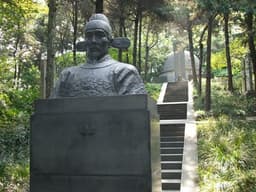
Fang Xiaoru
Politician · Medieval
49.0Total

Napoleon Bonaparte
General · Modern
70.9Total
Basic Information
Born
1357
1769
Died
1402
1821
Era
Medieval
Modern
Nationality
China
France
Occupation
Politician
General
Civilization
Eastern
Western
Score Comparison
Military (10%)
45.7
94.0
Political (20%)
33.6
72.0
Influence (20%)
59.0
40.0
Legacy (20%)
58.0
80.0
Leadership (15%)
43.8
78.0
Strategy (15%)
35.9
90.0
TOTAL
49.0
70.9
Fang Xiaoru — Complete Timeline
1402 AD
Refused to Draft Edict for Yongle EmperorPolitical Action
After the Yongle Emperor usurped the throne, he ordered Fang Xiaoru to draft the accession edict. Fang refused, calling the usurper a traitor. This act of defiance led to his execution and the massacre of his entire clan.
Ming DynastyConfucian ScholarDefiance
Impact: nationaltragic
Executed with Ten ClansPolitical Action◆ Major
Fang Xiaoru was executed by dismemberment, and his family, students, and associates
Ming DynastyMassacreConfucian Resistance
Impact: nationaldestructive
Napoleon Bonaparte — Complete Timeline
1799 AD
Coup of 18 BrumaireOther◆ Major
Napoleon Bonaparte, with support from his brother Lucien and key political figures, overthrew the Directory in a bloodless coup. He established the Consulate with himself as First Consul, effectively becoming the ruler of France. This event ended the French Revolution's most unstable period.
French RevolutionCoupRise to Power
Impact: regional
1804 AD
Promulgation of the Napoleonic CodeOther◆ Major
Napoleon enacted the Civil Code of the French, known as the Napoleonic Code, a comprehensive set of laws that replaced the fragmented feudal legal systems. The code established legal equality, protected property rights, and secularized law. It became the basis for legal systems in many European and world countries.
Legal ReformNapoleonic CodeCivil Law
Impact: globalconstructive
1805 AD
Battle of AusterlitzWar◆ Major
Napoleon's Grande Arm
Napoleonic WarsBattleDecisive Victory
Impact: global
1812 AD
Invasion of RussiaWar◆ Major
Napoleon led the Grande Arm
Napoleonic WarsInvasionDisaster
Impact: globaldestructive
1815 AD
Battle of WaterlooWar◆ Major
Napoleon's French army was defeated by the combined forces of the Duke of Wellington's Anglo-Allied army and Gebhard Leberecht von Bl
Napoleonic WarsBattleFinal Defeat
Impact: globaldestructive
Expert Analysis
fang-xiaoru-vs-napoleon-bonaparte
# The Conqueror and the Scholar: Two Fates at the Crossroads of History
On a cold morning in June 1815, Napoleon Bonaparte watched his Imperial Guard march into the mud of Waterloo, their last charge crumbling under British and Prussian fire. Just over four centuries earlier, in the summer of 1402, a Confucian scholar named Fang Xiaoru knelt before a usurper in Nanjing, his brush poised over a blank edict. One man would spend his final years in exile, writing memoirs on a remote Atlantic island. The other would be torn apart in the marketplace, his entire lineage erased from the earth. Both faced moments that defined them—yet their paths, their choices, and their worlds could not have been more different. What drives a man to conquer continents, and what drives another to die for a single sentence?
Origins
Napoleon was born in 1769 on Corsica, an island that had only recently become French. His family was minor nobility, struggling and ambitious. The young Bonaparte grew up speaking Italian-accented French, a perpetual outsider in a nation he would one day rule. His era was the Enlightenment, a time of upheaval when old monarchies were crumbling and new ideas of merit, law, and nationhood were reshaping Europe. He absorbed mathematics, history, and military science at French military academies, but he never forgot his sense of being an interloper—a hunger that would drive him to prove himself beyond all doubt.
Fang Xiaoru was born in 1357, deep in the heart of Ming Dynasty China, into a family of Confucian scholars. His father was a respected official, and from childhood, Fang was immersed in the classics: the Analects, the Mencius, the ritual texts that prescribed how a virtuous man should live and die. His era was one of consolidation, as the Ming emperor Zhu Yuanzhang had just driven out the Mongols and restored Han Chinese rule. For Fang, the world was ordered by hierarchy, loyalty, and moral duty. There was no room for personal ambition—only the pursuit of righteousness.
Rise to Power
Napoleon’s ascent was explosive and improbable. In 1793, at age twenty-four, he drove the British out of Toulon with a brilliant artillery plan. By 1796, he was commanding the Army of Italy, winning battle after battle against the Austrians. His political genius matched his military prowess: he knew how to manipulate the press, stage-manage his image, and position himself as the savior of the French Revolution. In 1799, he seized power in a coup, becoming First Consul. Five years later, he crowned himself Emperor in Notre Dame, taking the crown from the Pope’s hands and placing it on his own head. The message was clear: he owed nothing to God or tradition.
Fang Xiaoru’s rise was scholarly and gradual. He earned a reputation as a brilliant teacher and moralist, attracting the attention of the Jianwen Emperor, who ascended the throne in 1398. The young emperor was idealistic and wanted to reform the empire, reducing the power of his princely uncles. Fang became his chief advisor, a position of immense influence. But Fang’s power was borrowed—it came from the emperor’s trust, not from armies or alliances. He was a man of ideas in a world that was about to be decided by swords.
Leadership & Governance
Napoleon ruled with a blend of iron efficiency and visionary reform. His Napoleonic Code, enacted in 1804, standardized French law, abolished feudal privileges, and enshrined principles of equality before the law—though not for women. He built roads, canals, and schools; he reorganized the bureaucracy and created a system of merit-based promotion. His military leadership was legendary: he moved armies faster than any commander before him, used artillery as a shock weapon, and exploited enemy weaknesses with surgical precision. At Austerlitz in 1805, he crushed the combined forces of Russia and Austria in a single day, a masterpiece of deception and timing. Yet his political score of 75.0 reflects a fatal flaw: he could conquer but could not consolidate. He placed his brothers on thrones across Europe, but they were puppets, not partners.
Fang Xiaoru governed through moral exhortation and ritual. As the Jianwen Emperor’s chief minister, he promoted Confucian education, reduced taxes, and tried to curb the power of the military princes. His political score of 47.8 is low, but it masks a different kind of leadership: the leadership of principle. He believed that a ruler must be virtuous, and that virtue would inspire loyalty. He had no army, no police, no secret police. He had only the power of the word. When the prince Zhu Di rebelled in 1399, Fang urged the emperor to resist through righteous decrees. He did not understand that rebels do not read edicts.
Triumph & Tragedy
Napoleon’s greatest moment was perhaps 1806, when he entered Berlin as a conqueror, or 1807, when he met Tsar Alexander I on a raft in the Niemen River and carved up Europe between them. His empire stretched from Spain to Poland, from the Baltic to the Adriatic. But his greatest tragedy was the invasion of Russia in 1812. He marched with 600,000 men; fewer than 100,000 returned. The Russian winter, the scorched-earth tactics, and his own refusal to compromise destroyed the Grand Army. He was exiled to Elba in 1814, escaped in 1815, and was finally defeated at Waterloo. His military score of 94.0 and strategy score of 93.0 are among the highest in history, but they could not save him from his own ambition.
Fang Xiaoru’s triumph was moral, not military. In 1402, when Zhu Di’s armies breached Nanjing, the Jianwen Emperor disappeared (probably burned alive in the palace). Zhu Di, now the Yongle Emperor, needed legitimacy. He summoned Fang Xiaoru and ordered him to draft the accession edict. Fang refused. He called the usurper a thief. The Yongle Emperor threatened him with the extermination of his entire clan. Fang replied: “You may kill my ten clans, but you cannot change the truth.” He was executed by dismemberment, and the Yongle Emperor carried out his threat: Fang’s family, his students, his associates—everyone connected to him within nine degrees of kinship, plus his teachers and students, making ten clans—were slaughtered. Over 800 people died. It was an unprecedented act of cruelty, and it became a symbol of tyranny.
Character & Destiny
Napoleon was a man of boundless energy, brilliant intellect, and relentless ambition. He once said, “Impossible is a word to be found only in the dictionary of fools.” His personality drove him to conquer, but it also drove him to overreach. He could not stop, could not delegate, could not trust. He micromanaged his armies from hundreds of miles away, and he alienated allies through arrogance. His destiny was shaped by the chaos of revolutionary Europe, which rewarded audacity and punished caution. He was a product of his time, but he also bent time to his will.
Fang Xiaoru was a man of absolute principle. He once wrote, “A scholar may die, but his integrity cannot be destroyed.” His personality was rigid, uncompromising, and deeply Confucian. He believed that the universe had a moral order, and that a true man must uphold it even at the cost of his life. His destiny was shaped by the Ming Dynasty’s succession crisis, which pitted legitimacy against power. He chose legitimacy, and he paid the ultimate price. His leadership score of 40.5 reflects his inability to adapt, but his influence score of 72.8 and legacy score of 66.2 show that his death was not in vain.
Legacy
Napoleon’s legacy is everywhere. His legal code influenced civil law systems across Europe, Latin America, and parts of Asia. His military innovations are still studied in war colleges. His legend—the little Corsican who conquered Europe—has inspired countless books, films, and myths. But his legacy is also contested: he restored slavery in French colonies, suppressed women’s rights, and caused the deaths of millions. He is remembered as both a hero and a tyrant, a genius and a madman.
Fang Xiaoru’s legacy is quieter but deeper. In China, he became a symbol of scholarly integrity and resistance to tyranny. His story is taught in schools, and his name is invoked whenever officials face corrupt rulers. The Yongle Emperor went on to build the Forbidden City and launch Zheng He’s voyages, but his brutality against Fang Xiaoru stained his reign. Fang’s refusal to write that edict became a legend—a reminder that some things are worth dying for. His total score of 58.2 does not capture his moral weight.
Conclusion
Napoleon and Fang Xiaoru lived in different worlds—one of gunpowder and empires, the other of ink and ritual. One sought to change the world through force; the other sought to uphold the world through principle. Napoleon’s life was a grand opera of victory and defeat; Fang’s was a quiet tragedy of conviction and martyrdom. Yet both faced the same fundamental question: what do you do when power confronts principle? Napoleon chose power, and it consumed him. Fang chose principle, and it destroyed him. Perhaps history’s judgment is not about who was right, but about what we are willing to sacrifice. In the end, the conqueror died alone on a rock in the Atlantic, while the scholar’s name still echoes in the halls of the Forbidden City.
Rankings
🥇
Napoleon BonaparteLeader
Mil: 94.0Pol: 72.0Inf: 40.0
70.9
🥈
Fang Xiaoru
Mil: 45.7Pol: 33.6Inf: 59.0
49.0
+21.9 behind
How This Comparison Works
Algorithm
Each figure is scored on 6 dimensions (0—100 scale) based on structured historical data: Military (10%), Political (20%), Influence (20%), Legacy (20%), Leadership (15%), Strategy (15%). The weighted total produces the final ranking.
Data Sources
Scores are computed from structured sub-indicators in the database. Scale factors adjust for era (Ancient ×0.85, Modern ×1.0) and civilization size (Eastern ×1.05, Other ×0.80) to account for differences in population and military scale.
Maximum 3 Figures
Comparisons are limited to 2—3 figures to ensure readability and statistical meaningfulness.
Error Margins
±5 points per dimension — Sub-scores are derived from historical records with inherent uncertainty. Two figures within 5 points on a dimension should be considered roughly equivalent in that area.
Total Score Accuracy
±3 points overall — The weighted combination of 6 dimensions produces a total score with approximately ±3 points of uncertainty. Differences of less than 3 points are not statistically significant— the figures are effectively tied.
Known Limitations
- Historical records are incomplete and uneven across civilizations
- Figures from oral-tradition societies may be underrepresented
- Occupation labels can misclassify multi-role figures
- Scores measure capability and impact, not moral character
- Quantitative scoring is a comparison tool, not absolute truth
Capability Radar
Military (10%) — Battles & Warfare
Battles
38
95
Win Rate
41
90
Expansion
45
95
Political (20%) — Governance & Reform
Reform
20
95
Diplomacy
10
80
Economy
10
85
Influence (20%) — Cultural & Global Reach
Cultural
55
85
Global
40
90
Legacy (20%) — Historical Impact
Historical
60
95
Longevity
65
90
Leadership (15%) — Power & Stability
Tenure
15
85
Stability
5
70
Strategy (15%) — Tactics & Innovation
Strategy
45
95
Tactics
53
98
Reform
54
92
Similar Comparisons
Comments & Discussion
No comments yet. Be the first to share your thoughts!