Loading...
Fedor von Bock vs Julius Caesar
Julius Caesar leads by 32.6 pts · 2 figures compared
…
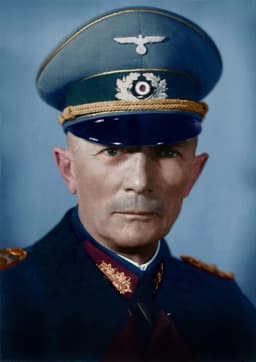
Fedor von Bock
General · Modern
50.2Total

Julius Caesar
General · Ancient
82.8Total
Basic Information
Born
1880
-100
Died
1945
-44
Era
Modern
Ancient
Nationality
Germany
Roman Republic
Occupation
General
General
Civilization
Western
Western
Score Comparison
Military (10%)
80.0
88.0
Political (20%)
27.9
78.0
Influence (20%)
58.0
85.0
Legacy (20%)
50.0
82.0
Leadership (15%)
40.4
80.0
Strategy (15%)
50.0
85.0
TOTAL
50.2
82.8
Fedor von Bock — Complete Timeline
1939 AD
Commanded Army Group North in Invasion of PolandWar◆ Major
Von Bock commanded Army Group North during the invasion of Poland. His forces advanced from Pomerania and East Prussia, encircling Polish forces. The campaign ended with the surrender of Warsaw and the partition of Poland between Germany and the Soviet Union.
World War IIInvasion of PolandArmy Group North
Impact: regionaldestructive
1941 AD
Led Army Group Center in Operation BarbarossaWar
Von Bock commanded Army Group Center, the main German force in the invasion of the Soviet Union. His forces captured Minsk, Smolensk, and advanced to the outskirts of Moscow. The campaign stalled in winter, failing to capture Moscow.
World War IIOperation BarbarossaEastern Front
Impact: globaldestructive
Battle of Moscow - German DefeatWar
Von Bock's Army Group Center launched Operation Typhoon to capture Moscow. Soviet counterattacks and harsh winter conditions halted the German advance. The failure to take Moscow marked the first major German defeat on the Eastern Front.
World War IIBattle of MoscowDefeat
Impact: globaltragic
1942 AD
Relieved of Command and RetiredPolitical Action
After the failure at Moscow, von Bock was relieved of command by Hitler. He was briefly recalled in 1942 to command Army Group South but was again dismissed after disagreements with Hitler over strategy. He retired to his estate and was killed in an air raid in 1945.
World War IIDismissalEastern Front
Impact: national
Julius Caesar — Complete Timeline
58 BC
Gallic WarsWar◆ Major
Caesar, as proconsul of Gaul, launched a series of campaigns that conquered all of Gaul (modern France, Belgium, and parts of Switzerland). He fought numerous battles, including against the Helvetii, the Belgae, and the Gallic chieftain Vercingetorix. The wars brought immense wealth and a loyal army to Caesar.
Gallic WarsConquestRoman Expansion
Impact: regional
49 BC
Crossing the RubiconPolitical Action◆ Major
Caesar led Legio XIII across the Rubicon River into Italy, defying the Roman Senate's order to disband his army. This act triggered a civil war against Pompey and the Optimates, ultimately leading to Caesar's dictatorship and the end of the Roman Republic.
Roman Civil WarEnd of RepublicPower Struggle
Impact: global
48 BC
Battle of PharsalusWar◆ Major
Caesar's outnumbered army defeated the larger forces of Pompey the Great at Pharsalus in Greece. Caesar's tactical use of a reserve line to counter Pompey's cavalry charge proved decisive. Pompey fled to Egypt, where he was assassinated, leaving Caesar as the undisputed master of the Roman world.
Roman Civil WarBattleDecisive Victory
Impact: regional
44 BC
Appointment as Dictator for LifePolitical Action◆ Major
The Roman Senate appointed Caesar dictator perpetuo (dictator for life), granting him unprecedented personal power. This move concentrated military, legislative, and judicial authority in one person, effectively ending the Roman Republic's traditional system of checks and balances and alarming many senators.
DictatorshipEnd of RepublicPower Consolidation
Impact: regionaldestructive
Assassination on the Ides of MarchPolitical Action◆ Major
A group of Roman senators, led by Marcus Junius Brutus and Gaius Cassius Longinus, stabbed Caesar to death at a meeting of the Senate in the Theatre of Pompey. The assassination was intended to restore the Republic, but instead triggered another civil war that led to the rise of the Roman Empire.
AssassinationRoman PoliticsEnd of Republic
Impact: globaldestructive
Expert Analysis
fedor-von-bock-vs-julius-caesar
The Rubicon and the Moscow Road
On a January morning in 49 BCE, Julius Caesar stood at the edge of a small river in northern Italy. The Rubicon was little more than a stream, but crossing it meant civil war—an irreversible act that would shatter the Republic and remake the world. He is said to have murmured, "The die is cast," and stepped forward. Two thousand years later, on a frozen December morning in 1941, Field Marshal Fedor von Bock stood before the wreckage of Army Group Center outside Moscow. His tanks were stranded in snow, his men froze in summer uniforms, and the Soviet counterattack was rolling in from the east. He had no Rubicon to cross; the only choice was retreat. Both men were generals of immense skill, yet one forged an empire, while the other witnessed the collapse of one. Why? The answer lies not in tactics alone, but in the deeper currents of character, politics, and destiny.
Origins
Gaius Julius Caesar was born in 100 BCE into a patrician family that had seen better days. His Rome was a Republic in crisis—corrupt, violent, and torn between senatorial oligarchs and populist reformers. Caesar grew up in the shadow of civil wars, learning that power was not inherited but seized. He cultivated his image as a man of the people, borrowing fortunes to fund spectacles and bribes, and nearly lost his life in the political purges of Sulla. From the start, he understood that survival meant mastering both the sword and the crowd.
Fedor von Bock was born in 1880 in Küstrin, Prussia, into a military family with a lineage stretching back to the Prussian kings. His Germany was an empire of discipline, order, and rigid hierarchy. Young von Bock was raised to obey, to command, and to serve the state without question. He fought in World War I with distinction, and after Germany's defeat, he remained in the truncated Reichswehr, a soldier who never doubted his duty. Where Caesar learned to bend rules, von Bock learned to follow them.
Rise to Power
Caesar’s ascent was a masterpiece of calculated risk. He rose through the ranks of Roman politics—quaestor, aedile, praetor—but his true breakthrough came in 58 BCE when he secured command of Gaul. Over eight years, he conquered a territory larger than Italy, amassed a fortune, and built an army that was loyal to him personally, not to the Republic. His Commentaries on the Gallic Wars were not just history; they were propaganda, broadcasting his genius to Rome. When the Senate ordered him to disband his army, he chose war. Crossing the Rubicon in 49 BCE was not a desperate act but a deliberate gamble by a man who had spent his life calculating odds.
Von Bock’s rise was quieter, more institutional. He commanded Army Group North in the 1939 invasion of Poland, a swift and efficient campaign that showcased German blitzkrieg tactics. By 1941, he was given the most prestigious command in the Wehrmacht: Army Group Center, the spearhead of Operation Barbarossa, the invasion of the Soviet Union. He was not a political general like some of his peers; he was a professional, respected for his competence and his cold, aristocratic demeanor. Hitler called him "the Holy Ghost" for his aloofness. But that aloofness was also a limitation: von Bock served the Nazi state without ever truly owning its vision.
Leadership & Governance
Caesar governed as he fought—boldly, personally, and with an eye on the future. As dictator, he reformed the calendar, extended citizenship to provincials, launched public works, and centralized authority. His military genius lay in speed and adaptability: at Alesia in 52 BCE, he besieged a Gallic stronghold while simultaneously building fortifications to repel a relief army, a double-ringed masterpiece of engineering and nerve. He led from the front, shared his soldiers' hardships, and rewarded talent regardless of birth. Yet his political wisdom was flawed: he pardoned his enemies, expecting gratitude, and ignored the deep resentment of the senatorial class.
Von Bock was a master of conventional warfare. In 1941, his Army Group Center captured Minsk, Smolensk, and nearly a million Soviet prisoners. He followed the classic Prussian doctrine of *Kesselschlacht*—battles of encirclement—and executed them with brutal efficiency. But his strategic vision was limited. When Hitler ordered the drive on Moscow in September 1941, von Bock obeyed, despite the approaching winter and exhausted supply lines. He was a brilliant executor, not a visionary. Unlike Caesar, who could defy the Senate and rewrite the rules, von Bock could not defy his Führer. His discipline became his cage.
Triumph & Tragedy
Caesar’s greatest triumph was his conquest of Gaul, which doubled Rome’s territory and made him the most powerful man in the Republic. His greatest tragedy was his assassination on the Ides of March in 44 BCE, stabbed by senators he had pardoned. He died at the height of his power, but his name lived on: "Caesar" became synonymous with emperor, and his adopted heir, Octavian, would found the Roman Empire.
Von Bock’s greatest triumph was the capture of Smolensk in July 1941, a victory that opened the road to Moscow. His greatest tragedy was the Battle of Moscow itself. Operation Typhoon, launched in October, stalled in mud and snow. By December, Soviet reinforcements and a counteroffensive shattered the German lines. Von Bock was relieved of command in early 1942, his health broken, his reputation tarnished. He was briefly recalled to command Army Group South, but after further disagreements with Hitler, he was retired for good. He died in 1945 during an Allied air raid, a footnote in a war that had consumed his world.
Character & Destiny
Caesar was driven by an insatiable ambition that he never tried to hide. He once said, "It is better to be first in a village than second in Rome." His character was a blend of audacity, charm, and ruthless calculation. He understood that in a world of chaos, the only stability was his own will. That will built an empire—but it also made him a target. His destiny was to be both creator and victim of his own legend.
Von Bock was driven by duty, not ambition. He was a soldier who believed in order and hierarchy, and he placed his faith in a system that ultimately betrayed him. He never questioned Hitler’s strategic madness, never considered a coup, never sought to shape events beyond his command. His character was his tragedy: he was too loyal to defy, too professional to innovate, and too rigid to adapt. Where Caesar bent history to his will, von Bock was swept along by it.
Legacy
Caesar’s legacy is immeasurable. The Roman Empire, the Latin language, the Julian calendar, and the very concept of "dictator" all bear his mark. He is remembered as a military genius, a political reformer, and a cautionary tale about the price of absolute power. Shakespeare gave him the immortal line, "Et tu, Brute?"—a reminder that even the mightiest can fall.
Von Bock’s legacy is narrower. He is studied by military historians as a capable commander in a flawed cause. His name appears in footnotes on the Eastern Front, a symbol of the Wehrmacht’s professionalism and its moral blindness. He left no empire, no reforms, no enduring words. He left only the frozen fields outside Moscow, where the tide of war turned, and where a general who could not cross his own Rubicon watched his army die.
Conclusion
Caesar and von Bock stand on opposite sides of a chasm that is not just about time, but about vision. One man redefined the world; the other was defined by it. Caesar understood that power is not given—it is taken, shaped, and wielded. Von Bock understood only how to serve power, not how to create it. In the end, the difference between building an empire and losing a war is not just strategy or luck. It is the courage to cross the river, knowing that on the other side, everything will change—and that you alone must decide what comes next.
Rankings
🥇
Julius CaesarLeader
Mil: 88.0Pol: 78.0Inf: 85.0
82.8
🥈
Fedor von Bock
Mil: 80.0Pol: 27.9Inf: 58.0
50.2
+32.6 behind
How This Comparison Works
Algorithm
Each figure is scored on 6 dimensions (0—100 scale) based on structured historical data: Military (10%), Political (20%), Influence (20%), Legacy (20%), Leadership (15%), Strategy (15%). The weighted total produces the final ranking.
Data Sources
Scores are computed from structured sub-indicators in the database. Scale factors adjust for era (Ancient ×0.85, Modern ×1.0) and civilization size (Eastern ×1.05, Other ×0.80) to account for differences in population and military scale.
Maximum 3 Figures
Comparisons are limited to 2—3 figures to ensure readability and statistical meaningfulness.
Error Margins
±5 points per dimension — Sub-scores are derived from historical records with inherent uncertainty. Two figures within 5 points on a dimension should be considered roughly equivalent in that area.
Total Score Accuracy
±3 points overall — The weighted combination of 6 dimensions produces a total score with approximately ±3 points of uncertainty. Differences of less than 3 points are not statistically significant— the figures are effectively tied.
Known Limitations
- Historical records are incomplete and uneven across civilizations
- Figures from oral-tradition societies may be underrepresented
- Occupation labels can misclassify multi-role figures
- Scores measure capability and impact, not moral character
- Quantitative scoring is a comparison tool, not absolute truth
Capability Radar
Military (10%) — Battles & Warfare
Battles
75
95
Win Rate
70
92
Expansion
75
97
Political (20%) — Governance & Reform
Reform
10
90
Diplomacy
15
85
Economy
10
82
Influence (20%) — Cultural & Global Reach
Cultural
30
88
Global
50
94
Legacy (20%) — Historical Impact
Historical
55
95
Longevity
40
96
Leadership (15%) — Power & Stability
Tenure
20
75
Stability
15
60
Strategy (15%) — Tactics & Innovation
Strategy
70
94
Tactics
65
96
Reform
30
88
Similar Comparisons
Comments & Discussion
BockTheBarbarian6/17/2026
Caesar was a political animal who knew his legions were tools of statecraft. Von Bock was a pure technocrat who thought battlefield victories alone would win the war. Case in point: Caesar’s meticulous courting of German tribes through diplomacy before crossing the Rhine. Von Bock bungled Barbarossa by assuming the Red Army would simply dissolve. Technicians lose empires, statesmen build them. There’s your comparison in a nutshell.
RubiconStepper6/17/2026
Caesar crossed his little stream with a brilliant political calculation, knowing Gaul was pacified and Pompey divided. Von Bock faced a logistical nightmare—half his panzers lacked winter gear because Hitler thought Moscow would fall in August. One took a calculated risk that paid off; the other inherited a strategic fantasy. Tactics can’t fix delusion, gentlemen.
军团测谎仪6/17/2026
拿凯撒和博克比?凯撒的兵是公民兵,能边打仗边种地搞基建,高卢战役就那几场硬仗,其他全是政治收买。博克带的是职业国防军,结果巴巴罗萨计划里连后勤估算都是错的,燃料只够冲到斯摩棱斯克。一个是把战争当政治续集演,一个是把战争当军事考试答。两种思维,两种结局。没得辩。
历史计量师6/17/2026
你们都在吹天命和性格,我倒想看看数据。凯撒在高卢打了七年,年均伤亡不过三千,还全是围城战。博克的中央集团军前三个月就报销了十万多,关键是连莫斯科的影子都没摸到。伤亡率差了多少倍?军事效率差了多少个量级?别拿逻辑和修辞糊弄人,冷冰冰的数字最诚实:一个会打仗,一个在送死。
帝国情结纠察员6/17/2026
佩服各位的“伟大将领”叙事。可凯撒和博克都不过是帝国机器的代理零件。凯撒越了卢比孔是帮元老院财阀扫清政敌,高卢屠了百万人的债是罗马金库的利息。博克在莫斯科城外冻死是因为纳粹掠夺东欧的贪欲根本算不出补给线。英雄史观是给历史课增色,但别忘了,所谓名将不过是给野蛮扩张买单的高级管账先生。