Loading...
Ferdinand Foch vs Herbert Kitchener
Ferdinand Foch leads by 8.7 pts · 2 figures compared
…
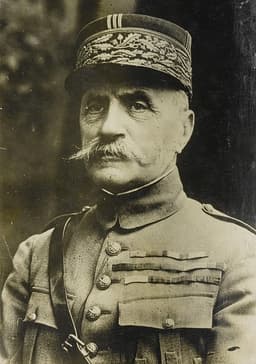
Ferdinand Foch
General · Modern
70.8Total

Herbert Kitchener
General · Modern
62.1Total
Basic Information
Born
1851
1850
Died
1929
1916
Era
Modern
Modern
Nationality
France
United Kingdom
Occupation
General
General
Civilization
Western
Western
Score Comparison
Military (10%)
78.0
72.0
Political (20%)
72.0
72.0
Influence (20%)
75.0
65.0
Legacy (20%)
65.0
55.0
Leadership (15%)
68.0
48.8
Strategy (15%)
70.0
68.0
TOTAL
70.8
62.1
Ferdinand Foch — Complete Timeline
1914 AD
First Battle of the MarneWar
As commander of the French Ninth Army, Foch's forces held the line and counterattacked at the First Battle of the Marne, helping to halt the German advance on Paris. This battle saved France from early defeat.
World War IWestern FrontDefense
Impact: global
1918 AD
Hundred Days OffensiveWar
Foch planned and directed the Allied Hundred Days Offensive, a series of coordinated attacks that broke the German lines and forced the German army to retreat. The offensive led directly to the Armistice.
World War IWestern FrontOffensive
Impact: global
Appointed Allied Supreme CommanderPolitical Action◆ Major
Foch was appointed Supreme Commander of the Allied Armies on the Western Front, coordinating the forces of France, Britain, the United States, and other allies. This unified command was crucial for the final Allied offensives.
World War ICommandAllied Unity
Impact: globalconstructive
Accepted the German ArmisticePolitical Action
Foch, as Allied Supreme Commander, accepted the German armistice delegation in a railway carriage at Compi
World War IArmisticePeace
Impact: global
Herbert Kitchener — Complete Timeline
1898 AD
Battle of OmdurmanWar◆ Major
Kitchener commanded Anglo-Egyptian forces at the Battle of Omdurman, defeating the Mahdist army in Sudan. The victory avenged the death of General Gordon and established British control over Sudan, with Kitchener becoming Governor-General.
SudanMahdist WarBritish Empire
Impact: regional
Fashoda IncidentPolitical Action◆ Major
Kitchener confronted a French expedition at Fashoda in Sudan, leading to a diplomatic crisis between Britain and France. The incident was resolved peacefully with French withdrawal, solidifying British control over the Nile Valley.
Fashoda IncidentColonial RivalryAnglo-French Relations
Impact: global
1902 AD
Appointed Commander-in-Chief in IndiaPolitical Action◆ Major
Kitchener was appointed Commander-in-Chief of the British Indian Army. He implemented major reforms, including reorganizing the army into divisions and improving training, but clashed with Viceroy Curzon over military administration.
Indian ArmyMilitary ReformBritish Raj
Impact: regionalconstructive
1914 AD
Appointed Secretary of State for WarPolitical Action
Kitchener was appointed Secretary of State for War at the outbreak of World War I. He organized the massive expansion of the British Army, raising the 'New Armies' of volunteers, a critical contribution to the war effort.
World War IBritish ArmyMilitary Organization
Impact: globalconstructive
1916 AD
Killed on HMS HampshireOther◆ Major
Kitchener died when HMS Hampshire struck a German mine off the Orkney Islands while en route to Russia. His death was a major shock to the British public and removed a key figure from the war leadership.
World War IDeathNaval Incident
Impact: globaltragic
Expert Analysis
Origins
Ferdinand Foch was born in 1851 in Tarbes, France, into a devout Catholic family. His father was a civil servant. Foch attended the Jesuit school in Metz, but after the Franco-Prussian War, he enlisted in the French army. He later graduated from the École Polytechnique and the École de Guerre, where he became a professor of military history and strategy.
Herbert Kitchener was born in 1850 in Ballylongford, Ireland, into a British military family. His father was a colonel. Kitchener was educated at the Royal Military Academy, Woolwich, and commissioned into the Royal Engineers. He served in Palestine, Cyprus, and the Sudan, where he learned Arabic and gained experience in colonial warfare.
Rise to Power
Foch rose to prominence during World War I. In 1914, as commander of the French Ninth Army, he played a key role in the First Battle of the Marne (September 1914), where his forces held the line and counterattacked, helping to halt the German advance. He later coordinated French and British efforts on the Somme and at Ypres. In 1917, he was appointed Chief of the French General Staff, and in March 1918, he became the Supreme Commander of the Allied Armies on the Western Front, a role that unified the Allied command.
Kitchener's rise came through colonial campaigns. He gained fame after his victory at the Battle of Omdurman in 1898, where he defeated the Mahdist forces in Sudan, avenging General Gordon. He then served as Commander-in-Chief in India from 1902 to 1909, where he reformed the Indian Army. In 1911, he became British Agent and Consul-General in Egypt. At the outbreak of World War I in 1914, he was appointed Secretary of State for War, overseeing the massive expansion of the British Army.
Leadership & Governance
Foch's leadership was characterized by strategic coordination and relentless offensive action. As Supreme Commander, he orchestrated the Hundred Days Offensive from August to November 1918, a series of coordinated attacks that broke the German lines. He insisted on unity of command, which was critical after the German Spring Offensive of 1918. His governance style was authoritative but collaborative, working closely with generals like Pershing and Haig. He scored 68.0 in leadership and 70.0 in strategy.
Kitchener's leadership was more administrative and imperial. As War Minister, he organized the recruitment of millions of volunteers (the "Kitchener Armies") and managed munitions production. However, he clashed with political leaders and generals, often lacking diplomatic finesse. His leadership score of 48.8 reflects his difficulties in managing the complex politics of the War Cabinet. He scored 68.0 in strategy for his foresight in preparing for a long war.
Triumph & Tragedy
Foch's greatest triumph was the successful coordination of the Allied forces that led to the Armistice on November 11, 1918. He accepted the German surrender in a railway carriage at Compiègne, a moment that cemented his legacy. His tragedy came after the war: he argued for harsh terms against Germany, predicting future conflict, but was largely ignored. He died in 1929 before seeing his fears realized.
Kitchener's triumph was the expansion of the British Army from 200,000 to over 3 million men, which provided the manpower for the Western Front. His tragedy was his death in 1916 when HMS Hampshire struck a mine, a loss that shocked Britain and removed a key figure from the war effort. He also faced criticism for the failed Gallipoli Campaign, though he was not solely responsible.
Character & Destiny
Foch was known for his relentless optimism and determination, often repeating "pressure, always pressure." His character drove him to maintain offensive operations even in dire circumstances. This stubbornness sometimes led to high casualties, but it also contributed to the final victory. His destiny was to be hailed as the architect of Allied victory.
Kitchener was aloof, secretive, and autocratic. He avoided public appearances and rarely explained his decisions. This made him an effective colonial administrator but a difficult wartime minister. His death at sea was almost symbolic of his mysterious persona. Historians note that his legacy was cut short, but his organizational impact was immense.
Legacy
Foch's legacy is as the commander who unified the Allied effort and ended World War I. His strategic concept of coordinated offensives became a model for coalition warfare. He is remembered with monuments like the statue in London and his tomb at Les Invalides. His influence score of 75.0 reflects his lasting impact on military doctrine.
Kitchener's legacy is tied to the expansion of the British Army and his iconic recruiting poster "Your Country Needs You." His reforms in India and Egypt had lasting effects. However, his death prevented him from shaping the post-war world. His influence score of 65.0 shows a more limited long-term impact compared to Foch.
Conclusion
Ferdinand Foch had a greater impact on history than Herbert Kitchener. With a total score of 70.8 to Kitchener's 62.1, Foch's role as Supreme Commander directly shaped the outcome of World War I. While Kitchener's organizational achievements were crucial, his influence was cut short by his death and his flaws in leadership. Foch's strategic vision and unified command were essential to the Allied victory, and his legacy endures in the study of modern warfare.
Rankings
🥇
Ferdinand FochLeader
Mil: 78.0Pol: 72.0Inf: 75.0
70.8
🥈
Herbert Kitchener
Mil: 72.0Pol: 72.0Inf: 65.0
62.1
+8.7 behind
How This Comparison Works
Algorithm
Each figure is scored on 6 dimensions (0—100 scale) based on structured historical data: Military (10%), Political (20%), Influence (20%), Legacy (20%), Leadership (15%), Strategy (15%). The weighted total produces the final ranking.
Data Sources
Scores are computed from structured sub-indicators in the database. Scale factors adjust for era (Ancient ×0.85, Modern ×1.0) and civilization size (Eastern ×1.05, Other ×0.80) to account for differences in population and military scale.
Maximum 3 Figures
Comparisons are limited to 2—3 figures to ensure readability and statistical meaningfulness.
Error Margins
±5 points per dimension — Sub-scores are derived from historical records with inherent uncertainty. Two figures within 5 points on a dimension should be considered roughly equivalent in that area.
Total Score Accuracy
±3 points overall — The weighted combination of 6 dimensions produces a total score with approximately ±3 points of uncertainty. Differences of less than 3 points are not statistically significant— the figures are effectively tied.
Known Limitations
- Historical records are incomplete and uneven across civilizations
- Figures from oral-tradition societies may be underrepresented
- Occupation labels can misclassify multi-role figures
- Scores measure capability and impact, not moral character
- Quantitative scoring is a comparison tool, not absolute truth
Capability Radar
Military (10%) — Battles & Warfare
Battles
85
75
Win Rate
80
80
Expansion
60
85
Political (20%) — Governance & Reform
Reform
50
70
Diplomacy
85
55
Economy
40
50
Influence (20%) — Cultural & Global Reach
Cultural
60
55
Global
80
70
Legacy (20%) — Historical Impact
Historical
85
75
Longevity
70
60
Leadership (15%) — Power & Stability
Tenure
65
60
Stability
55
45
Strategy (15%) — Tactics & Innovation
Strategy
90
85
Tactics
75
65
Reform
70
90
Similar Comparisons
Comments & Discussion
No comments yet. Be the first to share your thoughts!