Loading...
This comparison has not been analyzed yet.
One-time AI generation (~1 minute). Scores and timeline are already available below.
Ferdinand Foch vs Joaquin Crespo
Ferdinand Foch leads by 25.2 pts · 2 figures compared
…
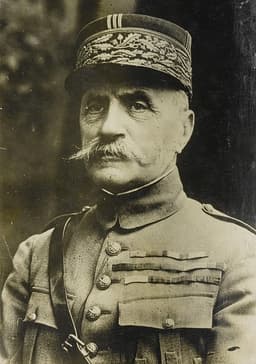
Ferdinand Foch
General · Modern
70.8Total

Joaquin Crespo
General · Modern
45.6Total
Basic Information
Born
1851
1841
Died
1929
1898
Era
Modern
Modern
Nationality
France
Venezuela
Occupation
General
General
Civilization
Western
Western
Score Comparison
Military (10%)
78.0
30.0
Political (20%)
72.0
39.4
Influence (20%)
75.0
50.2
Legacy (20%)
65.0
40.0
Leadership (15%)
68.0
64.5
Strategy (15%)
70.0
45.0
TOTAL
70.8
45.6
Ferdinand Foch — Complete Timeline
1914 AD
First Battle of the MarneWar
As commander of the French Ninth Army, Foch's forces held the line and counterattacked at the First Battle of the Marne, helping to halt the German advance on Paris. This battle saved France from early defeat.
World War IWestern FrontDefense
Impact: global
1918 AD
Hundred Days OffensiveWar
Foch planned and directed the Allied Hundred Days Offensive, a series of coordinated attacks that broke the German lines and forced the German army to retreat. The offensive led directly to the Armistice.
World War IWestern FrontOffensive
Impact: global
Appointed Allied Supreme CommanderPolitical Action◆ Major
Foch was appointed Supreme Commander of the Allied Armies on the Western Front, coordinating the forces of France, Britain, the United States, and other allies. This unified command was crucial for the final Allied offensives.
World War ICommandAllied Unity
Impact: globalconstructive
Accepted the German ArmisticePolitical Action
Foch, as Allied Supreme Commander, accepted the German armistice delegation in a railway carriage at Compi
World War IArmisticePeace
Impact: global
Joaquin Crespo — Complete Timeline
1892 AD
Seizure of Power in VenezuelaPolitical Action◆ Major
Crespo led a successful coup against President Raimundo Andueza Palacio, seizing power in Venezuela. He established a dictatorship and ruled as a caudillo, relying on military force and personal loyalty.
CoupDictatorshipCaudillo
Impact: nationaldestructive
1893 AD
Suppression of the Liberal RevolutionWar◆ Major
Crespo suppressed the Liberal Revolution, an uprising led by his political opponents. The rebellion was crushed with heavy casualties, and Crespo consolidated his control over the country.
Civil WarSuppressionLiberal Revolution
Impact: nationaldestructive
1897 AD
Negotiation of the Boundary Dispute with British GuianaPolitical Action◆ Major
Crespo negotiated with the United Kingdom over the boundary dispute between Venezuela and British Guiana. The dispute was submitted to international arbitration, which ultimately ruled against Venezuela, but Crespo's efforts were seen as defending national sovereignty.
Boundary DisputeInternational ArbitrationSovereignty
Impact: regional
1898 AD
Death in Battle at La Mata CarmeleraWar◆ Major
Crespo was killed in battle at La Mata Carmelera while fighting against a rebellion led by General Jos
BattleDeathCaudillo
Impact: nationaltragic
This comparison has not been analyzed yet.
One-time AI generation (~1 minute). Scores and timeline are already available below.
Rankings
🥇
Ferdinand FochLeader
Mil: 78.0Pol: 72.0Inf: 75.0
70.8
🥈
Joaquin Crespo
Mil: 30.0Pol: 39.4Inf: 50.2
45.6
+25.2 behind
How This Comparison Works
Algorithm
Each figure is scored on 6 dimensions (0—100 scale) based on structured historical data: Military (10%), Political (20%), Influence (20%), Legacy (20%), Leadership (15%), Strategy (15%). The weighted total produces the final ranking.
Data Sources
Scores are computed from structured sub-indicators in the database. Scale factors adjust for era (Ancient ×0.85, Modern ×1.0) and civilization size (Eastern ×1.05, Other ×0.80) to account for differences in population and military scale.
Maximum 3 Figures
Comparisons are limited to 2—3 figures to ensure readability and statistical meaningfulness.
Error Margins
±5 points per dimension — Sub-scores are derived from historical records with inherent uncertainty. Two figures within 5 points on a dimension should be considered roughly equivalent in that area.
Total Score Accuracy
±3 points overall — The weighted combination of 6 dimensions produces a total score with approximately ±3 points of uncertainty. Differences of less than 3 points are not statistically significant— the figures are effectively tied.
Known Limitations
- Historical records are incomplete and uneven across civilizations
- Figures from oral-tradition societies may be underrepresented
- Occupation labels can misclassify multi-role figures
- Scores measure capability and impact, not moral character
- Quantitative scoring is a comparison tool, not absolute truth
Capability Radar
Military (10%) — Battles & Warfare
Battles
85
45
Win Rate
80
40
Expansion
60
35
Political (20%) — Governance & Reform
Reform
50
30
Diplomacy
85
25
Economy
40
20
Influence (20%) — Cultural & Global Reach
Cultural
60
20
Global
80
10
Legacy (20%) — Historical Impact
Historical
85
25
Longevity
70
15
Leadership (15%) — Power & Stability
Tenure
65
55
Stability
55
15
Strategy (15%) — Tactics & Innovation
Strategy
90
30
Tactics
75
35
Reform
70
20
Similar Comparisons
Comments & Discussion
No comments yet. Be the first to share your thoughts!