Loading...
Ferdinand Foch vs Keith Park
Ferdinand Foch leads by 20.6 pts · 2 figures compared
…
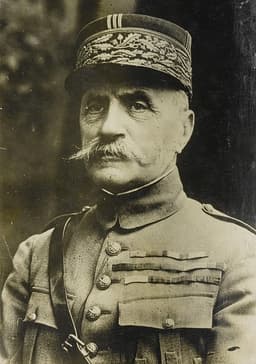
Ferdinand Foch
General · Modern
70.8Total

Keith Park
General · Modern
50.2Total
Basic Information
Born
1851
1892
Died
1929
1975
Era
Modern
Modern
Nationality
France
United Kingdom
Occupation
General
General
Civilization
Western
Western
Score Comparison
Military (10%)
78.0
52.5
Political (20%)
72.0
30.8
Influence (20%)
75.0
56.7
Legacy (20%)
65.0
54.0
Leadership (15%)
68.0
40.4
Strategy (15%)
70.0
66.3
TOTAL
70.8
50.2
Ferdinand Foch — Complete Timeline
1914 AD
First Battle of the MarneWar
As commander of the French Ninth Army, Foch's forces held the line and counterattacked at the First Battle of the Marne, helping to halt the German advance on Paris. This battle saved France from early defeat.
World War IWestern FrontDefense
Impact: global
1918 AD
Hundred Days OffensiveWar
Foch planned and directed the Allied Hundred Days Offensive, a series of coordinated attacks that broke the German lines and forced the German army to retreat. The offensive led directly to the Armistice.
World War IWestern FrontOffensive
Impact: global
Appointed Allied Supreme CommanderPolitical Action◆ Major
Foch was appointed Supreme Commander of the Allied Armies on the Western Front, coordinating the forces of France, Britain, the United States, and other allies. This unified command was crucial for the final Allied offensives.
World War ICommandAllied Unity
Impact: globalconstructive
Accepted the German ArmisticePolitical Action
Foch, as Allied Supreme Commander, accepted the German armistice delegation in a railway carriage at Compi
World War IArmisticePeace
Impact: global
Keith Park — Complete Timeline
1940 AD
Commanded No. 11 Group in Battle of BritainWar◆ Major
Park commanded No. 11 Group, responsible for defending London and southeast England, the most heavily attacked sector. His tactical decisions, including using small formations to intercept German raids, were crucial to the British victory.
World War IIAir BattleRoyal Air Force
Impact: nationalconstructive
Relieved of Command of No. 11 GroupPolitical Action
Park was removed from command of No. 11 Group in December 1940, partly due to conflicts with Trafford Leigh-Mallory over the 'Big Wing' tactic. He was reassigned to Training Command, a less prestigious role.
World War IICommand ChangeRoyal Air Force
Impact: nationaltragic
1942 AD
Commanded Air Forces in MaltaWar◆ Major
Park was appointed Air Officer Commanding in Malta, organizing the air defense of the island during the siege. He improved fighter tactics and coordination with naval forces, helping to break the Axis supply lines to North Africa.
World War IIAir DefenseMediterranean
Impact: regionalconstructive
Expert Analysis
Origins
Ferdinand Foch was born on October 2, 1851, in Tarbes, France, into a devout Catholic family. His father, a civil servant, encouraged his education. Foch attended the Jesuit school in Metz and later the École Polytechnique, graduating in 1873. He then entered the École d'Application de l'Artillerie et du Génie and eventually the École Supérieure de Guerre, where he became a professor of military history and strategy.
Keith Park was born on June 15, 1892, in Thames, New Zealand, to a Scottish immigrant father and a New Zealand mother. He was educated at Thames High School and later worked as a seaman before joining the Union Steam Ship Company. In 1914, he enlisted in the New Zealand Expeditionary Force and served in the Gallipoli Campaign. After the war, he transferred to the Royal Air Force and trained as a pilot.
Rise to Power
Foch's rise began during World War I. After commanding the French Ninth Army at the First Battle of the Marne in September 1914, where his forces held the line and counterattacked, he gained recognition. He was later appointed commander of the Northern Army Group and then Chief of the French General Staff in 1917. In March 1918, with the German Spring Offensive threatening, Foch was appointed Supreme Commander of the Allied Armies on the Western Front, coordinating the forces of France, Britain, the United States, and others.
Park's rise came through the Royal Air Force. He served in various staff and command roles, including as a flight commander in Egypt. In 1940, during the Battle of Britain, he was appointed Air Officer Commanding No. 11 Group, responsible for defending London and southeast England. His tactical decisions, including using smaller formations and focusing on intercepting German bombers, were crucial.
Leadership & Governance
Foch's leadership was characterized by relentless offensive spirit and strategic coordination. He believed in concentration of force and continuous pressure. During the Hundred Days Offensive from August to November 1918, he planned and directed a series of coordinated attacks that broke the German lines, leading to the armistice. His military score of 78.0 reflects his effectiveness, while his political score of 72.0 shows his ability to manage Allied coalition.
Park's leadership was more tactical and focused on air defense. He emphasized flexible response and efficient use of limited resources. His strategy of using small formations to break up German formations was controversial, leading to conflicts with Trafford Leigh-Mallory over the 'Big Wing' tactic. Park's leadership score of 40.4 is relatively low, partly due to these conflicts and his eventual removal from command in December 1940.
Triumph & Tragedy
Foch's greatest triumph was the successful coordination of the Allied forces during the Hundred Days Offensive, which forced the German army to retreat and led to the armistice on November 11, 1918. He personally accepted the German delegation in a railway carriage at Compiègne. However, his greatest failure was his inability to prevent the harsh conditions of the Treaty of Versailles, which many historians argue contributed to World War II. His legacy score of 65.0 reflects this mixed outcome.
Park's triumph was his role in the Battle of Britain, where his command of No. 11 Group was instrumental in defeating the German air campaign. He also later commanded air forces in Malta, improving fighter tactics and coordination. However, his tragedy was being relieved of command due to political infighting, which cut short his direct influence on the war. His influence score of 56.7 and legacy of 54.0 reflect his limited broader impact.
Character & Destiny
Foch was known for his determination, optimism, and strategic vision. He was a devout Catholic and a strong nationalist. His character shaped his destiny as the supreme coordinator of the Allied war effort, but his inflexibility and desire for a punitive peace may have contributed to future conflicts. Historical assessments often praise his military acumen but criticize his political naivety.
Park was practical, detail-oriented, and courageous. He was a skilled pilot and commander who focused on tactical efficiency. His character led him to prioritize the defense of London, but his stubbornness in tactical disputes led to his removal. He is remembered as a key figure in the Battle of Britain but not as a major strategic leader.
Legacy
Foch's legacy is the successful coordination of coalition warfare and the end of World War I. His methods influenced later Allied command structures in World War II. However, his involvement in the Versailles Treaty ties him to the interwar period's failures. His total score of 70.8 reflects his significant but flawed impact.
Park's legacy is primarily as a defender of Britain during the Battle of Britain. His tactics influenced air defense strategies, but his removal limited his long-term influence. He is celebrated in New Zealand and the UK, but his overall score of 50.2 indicates a more localized and less transformative impact.
Conclusion
Ferdinand Foch had a greater impact on history than Keith Park. Foch's military score of 78.0 versus Park's 52.5 and total score of 70.8 versus 50.2 demonstrate his broader influence. While Park's contributions to the Battle of Britain were crucial, Foch's role as Supreme Commander shaped the outcome of World War I and the subsequent peace. His strategic coordination set a precedent for modern coalition warfare, whereas Park's influence was confined to tactical air defense. Therefore, Foch is the more historically significant figure.
Rankings
🥇
Ferdinand FochLeader
Mil: 78.0Pol: 72.0Inf: 75.0
70.8
🥈
Keith Park
Mil: 52.5Pol: 30.8Inf: 56.7
50.2
+20.6 behind
How This Comparison Works
Algorithm
Each figure is scored on 6 dimensions (0—100 scale) based on structured historical data: Military (10%), Political (20%), Influence (20%), Legacy (20%), Leadership (15%), Strategy (15%). The weighted total produces the final ranking.
Data Sources
Scores are computed from structured sub-indicators in the database. Scale factors adjust for era (Ancient ×0.85, Modern ×1.0) and civilization size (Eastern ×1.05, Other ×0.80) to account for differences in population and military scale.
Maximum 3 Figures
Comparisons are limited to 2—3 figures to ensure readability and statistical meaningfulness.
Error Margins
±5 points per dimension — Sub-scores are derived from historical records with inherent uncertainty. Two figures within 5 points on a dimension should be considered roughly equivalent in that area.
Total Score Accuracy
±3 points overall — The weighted combination of 6 dimensions produces a total score with approximately ±3 points of uncertainty. Differences of less than 3 points are not statistically significant— the figures are effectively tied.
Known Limitations
- Historical records are incomplete and uneven across civilizations
- Figures from oral-tradition societies may be underrepresented
- Occupation labels can misclassify multi-role figures
- Scores measure capability and impact, not moral character
- Quantitative scoring is a comparison tool, not absolute truth
Capability Radar
Military (10%) — Battles & Warfare
Battles
85
65
Win Rate
80
70
Expansion
60
20
Political (20%) — Governance & Reform
Reform
50
10
Diplomacy
85
25
Economy
40
10
Influence (20%) — Cultural & Global Reach
Cultural
60
40
Global
80
55
Legacy (20%) — Historical Impact
Historical
85
60
Longevity
70
45
Leadership (15%) — Power & Stability
Tenure
65
20
Stability
55
15
Strategy (15%) — Tactics & Innovation
Strategy
90
70
Tactics
75
75
Reform
70
30
Similar Comparisons
Comments & Discussion
No comments yet. Be the first to share your thoughts!