Loading...
This comparison has not been analyzed yet.
One-time AI generation (~1 minute). Scores and timeline are already available below.
Ferdinand VI of Spain vs Islam II Giray
Ferdinand VI of Spain leads by 9.4 pts · 2 figures compared
…
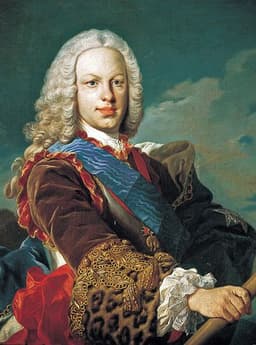
Ferdinand VI of Spain
Emperor · Modern
57.0Total

Islam II Giray
Emperor · Modern
47.6Total
Basic Information
Born
1713
1575
Died
1759
1588
Era
Modern
Modern
Nationality
Spain
Crimean Khanate
Occupation
Emperor
Emperor
Civilization
Western
Eastern
Score Comparison
Military (10%)
45.0
10.0
Political (20%)
75.0
68.0
Influence (20%)
53.3
51.8
Legacy (20%)
45.0
40.8
Leadership (15%)
82.0
53.2
Strategy (15%)
43.3
52.5
TOTAL
57.0
47.6
Ferdinand VI of Spain — Complete Timeline
1746 AD
Became King of SpainPolitical Action
Ferdinand VI succeeded his father Philip V as king of Spain. His reign focused on domestic reform and maintaining neutrality in European conflicts, a departure from his father's aggressive foreign policy.
SuccessionReformNeutrality
Impact: nationalconstructive
1749 AD
Promoted Economic and Administrative ReformsReform◆ Major
Ferdinand VI implemented reforms to modernize Spain's economy and administration, including tax reforms, infrastructure improvements, and the promotion of trade. His minister, the Marquis of Ensenada, led many of these initiatives.
Economic ReformAdministrationEnsenada
Impact: nationalconstructive
1753 AD
Signed the Concordat of 1753 with the VaticanPolitical Action◆ Major
Ferdinand VI signed the Concordat of 1753 with the Holy See, granting the Spanish crown greater control over church appointments and revenues. This strengthened royal authority over the Catholic Church in Spain.
Church-State RelationsConcordatRoyal Authority
Impact: nationalconstructive
1756 AD
Maintained Spanish Neutrality During the Seven Years' WarPolitical Action◆ Major
Ferdinand VI kept Spain neutral during the Seven Years' War (1756-1763), avoiding costly military engagements. This policy allowed Spain to focus on economic recovery and administrative reforms, strengthening the state's finances.
NeutralitySeven Years' WarEconomic Recovery
Impact: globalconstructive
1759 AD
Suffered from Mental Illness and Died Without HeirOther◆ Major
Ferdinand VI suffered from severe depression and mental illness following the death of his wife, Barbara of Portugal. He died without an heir, leading to the succession of his half-brother Charles III.
Mental HealthSuccessionDeath
Impact: nationaltragic
Islam II Giray — Complete Timeline
1580 AD
Military Modernization ReformsReform◆ Major
Islam II Giray implemented reforms to modernize the Crimean army. He introduced new firearms, including muskets and cannons, and reorganized the military structure. These reforms aimed to reduce reliance on traditional cavalry and improve the khanate's defensive capabilities.
Military ReformModernizationFirearms
Impact: nationalconstructive
1584 AD
Conflict with the Ottoman EmpirePolitical Action
Islam II Giray resisted Ottoman attempts to control Crimean foreign policy. He refused to participate in Ottoman campaigns against Persia and sought greater independence. This led to tensions with the Sublime Porte, though open conflict was avoided.
DiplomacyOttoman EmpireIndependence
Impact: regional
1586 AD
Raid on the Polish-Lithuanian CommonwealthWar
Islam II Giray led a military campaign into the Polish-Lithuanian Commonwealth. The raid targeted the southern borderlands, capturing slaves and plundering settlements. This was part of the ongoing pattern of Crimean raids for economic gain.
RaidPoland-LithuaniaSlave Raiding
destructive
This comparison has not been analyzed yet.
One-time AI generation (~1 minute). Scores and timeline are already available below.
Rankings
🥇
Ferdinand VI of SpainLeader
Mil: 45.0Pol: 75.0Inf: 53.3
57.0
🥈
Islam II Giray
Mil: 10.0Pol: 68.0Inf: 51.8
47.6
+9.4 behind
How This Comparison Works
Algorithm
Each figure is scored on 6 dimensions (0—100 scale) based on structured historical data: Military (10%), Political (20%), Influence (20%), Legacy (20%), Leadership (15%), Strategy (15%). The weighted total produces the final ranking.
Data Sources
Scores are computed from structured sub-indicators in the database. Scale factors adjust for era (Ancient ×0.85, Modern ×1.0) and civilization size (Eastern ×1.05, Other ×0.80) to account for differences in population and military scale.
Maximum 3 Figures
Comparisons are limited to 2—3 figures to ensure readability and statistical meaningfulness.
Error Margins
±5 points per dimension — Sub-scores are derived from historical records with inherent uncertainty. Two figures within 5 points on a dimension should be considered roughly equivalent in that area.
Total Score Accuracy
±3 points overall — The weighted combination of 6 dimensions produces a total score with approximately ±3 points of uncertainty. Differences of less than 3 points are not statistically significant— the figures are effectively tied.
Known Limitations
- Historical records are incomplete and uneven across civilizations
- Figures from oral-tradition societies may be underrepresented
- Occupation labels can misclassify multi-role figures
- Scores measure capability and impact, not moral character
- Quantitative scoring is a comparison tool, not absolute truth
Capability Radar
Military (10%) — Battles & Warfare
Battles
0
40
Win Rate
0
45
Expansion
0
35
Political (20%) — Governance & Reform
Reform
75
55
Diplomacy
80
50
Economy
70
40
Influence (20%) — Cultural & Global Reach
Cultural
30
30
Global
20
20
Legacy (20%) — Historical Impact
Historical
40
35
Longevity
30
20
Leadership (15%) — Power & Stability
Tenure
60
55
Stability
85
45
Strategy (15%) — Tactics & Innovation
Strategy
0
45
Tactics
0
50
Reform
5
60
Similar Comparisons
Comments & Discussion
No comments yet. Be the first to share your thoughts!