Loading...
Fidel Ramos vs Louis Mountbatten
Louis Mountbatten leads by 5.9 pts · 2 figures compared
…
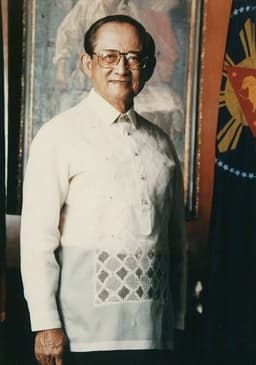
Fidel Ramos
General · Modern
53.2Total

Louis Mountbatten
General · Modern
59.1Total
Basic Information
Born
1928
1900
Died
—
1979
Era
Modern
Modern
Nationality
Philippines
United Kingdom
Occupation
General
General
Civilization
Eastern
Western
Score Comparison
Military (10%)
55.0
45.0
Political (20%)
60.0
55.0
Influence (20%)
56.4
65.0
Legacy (20%)
48.3
52.0
Leadership (15%)
48.8
70.0
Strategy (15%)
52.5
66.3
TOTAL
53.2
59.1
Fidel Ramos — Complete Timeline
1989 AD
Suppressed the 1989 Coup AttemptPolitical Action◆ Major
As Chief of the Philippine Constabulary, Ramos played a key role in suppressing the 1989 coup attempt against President Corazon Aquino. He remained loyal to the government and helped stabilize the country.
Coup AttemptLoyaltyStability
Impact: nationalconstructive
1992 AD
Initiated Economic Liberalization ReformsReform◆ Major
Ramos implemented a series of economic liberalization policies, including deregulation, privatization of state-owned enterprises, and opening the economy to foreign investment. These reforms led to sustained economic growth.
Economic ReformLiberalizationGrowth
Impact: nationalconstructive
Elected President of the PhilippinesPolitical Action◆ Major
Ramos was elected as the 12th President of the Philippines, succeeding Corazon Aquino. He was the first Protestant president in a predominantly Catholic country and focused on economic reforms and peace negotiations.
ElectionPresidencyProtestant
Impact: nationalconstructive
1996 AD
Signed the Final Peace Agreement with the MNLFPolitical Action◆ Major
Ramos signed a final peace agreement with the Moro National Liberation Front (MNLF), ending decades of insurgency in Mindanao. The agreement established the Autonomous Region in Muslim Mindanao (ARMM).
Peace AgreementMNLFMindanao
Impact: regionalconstructive
Louis Mountbatten — Complete Timeline
1943 AD
Appointed Supreme Allied Commander South East AsiaOther◆ Major
Mountbatten was appointed Supreme Allied Commander of the South East Asia Command (SEAC). He oversaw Allied operations against Japanese forces in Burma, Sumatra, and the Dutch East Indies, coordinating British, Indian, American, and Chinese forces until the Japanese surrender in 1945.
World War IIMilitary CommandSEAC
Impact: regional
1947 AD
Appointed Last Viceroy of IndiaPolitical Action◆ Major
Mountbatten was appointed Viceroy of India by the British government with a mandate to oversee the transfer of power to Indian hands. He arrived in March 1947 and immediately began negotiations with Indian leaders including Nehru, Jinnah, and Gandhi for a unified or partitioned independence.
Indian IndependenceDecolonizationBritish Empire
Impact: global
Announced Partition of India PlanOther◆ Major
Mountbatten announced the plan for the partition of British India into two independent dominions, India and Pakistan, on June 3, 1947. The plan set an accelerated timeline of August 15, 1947, for independence, leading to massive population transfers and communal violence.
PartitionIndiaPakistanDecolonization
Impact: globaldestructive
1955 AD
Served as First Sea LordOther◆ Major
Mountbatten was appointed First Sea Lord, the professional head of the Royal Navy. He served from 1955 to 1959, overseeing naval modernization and the transition from conventional to nuclear-powered submarines and aircraft carriers during the Cold War.
Royal NavyCold WarMilitary Leadership
Impact: national
1979 AD
Assassinated by IRA BombingPolitical Action◆ Major
Mountbatten was killed by a bomb planted on his fishing boat, Shadow V, by the Provisional Irish Republican Army (IRA) near Mullaghmore, County Sligo, Ireland. The explosion also killed three others, including his grandson Nicholas Knatchbull. The assassination was a major propaganda victory for the IRA.
IRAAssassinationNorthern Ireland Conflict
Impact: nationaldestructive
Expert Analysis
Origins
Fidel Valdez Ramos was born on March 18, 1928, in Lingayen, Pangasinan, Philippines, into a political family; his father was a senator and his cousin was President Ferdinand Marcos. He studied at the University of the Philippines and the United States Military Academy at West Point, graduating in 1950. His early career was in the Philippine Constabulary, where he specialized in intelligence and counterinsurgency.
Louis Francis Albert Victor Nicholas Mountbatten was born on June 25, 1900, in Windsor, England, into the British royal family as a great-grandson of Queen Victoria. He joined the Royal Navy as a cadet in 1913 and served in World War I. He studied at the Royal Naval College, Dartmouth, and later specialized in signals and communications. His early career included service in the Mediterranean Fleet and command of destroyers.
Rise to Power
Ramos rose to prominence during the martial law regime of Ferdinand Marcos, serving as chief of the Philippine Constabulary from 1972. He played a key role in enforcing martial law but later broke with Marcos during the 1986 People Power Revolution, siding with Corazon Aquino. His loyalty to the new government was tested during the 1989 coup attempt, which he helped suppress as chief of the constabulary. He was appointed Secretary of National Defense in 1988 and successfully managed the military's loyalty. In 1992, he ran for president and won with 23.6% of the vote, becoming the first Protestant president of the predominantly Catholic Philippines.
Mountbatten's rise was accelerated by his royal connections. He commanded the destroyer HMS Kelly in World War II, gaining fame for its exploits and survival. In 1943, he was appointed Supreme Allied Commander of the South East Asia Command (SEAC), overseeing the reconquest of Burma. His diplomatic skills led to his appointment as Viceroy of India in 1947 with the mandate to transfer power. He became the last Viceroy and first Governor-General of independent India from 1947 to 1948. Later, he served as First Sea Lord (1955–1959) and Chief of the Defence Staff (1959–1965).
Leadership & Governance
Ramos's leadership style was pragmatic and technocratic. He focused on economic liberalization, deregulating industries, privatizing state assets, and opening the economy to foreign investment. His administration achieved GDP growth rates averaging 4.5% annually and reduced inflation from 8.9% in 1993 to 4.7% in 1997. He pursued peace with the Moro National Liberation Front (MNLF), signing the Final Peace Agreement in 1996, which established the Autonomous Region in Muslim Mindanao. However, his governance faced criticism for human rights abuses during his tenure as constabulary chief, including extrajudicial killings.
Mountbatten's leadership was characterized by charm, ambition, and a hands-on approach. As Viceroy, he accelerated the partition timeline, announcing the plan on June 3, 1947, with a transfer of power date of August 15, 1947. He oversaw the Radcliffe Line boundary commission, which drew borders between India and Pakistan in just five weeks. The partition led to one of the largest mass migrations in history, with an estimated 14 million people displaced and up to 2 million deaths from violence and disease. Mountbatten's critics argue that his rush to leave India contributed to the chaos. As First Sea Lord, he modernized the Royal Navy, introducing nuclear submarines and aircraft carriers.
Triumph & Tragedy
Ramos's greatest triumph was stabilizing the Philippines after the turbulent Aquino years. He successfully suppressed coup attempts, restored economic growth, and achieved a peace deal with the MNLF. His economic reforms laid the groundwork for the Philippines' later growth. However, his tragedy lies in his legacy being overshadowed by the human rights abuses during his earlier career. His failure to address systemic corruption and poverty meant that many Filipinos saw little improvement in their daily lives.
Mountbatten's triumph was his role in the British withdrawal from India, which he saw as a successful transfer of power. He also served with distinction in World War II and later in the Royal Navy. However, his tragedy is the catastrophic human cost of partition. The violence and displacement that occurred under his watch has been called one of the worst humanitarian disasters of the 20th century. His assassination by the IRA in 1979 added a tragic end to his life.
Character & Destiny
Ramos was known for his discipline, integrity, and calm demeanor. He was a Protestant in a Catholic country, which required political finesse. His decision to side with Aquino in 1986 showed his commitment to democracy over loyalty to Marcos. His character was shaped by his military training and his family's political background. He was decisive but cautious, often seeking consensus.
Mountbatten was charismatic, ambitious, and sometimes reckless. His rush to partition India was driven by a desire to leave a legacy and avoid a prolonged British presence. He was a skilled diplomat but also a controversial figure, accused of favoritism and poor judgment in the boundary commission. His royal status gave him access and influence, but also made him a target. His character combined charm with a sense of destiny, believing he was meant for great things.
Legacy
Ramos's legacy in the Philippines is mixed. He is remembered as a stabilizing force and a reformer, but his human rights record tarnishes his image. His economic policies are credited with starting the Philippines' transformation into a rising Asian economy. However, his impact is limited to the Philippines, and his scores reflect this: Military 55.0, Political 60.0, Influence 56.4, Legacy 48.3, Leadership 48.8, Strategy 52.5, Total 53.2.
Mountbatten's legacy is global. He played a key role in the end of British colonialism in India and in the development of modern naval warfare. His name is associated with the partition and its violence, but also with the peaceful transfer of power. His scores: Military 45.0, Political 55.0, Influence 65.0, Legacy 52.0, Leadership 70.0, Strategy 66.3, Total 59.1.
Conclusion
Mountbatten had a greater impact on world history due to his role in the partition of India and the decolonization of the British Empire. His actions directly affected hundreds of millions of people and reshaped the geopolitical map of South Asia. Despite the tragic consequences, his influence and leadership scores are higher. Ramos, while significant for the Philippines, had a more localized impact. The score gap of 5.9 points in Mountbatten's favor reflects this. Therefore, Louis Mountbatten had a greater historical impact.
Rankings
🥇
Louis MountbattenLeader
Mil: 45.0Pol: 55.0Inf: 65.0
59.1
🥈
Fidel Ramos
Mil: 55.0Pol: 60.0Inf: 56.4
53.2
+5.9 behind
How This Comparison Works
Algorithm
Each figure is scored on 6 dimensions (0—100 scale) based on structured historical data: Military (10%), Political (20%), Influence (20%), Legacy (20%), Leadership (15%), Strategy (15%). The weighted total produces the final ranking.
Data Sources
Scores are computed from structured sub-indicators in the database. Scale factors adjust for era (Ancient ×0.85, Modern ×1.0) and civilization size (Eastern ×1.05, Other ×0.80) to account for differences in population and military scale.
Maximum 3 Figures
Comparisons are limited to 2—3 figures to ensure readability and statistical meaningfulness.
Error Margins
±5 points per dimension — Sub-scores are derived from historical records with inherent uncertainty. Two figures within 5 points on a dimension should be considered roughly equivalent in that area.
Total Score Accuracy
±3 points overall — The weighted combination of 6 dimensions produces a total score with approximately ±3 points of uncertainty. Differences of less than 3 points are not statistically significant— the figures are effectively tied.
Known Limitations
- Historical records are incomplete and uneven across civilizations
- Figures from oral-tradition societies may be underrepresented
- Occupation labels can misclassify multi-role figures
- Scores measure capability and impact, not moral character
- Quantitative scoring is a comparison tool, not absolute truth
Capability Radar
Military (10%) — Battles & Warfare
Battles
35
45
Win Rate
40
55
Expansion
20
40
Political (20%) — Governance & Reform
Reform
65
60
Diplomacy
60
75
Economy
55
50
Influence (20%) — Cultural & Global Reach
Cultural
30
55
Global
40
65
Legacy (20%) — Historical Impact
Historical
45
70
Longevity
35
50
Leadership (15%) — Power & Stability
Tenure
55
70
Stability
50
45
Strategy (15%) — Tactics & Innovation
Strategy
50
60
Tactics
45
50
Reform
60
65
Similar Comparisons
Comments & Discussion
No comments yet. Be the first to share your thoughts!