Loading...
Franklin D. Roosevelt vs Joseph Stalin
Franklin D. Roosevelt leads by 2.2 pts · 2 figures compared
…
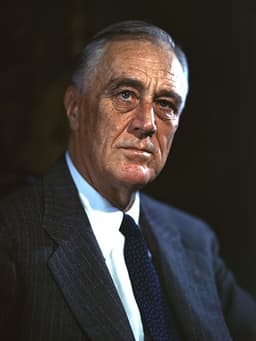
Franklin D. Roosevelt
Politician · Modern
71.0Total
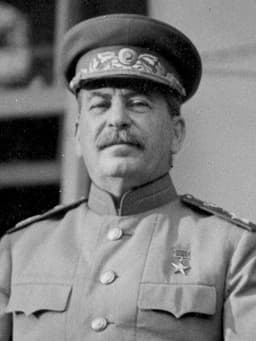
Joseph Stalin
Politician · Modern
68.8Total
Basic Information
Born
1882
1878
Died
1945
1953
Era
Modern
Modern
Nationality
United States
Russia
Occupation
Politician
Politician
Civilization
Western
Western
Score Comparison
Military (10%)
45.0
75.0
Political (20%)
85.0
70.0
Influence (20%)
75.0
72.0
Legacy (20%)
65.0
55.0
Leadership (15%)
85.0
80.0
Strategy (15%)
60.0
70.0
TOTAL
71.0
68.8
Franklin D. Roosevelt — Complete Timeline
1933 AD
Inaugurated as 32nd PresidentOther◆ Major
Franklin D. Roosevelt was inaugurated as President of the United States on March 4, 1933, during the Great Depression. His inaugural address declared 'the only thing we have to fear is fear itself,' and he immediately called Congress into special session to address the banking crisis.
Great DepressionPresidencyInauguration
Impact: national
Enacted the New DealOther◆ Major
Roosevelt launched the New Deal in 1933, a series of federal programs including the Civilian Conservation Corps, the Agricultural Adjustment Act, and the Tennessee Valley Authority. These measures aimed to provide relief, recovery, and reform during the Great Depression, fundamentally expanding the role of the federal government.
Great DepressionEconomic PolicySocial Reform
Impact: nationalconstructive
1935 AD
Signed the Social Security ActOther◆ Major
Roosevelt signed the Social Security Act into law on August 14, 1935, establishing a federal system of old-age pensions, unemployment insurance, and aid for dependent children. This created the modern American welfare state and provided a safety net for millions of citizens.
Social WelfareLegislationNew Deal
Impact: nationalconstructive
1941 AD
Lend-Lease ActOther◆ Major
Roosevelt signed the Lend-Lease Act on March 11, 1941, authorizing the transfer of military equipment and supplies to Allied nations, particularly Britain and the Soviet Union. This program provided critical material support to countries fighting the Axis powers before U.S. entry into World War II.
World War IIForeign PolicyMilitary Aid
Impact: globalconstructive
Declaration of War on JapanPolitical Action◆ Major
Following the Japanese attack on Pearl Harbor on December 7, 1941, Roosevelt delivered his 'Day of Infamy' speech to Congress the next day, requesting a declaration of war. Congress approved the declaration, bringing the United States into World War II.
World War IIPearl HarborDeclaration of War
Impact: globaldestructive
1942 AD
Executive Order 9066Other◆ Major
Roosevelt signed Executive Order 9066 on February 19, 1942, authorizing the forced relocation and internment of Japanese Americans living on the West Coast. Over 110,000 people, mostly U.S. citizens, were incarcerated in camps for the duration of the war, a decision later widely condemned as a violation of civil rights.
World War IICivil RightsInternment
Impact: nationaldestructive
1944 AD
Elected to Fourth TermOther◆ Major
Roosevelt was elected to an unprecedented fourth term as president in November 1944, defeating Republican Thomas E. Dewey. This election occurred during the final stages of World War II, and Roosevelt's continued leadership ensured stability in the war effort and post-war planning.
PresidencyElectionWorld War II
Impact: national
1945 AD
Yalta ConferenceOther◆ Major
Roosevelt met with Winston Churchill and Joseph Stalin at the Yalta Conference in February 1945 to discuss post-war Europe. Agreements included the division of Germany, Soviet entry into the war against Japan, and the creation of the United Nations, shaping the post-war world order.
World War IIDiplomacyPost-War Planning
Impact: global
Joseph Stalin — Complete Timeline
1928 AD
Launched the First Five-Year PlanReform
Stalin initiated a series of centralized economic plans aimed at rapid industrialization and collectivization of agriculture. The First Five-Year Plan set ambitious targets for heavy industry, leading to significant growth but also severe shortages and human cost.
Impact: global
1929 AD
Implemented forced collectivization of agricultureReform
Stalin ordered the consolidation of individual peasant farms into collective farms (kolkhozy). This was met with resistance, leading to the liquidation of kulaks (wealthy peasants) as a class. The policy caused a catastrophic famine, particularly in Ukraine (Holodomor), resulting in millions of deaths.
Impact: nationaldestructive
1937 AD
Conducted the Great Purge (Great Terror)Political Action
Stalin orchestrated a campaign of political repression against alleged enemies of the state. Millions were arrested, executed, or sent to the Gulag labor camps. The purges targeted the Communist Party, military leadership, intellectuals, and ordinary citizens, consolidating Stalin's absolute power.
Impact: nationaldestructive
1945 AD
Led the Soviet Union to victory in World War IIWar
Stalin served as Supreme Commander of the Soviet armed forces. The Soviet Union bore the brunt of the war against Nazi Germany, suffering immense casualties. The Red Army's victory at Stalingrad and the capture of Berlin were key turning points. The war ended with Soviet domination of Eastern Europe.
Impact: global
Established the Eastern Bloc and the Iron CurtainPolitical Action◆ Major
After WWII, Stalin imposed communist governments in Eastern European countries occupied by the Red Army, creating a buffer zone against the West. This division of Europe into Soviet and Western spheres of influence marked the beginning of the Cold War.
Impact: globaldestructive
Expert Analysis
Franklin D. Roosevelt vs Joseph Stalin
# The Two Titans of the Twentieth Century
In April 1945, as Franklin Delano Roosevelt lay dying in Warm Springs, Georgia, a world away in Moscow, Joseph Stalin received the news with what observers described as genuine emotion. "What will we do without him?" Stalin reportedly asked his inner circle. It was a rare moment of vulnerability from a man who had ordered the deaths of millions, and it captured something essential about the relationship between these two men who, more than any others, shaped the mid-twentieth century. They were allies of necessity, adversaries by ideology, and mirror images of what leadership could become in an age of total war and total crisis.
Origins
Franklin Roosevelt was born into privilege in 1882, the only child of a wealthy Hudson Valley family. His world was one of private tutors, European tours, and the quiet confidence of America's landed gentry. When he entered politics, it was as a reform-minded Democrat who believed government could be a force for good—a product of the Progressive Era's optimism.
Joseph Stalin, born Ioseb Dzhugashvili in 1878 in the Georgian town of Gori, emerged from a world of violence and poverty. His father was a drunken shoemaker who beat him; his mother was a devout woman who wanted him to become a priest. Instead, Stalin found his calling in revolutionary conspiracy, robbing banks and evading the Tsar's police. Where Roosevelt inherited a sense of noblesse oblige, Stalin inherited a deep, abiding suspicion of everyone and everything.
Their eras shaped them differently too. Roosevelt came of age when America was rising but still isolationist; Stalin came of age when Russia was collapsing into revolution and civil war. Roosevelt learned politics in state legislatures and governors' mansions; Stalin learned it in Siberian exile and underground cells.
Rise to Power
Roosevelt's path to power was a study in conventional politics done exceptionally well. He served as Assistant Secretary of the Navy, ran for Vice President, and contracted polio in 1921—a disease that left him paralyzed from the waist down. Rather than ending his career, it forged him. He learned to project strength from a wheelchair, to charm reporters, to build a coalition of Democrats, progressives, and working-class voters. In 1932, as the Great Depression devastated America, he won the presidency by promising a "New Deal."
Stalin's rise was far darker. After Lenin's death in 1924, Stalin maneuvered through the Communist Party bureaucracy, appointing loyalists, discrediting rivals like Trotsky, and slowly accumulating absolute power. By 1928, when he launched the First Five-Year Plan, he had eliminated all meaningful opposition. Where Roosevelt had to win elections, Stalin only had to survive purges.
Leadership & Governance
As leaders, they could not have been more different. Roosevelt governed through persuasion, radio addresses, and legislative deals. He created the Social Security system, regulated Wall Street, and put millions to work building roads, bridges, and dams. His leadership style was experimental: "Take a method and try it," he said. "If it fails, admit it frankly and try another."
Stalin governed through terror. When he ordered forced collectivization of agriculture in 1929, millions of Ukrainian peasants starved to death. When he suspected disloyalty, he launched the Great Purge of 1937, executing military officers, party officials, and ordinary citizens by the hundreds of thousands. Yet he also transformed the Soviet Union from a backward agrarian state into an industrial superpower capable of defeating Nazi Germany.
In war, both men proved formidable. Roosevelt was the strategist who held together the Grand Alliance with Churchill and Stalin, who approved the Manhattan Project, who insisted on unconditional surrender. Stalin was the commander who refused to abandon Moscow, who accepted catastrophic losses at Stalingrad, who drove his generals mercilessly toward Berlin.
Triumph & Tragedy
Roosevelt's greatest triumph was also his final act: leading America through World War II and laying the foundations for the United Nations. His tragedy was that he did not live to see the peace he helped create—and that his trust in Stalin proved tragically naive.
Stalin's greatest triumph was victory itself. The Soviet Union lost 27 million people, but it emerged from the war as one of two global superpowers. His tragedy was that his paranoia and cruelty poisoned everything he built. The Eastern Bloc he created after 1945 became a prison of nations, and his legacy would ultimately bankrupt the Soviet system he so ruthlessly constructed.
Character & Destiny
Roosevelt was fundamentally an optimist who believed in human progress and democratic institutions. His polio taught him patience and empathy; his patrician background gave him confidence without cruelty. He could charm Churchill, manipulate Stalin, and reassure Americans all in the same day.
Stalin was a pessimist who believed only power mattered. His childhood taught him that the world was hostile, that trust was weakness, that cruelty was necessary. He could be charming when useful, but his default setting was suspicion. He read constantly, micromanaged everything, and trusted no one.
These personalities shaped history. Roosevelt's optimism allowed him to dream of a postwar world of peace and prosperity. Stalin's pessimism led him to create buffer states and secret police. The Cold War was, in part, a clash of these two temperaments projected onto a global scale.
Legacy
Roosevelt is remembered as one of America's greatest presidents—the man who saved capitalism from itself and democracy from fascism. His New Deal programs still define American social policy; his leadership during World War II remains a model of presidential courage. His score of 75.7 reflects a figure of immense political skill and lasting influence.
Stalin's legacy is far more ambiguous. He is remembered as the man who defeated Hitler but also as the man who starved Ukraine, purged the military, and built a totalitarian state. His score of 68.3 reflects this tension: high marks for military and political effectiveness, low marks for legacy and morality.
Conclusion
Standing at the Yalta Conference in February 1945, these two men—the crippled aristocrat and the Georgian terrorist—divided Europe between them. Roosevelt believed he could manage Stalin; Stalin believed he could outlast Roosevelt. Both were partly right and partly wrong. Their alliance won the war; their enmity defined the peace. In the end, they remind us that history is not made by saints or monsters, but by flawed human beings who, for better and worse, change the world in their own image.
Rankings
🥇
Franklin D. RooseveltLeader
Mil: 45.0Pol: 85.0Inf: 75.0
71.0
🥈
Joseph Stalin
Mil: 75.0Pol: 70.0Inf: 72.0
68.8
+2.2 behind
How This Comparison Works
Algorithm
Each figure is scored on 6 dimensions (0—100 scale) based on structured historical data: Military (10%), Political (20%), Influence (20%), Legacy (20%), Leadership (15%), Strategy (15%). The weighted total produces the final ranking.
Data Sources
Scores are computed from structured sub-indicators in the database. Scale factors adjust for era (Ancient ×0.85, Modern ×1.0) and civilization size (Eastern ×1.05, Other ×0.80) to account for differences in population and military scale.
Maximum 3 Figures
Comparisons are limited to 2—3 figures to ensure readability and statistical meaningfulness.
Error Margins
±5 points per dimension — Sub-scores are derived from historical records with inherent uncertainty. Two figures within 5 points on a dimension should be considered roughly equivalent in that area.
Total Score Accuracy
±3 points overall — The weighted combination of 6 dimensions produces a total score with approximately ±3 points of uncertainty. Differences of less than 3 points are not statistically significant— the figures are effectively tied.
Known Limitations
- Historical records are incomplete and uneven across civilizations
- Figures from oral-tradition societies may be underrepresented
- Occupation labels can misclassify multi-role figures
- Scores measure capability and impact, not moral character
- Quantitative scoring is a comparison tool, not absolute truth
Capability Radar
Military (10%) — Battles & Warfare
Battles
10
85
Win Rate
10
80
Expansion
10
85
Political (20%) — Governance & Reform
Reform
95
90
Diplomacy
90
70
Economy
95
85
Influence (20%) — Cultural & Global Reach
Cultural
80
70
Global
90
95
Legacy (20%) — Historical Impact
Historical
90
95
Longevity
85
80
Leadership (15%) — Power & Stability
Tenure
90
95
Stability
75
60
Strategy (15%) — Tactics & Innovation
Strategy
65
85
Tactics
10
60
Reform
70
90
Similar Comparisons
Comments & Discussion
The New Deal Killer6/16/2026
Calling them "titans" whitewashes Stalin's deliberate famines that killed millions more than WWII ever did. FDR's New Deal saved capitalism by co-opting socialist ideas—Stalin just murdered his way to industrialization. One had polio and empathy; the other had paranoia and a taste for genocide. There's no mirror here, only a grotesque contrast between reform and annihilation.
数据清洗员6/16/2026
把罗斯福和斯大林并列成“双雄”,简直是历史虚无主义。斯大林在1932-33年人为制造乌克兰大饥荒,死了400万人;罗斯福却在推行田纳西河流域管理局,用公共工程养活失业者。一个搞大清洗处决65万人,一个搞“炉边谈话”温暖民心。数据不会说谎:苏联人均寿命1939年比1913年还低两岁,美国却整整提高了五年。
Classicist Commander6/16/2026
Roosevelt's "Four Freedoms" speech channeled Pericles' funeral oration—democracy as a moral universe. Stalin's cult of personality mimicked Alexander the Great's deification, but without the strategic vision. FDR built the UN; Stalin built gulags. The real titan of antiquity is Caesar crossing the Rubicon: Roosevelt did it with Lend-Lease, Stalin with the Molotov-Ribbentrop Pact. One expanded freedom; the other expanded the Gulag Archipelago.
铁幕侦察兵6/16/2026
说斯大林对罗斯福之死“动真情”,太天真了。1943年德黑兰会议上,斯大林坚持战后肢解德国,罗斯福却想搞“四警察”共治。1945年雅尔塔,罗斯福病重时被斯大林灌醉,签下出让东欧的协议。这不是“战友情”,是猎人布阵。结果呢?斯大林反手就在波兰搞卢布林政府,把大西洋宪章撕得粉碎。历史记住的是背叛,不是泪水。
Armchair Admiral6/16/2026
Strategic analysis: FDR won WWII by mobilizing US industry (300,000 aircraft, 100,000 tanks). Stalin won by sacrificing 27 million Soviet lives. One called for unconditional surrender; the other for unconditional purges. The real lesson? Roosevelt understood that war is won in factories and congresses; Stalin understood it's won in fields of frozen corpses. I know which "titan" I'd rather follow, but don't pretend they played the same game.