Loading...
Frederick Francis IV vs Ranjit Singh
Ranjit Singh leads by 22.5 pts · 2 figures compared
…
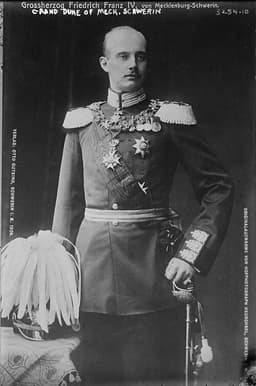
Frederick Francis IV
Emperor · Modern
40.7Total

Ranjit Singh
Emperor · Modern
63.2Total
Basic Information
Born
1882
1780
Died
1945
1839
Era
Modern
Modern
Nationality
Mecklenburg
India
Occupation
Emperor
Emperor
Civilization
Western
Indian
Score Comparison
Military (10%)
21.1
78.0
Political (20%)
30.8
59.6
Influence (20%)
45.5
58.3
Legacy (20%)
33.3
52.0
Leadership (15%)
55.3
80.0
Strategy (15%)
60.0
69.1
TOTAL
40.7
63.2
Frederick Francis IV — Complete Timeline
1897 AD
Accession as Grand Duke of Mecklenburg-SchwerinPolitical Action◆ Major
Frederick Francis IV became Grand Duke of Mecklenburg-Schwerin on 10 April 1897, succeeding his father Frederick Francis III. He ruled as a minor until 1901 under a regency.
Mecklenburg-SchwerinSuccession
Impact: national
1918 AD
World War I abdicationPolitical Action
On 14 November 1918, during the German Revolution, Frederick Francis IV abdicated the throne of Mecklenburg-Schwerin. He was the last grand duke, and his abdication ended the House of Mecklenburg-Schwerin's rule.
German RevolutionEnd of monarchyMecklenburg
Impact: nationaltragic
1945 AD
Death in exileOther
Frederick Francis IV died on 17 November 1945 at Flensburg, Germany, shortly after the end of World War II. He had lived in retirement since his abdication.
DeathExile
Ranjit Singh — Complete Timeline
1799 AD
Capture of LahoreWar◆ Major
Ranjit Singh captured Lahore from the Bhangi Misl, establishing it as his capital. This victory marked the beginning of the Sikh Empire and consolidated his control over the Punjab region.
Military CampaignCapital
Impact: regional
1801 AD
Coronation as MaharajaPolitical Action◆ Major
Ranjit Singh was formally crowned Maharaja of Punjab at Lahore, establishing the Sikh Empire. His coronation unified the Sikh misls under a single ruler and created a centralized state.
CoronationState Formation
Impact: regionalconstructive
1809 AD
Treaty of Amritsar with the BritishPolitical Action◆ Major
Ranjit Singh signed the Treaty of Amritsar with the British East India Company, establishing the Sutlej River as the boundary between Sikh and British territories. This treaty ensured peace with the British and allowed Ranjit Singh to focus on expansion westward.
TreatyDiplomacy
Impact: regional
1813 AD
Capture of the Koh-i-Noor DiamondWar
Ranjit Singh acquired the Koh-i-Noor diamond from the Afghan ruler Shuja Shah Durrani as part of a treaty. The diamond became a symbol of Sikh wealth and power, later passing to the British after the annexation of Punjab.
TreasureSymbol
Impact: regional
1818 AD
Annexation of MultanWar◆ Major
Ranjit Singh's forces captured Multan after a prolonged siege, extending Sikh rule into southern Punjab. This victory brought the rich trading city and its surrounding territories under Sikh control.
Military CampaignExpansion
Impact: regional
1822 AD
Modernization of the Sikh ArmyReform◆ Major
Ranjit Singh modernized the Sikh army by employing European officers, particularly French and Italian, to train troops in Western military tactics. He also established a foundry for artillery, creating a formidable military force.
Military ReformModernization
Impact: regionalconstructive
Expert Analysis
Origins
Frederick Francis IV was born on 9 April 1882 in Palermo, Italy, to Frederick Francis III, Grand Duke of Mecklenburg-Schwerin, and Grand Duchess Anastasia Mikhailovna of Russia. He grew up in a minor German royal house, with limited political influence. His father suffered from mental illness, leading to a regency during his early years. Frederick Francis IV studied at the University of Bonn and entered military service, but his upbringing was sheltered within the constraints of a small principality.
Ranjit Singh was born on 13 November 1780 in Gujranwala, Punjab (now Pakistan), into the Sandhawalia Jat Sikh family. His father, Maha Singh, was a misl leader, and his mother, Raj Kaur, was from a noble family. Orphaned at a young age, Ranjit Singh contracted smallpox, losing sight in one eye. He was raised by his mother and later by his father-in-law, learning martial skills and administration. His early exposure to the fragmented Sikh misls shaped his ambition to unify them.
Rise to Power
Frederick Francis IV ascended the throne on 10 April 1897 at age 15, but a regency ruled until 1901. His reign was largely ceremonial, as Mecklenburg-Schwerin was a constitutional monarchy within the German Empire. He focused on cultural patronage and modernization of infrastructure, but his power was constrained by the federal structure. During World War I, he supported the German war effort but had no significant military command. On 14 November 1918, amid the German Revolution, he abdicated without resistance, ending the dynasty.
Ranjit Singh captured Lahore on 7 July 1799 from the Bhangi Misl, establishing his capital. He was formally crowned Maharaja on 12 April 1801, unifying the Sikh misls under his rule. Through diplomacy and warfare, he annexed territories such as Multan (1818), Kashmir (1819), and Peshawar (1834). He signed the Treaty of Amritsar with the British in 1809, setting the Sutlej River as the boundary, which secured his western flank. By 1830, his empire spanned from the Khyber Pass to the Sutlej, with a population of over 4 million.
Leadership & Governance
Frederick Francis IV governed as a constitutional monarch with limited authority. He introduced social reforms, including building schools and hospitals, but his rule was overshadowed by the German Emperor. His leadership score of 55.3 reflects his passive style; he avoided confrontation and failed to modernize the state effectively. He maintained a small court and focused on managing a declining principality.
Ranjit Singh, with a leadership score of 80.0, was a hands-on ruler who centralized power. He modernized the Sikh army by employing European officers like Jean-Baptiste Ventura and Claude Auguste Court to train troops in Napoleonic tactics. He established a secular administration, appointing Muslims and Hindus to high positions. His governance promoted religious tolerance, but he maintained absolute control, suppressing dissent with force. His political score of 59.6 indicates effective but authoritarian rule.
Triumph & Tragedy
Frederick Francis IV's greatest success was maintaining stability in Mecklenburg-Schwerin during his reign, avoiding major conflicts. However, his abdication in 1918 without any fight to preserve the monarchy is his greatest failure. He scored only 21.1 in military and 30.8 in political, reflecting his inability to navigate the turbulent era. His legacy score of 33.3 is low because he is largely forgotten.
Ranjit Singh's triumphs include founding the Sikh Empire, capturing Lahore, and defending against Afghan invasions. His modernization of the army ensured the empire's strength. However, his failure to establish a succession plan led to internal strife after his death. He died on 27 June 1839 in Lahore, possibly from a stroke, leaving his sons to quarrel over the throne, which led to British annexation in 1849. His military score of 78.0 and strategy score of 69.1 show his prowess, but his legacy score of 52.0 is tempered by the empire's collapse.
Character & Destiny
Frederick Francis IV was cautious and unambitious, preferring a quiet life. His decision to abdicate without resistance reflects a pragmatic but weak character. He lived in retirement until his death on 17 November 1945 in Flensburg. Historians view him as a minor figure, overshadowed by larger events.
Ranjit Singh was bold, charismatic, and ruthless. He was known as the "Lion of Punjab" for his courage and military acumen. His blindness in one eye and smallpox scars did not hinder his leadership. He was decisive but also prone to alcoholism in his later years. His character shaped the empire's rise but also its fragility due to his centralization of power.
Legacy
Frederick Francis IV's legacy is minimal; he is the last grand duke of Mecklenburg-Schwerin, and his abdication ended a dynasty. His influence score of 45.5 is inflated by his title, but he had no lasting impact on Germany or Europe.
Ranjit Singh's legacy is profound. He is celebrated as a unifier of Punjab and a symbol of Sikh sovereignty. The Sikh Empire he founded, though short-lived, inspired later movements for Sikh identity. His secular governance model influenced the region. His influence score of 58.3 and legacy score of 52.0 reflect his enduring significance in South Asian history.
Conclusion
Ranjit Singh, with a total score of 63.2, had a far greater impact than Frederick Francis IV, who scored 40.7. Ranjit Singh built an empire from fragmented misls, defended it against British expansion, and left a lasting cultural legacy. Frederick Francis IV, despite his title, was a minor monarch who abdicated without resistance. The 22.5-point gap underscores the difference in scale: one was a founder of a major empire, the other a footnote in German history. Ranjit Singh's military, leadership, and strategy scores all exceed Frederick Francis IV's, making him the more significant historical figure.
Rankings
🥇
Ranjit SinghLeader
Mil: 78.0Pol: 59.6Inf: 58.3
63.2
🥈
Frederick Francis IV
Mil: 21.1Pol: 30.8Inf: 45.5
40.7
+22.5 behind
How This Comparison Works
Algorithm
Each figure is scored on 6 dimensions (0—100 scale) based on structured historical data: Military (10%), Political (20%), Influence (20%), Legacy (20%), Leadership (15%), Strategy (15%). The weighted total produces the final ranking.
Data Sources
Scores are computed from structured sub-indicators in the database. Scale factors adjust for era (Ancient ×0.85, Modern ×1.0) and civilization size (Eastern ×1.05, Other ×0.80) to account for differences in population and military scale.
Maximum 3 Figures
Comparisons are limited to 2—3 figures to ensure readability and statistical meaningfulness.
Error Margins
±5 points per dimension — Sub-scores are derived from historical records with inherent uncertainty. Two figures within 5 points on a dimension should be considered roughly equivalent in that area.
Total Score Accuracy
±3 points overall — The weighted combination of 6 dimensions produces a total score with approximately ±3 points of uncertainty. Differences of less than 3 points are not statistically significant— the figures are effectively tied.
Known Limitations
- Historical records are incomplete and uneven across civilizations
- Figures from oral-tradition societies may be underrepresented
- Occupation labels can misclassify multi-role figures
- Scores measure capability and impact, not moral character
- Quantitative scoring is a comparison tool, not absolute truth
Capability Radar
Military (10%) — Battles & Warfare
Battles
35
75
Win Rate
41
80
Expansion
41
80
Political (20%) — Governance & Reform
Reform
10
80
Diplomacy
20
78
Economy
15
75
Influence (20%) — Cultural & Global Reach
Cultural
5
65
Global
5
55
Legacy (20%) — Historical Impact
Historical
5
70
Longevity
5
60
Leadership (15%) — Power & Stability
Tenure
30
85
Stability
20
70
Strategy (15%) — Tactics & Innovation
Strategy
43
82
Tactics
47
78
Reform
53
85
Similar Comparisons
Comments & Discussion
No comments yet. Be the first to share your thoughts!