Loading...
Frederick the Great vs Julius Caesar
Julius Caesar leads by 14.7 pts · 2 figures compared
…
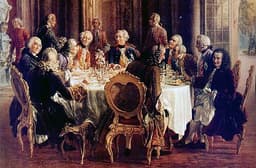
Frederick the Great
Emperor · Modern
68.1Total

Julius Caesar
General · Ancient
82.8Total
Basic Information
Born
1712
-100
Died
1786
-44
Era
Modern
Ancient
Nationality
Prussia
Roman Republic
Occupation
Emperor
General
Civilization
Western
Western
Score Comparison
Military (10%)
90.0
88.0
Political (20%)
75.0
78.0
Influence (20%)
55.0
85.0
Legacy (20%)
52.0
82.0
Leadership (15%)
82.0
80.0
Strategy (15%)
88.0
85.0
TOTAL
68.1
82.8
Frederick the Great — Complete Timeline
1723 AD
General Directory EstablishedReform◆ Major
Frederick the Great reorganized the Prussian government by establishing the General Directory, a centralized administrative body. This reform improved tax collection, military logistics, and state efficiency, strengthening Prussia's fiscal and military capacity.
AdministrationReformState Building
Impact: nationalconstructive
1757 AD
Battle of RossbachWar◆ Major
Frederick the Great's Prussian army defeated a larger Franco-Imperial force at Rossbach during the Seven Years' War. The victory showcased Prussian military discipline and Frederick's tactical genius, securing his reputation as a leading commander.
Seven Years' WarBattleMilitary Tactics
Impact: regional
Battle of LeuthenWar◆ Major
Frederick the Great led Prussian forces to a decisive victory over the Austrian army at Leuthen. The battle, fought in Silesia, demonstrated Frederick's use of oblique order tactics and helped Prussia retain control of Silesia during the Seven Years' War.
Seven Years' WarBattleSilesia
Impact: regional
1763 AD
Treaty of Hubertusburg SignedPolitical Action
Frederick the Great signed the Treaty of Hubertusburg with Austria, ending the Seven Years' War. The treaty confirmed Prussian possession of Silesia and established Prussia as a major European power, despite near-defeat earlier in the war.
TreatySeven Years' WarPrussia
Impact: regionalconstructive
1772 AD
First Partition of PolandPolitical Action◆ Major
Frederick the Great orchestrated the First Partition of Poland alongside Russia and Austria. Prussia gained West Prussia, connecting its territories and gaining control of the Vistula River trade, at the expense of Polish sovereignty.
PartitionPolandTerritorial Expansion
Impact: regionaldestructive
Julius Caesar — Complete Timeline
58 BC
Gallic WarsWar◆ Major
Caesar, as proconsul of Gaul, launched a series of campaigns that conquered all of Gaul (modern France, Belgium, and parts of Switzerland). He fought numerous battles, including against the Helvetii, the Belgae, and the Gallic chieftain Vercingetorix. The wars brought immense wealth and a loyal army to Caesar.
Gallic WarsConquestRoman Expansion
Impact: regional
49 BC
Crossing the RubiconPolitical Action◆ Major
Caesar led Legio XIII across the Rubicon River into Italy, defying the Roman Senate's order to disband his army. This act triggered a civil war against Pompey and the Optimates, ultimately leading to Caesar's dictatorship and the end of the Roman Republic.
Roman Civil WarEnd of RepublicPower Struggle
Impact: global
48 BC
Battle of PharsalusWar◆ Major
Caesar's outnumbered army defeated the larger forces of Pompey the Great at Pharsalus in Greece. Caesar's tactical use of a reserve line to counter Pompey's cavalry charge proved decisive. Pompey fled to Egypt, where he was assassinated, leaving Caesar as the undisputed master of the Roman world.
Roman Civil WarBattleDecisive Victory
Impact: regional
44 BC
Appointment as Dictator for LifePolitical Action◆ Major
The Roman Senate appointed Caesar dictator perpetuo (dictator for life), granting him unprecedented personal power. This move concentrated military, legislative, and judicial authority in one person, effectively ending the Roman Republic's traditional system of checks and balances and alarming many senators.
DictatorshipEnd of RepublicPower Consolidation
Impact: regionaldestructive
Assassination on the Ides of MarchPolitical Action◆ Major
A group of Roman senators, led by Marcus Junius Brutus and Gaius Cassius Longinus, stabbed Caesar to death at a meeting of the Senate in the Theatre of Pompey. The assassination was intended to restore the Republic, but instead triggered another civil war that led to the rise of the Roman Empire.
AssassinationRoman PoliticsEnd of Republic
Impact: globaldestructive
Expert Analysis
frederick-the-great-vs-julius-caesar
# The Dictator and the Philosopher King
On the Ides of March, 44 BCE, a Roman senator named Casca struck the first blow. Within moments, Julius Caesar lay dead at the foot of Pompey's statue, stabbed twenty-three times by men he had called friends. Eighteen centuries later, in a very different world, Frederick the Great died peacefully in his armchair at Sanssouci Palace, a flute concerto he had composed still open on the music stand. Both men reshaped their nations and their eras. One was murdered by his own aristocracy; the other was mourned by his people as the father of his country. Why did their fates diverge so dramatically?
Origins
Caesar was born into the twilight of the Roman Republic, a world of crumbling traditions and naked ambition. His family, the Julii, claimed descent from the goddess Venus, but they were politically marginal. His father died when Caesar was sixteen, leaving him to navigate a violent era where Sulla’s proscriptions had taught every ambitious young aristocrat that mercy was weakness. The Republic was already dying; Caesar simply learned to dance on its grave.
Frederick was born into an absolute monarchy, but one that felt anything but secure. Prussia was a poor, sandy kingdom surrounded by giants—Austria, Russia, France. His father, Frederick William I, was a brutal martinet who beat his son for playing the flute and forced him to watch the execution of his best friend, Katte, when the teenage Frederick tried to flee Prussia. Where Caesar learned ruthlessness from Roman politics, Frederick learned it from his father’s dungeon.
Rise to Power
Caesar’s path was a masterclass in strategic patience. He borrowed fortunes to bribe his way into the priesthood, then into the praetorship, then into the consulship. His military career began late—he was forty when he took command in Gaul—but once he had an army, he never let go. The conquest of Gaul (58–50 BCE) was both a slaughter and a masterpiece, netting him a veteran army, immense wealth, and a legend that made him Rome’s most popular man. When the Senate ordered him to disband his legions, he crossed the Rubicon River in 49 BCE, famously saying, *“Alea iacta est”*—the die is cast. He gambled everything on civil war and won.
Frederick’s rise was nearly cut short before it began. When he inherited the throne in 1740 at age twenty-eight, his kingdom was broke, his army was untested, and his neighbors assumed he would be a weakling. Instead, he immediately invaded Silesia, a rich Austrian province, launching the War of Austrian Succession. He had no legal claim to Silesia; he simply took it. As he later wrote, *“If you like someone else’s land, you must be clever enough to keep it.”* Unlike Caesar, who spent decades climbing, Frederick seized his opportunity within months of taking power.
Leadership & Governance
Caesar ruled as a revolutionary. He reformed the calendar, granted citizenship to Gauls, reduced debt, and packed the Senate with his supporters. But he never bothered to build a stable system. He accepted the title “dictator for life” in 44 BCE, and when offered a crown, he did not refuse quickly enough. His genius was in conquest, not administration; he treated the Republic as his personal estate.
Frederick governed as an enlightened despot. He established the General Directory in 1723 to centralize tax collection and army supply, abolished torture, granted religious toleration, and built canals and roads. Yet he remained an absolute monarch—he once said, *“I am the first servant of the state,”* but he meant the first, not the only. His reforms made Prussia efficient, not free. He personally led his army into battle, taking bullet holes in his coat at Rossbach (1757) and Leuthen (1757), where he defeated larger forces through brilliant flanking maneuvers. The Treaty of Hubertusburg in 1763 preserved his conquest of Silesia, cementing Prussia as a great power.
Triumph & Tragedy
Caesar’s greatest triumph was his own survival—he defeated Pompey, the most celebrated general of the age, and returned to Rome as undisputed master of the known world. His tragedy was that he could imagine no successor. When he was assassinated, the Republic collapsed into another civil war, and the Empire that followed was built on his bones, not his blueprint.
Frederick’s greatest triumph was surviving the Seven Years’ War (1756–1763). Prussia was nearly destroyed—Berlin was occupied, his armies shattered—but Frederick never surrendered. When Russia switched sides upon the death of Empress Elizabeth, he snatched victory from annihilation. His tragedy was more subtle. He grew old, bitter, and isolated, living alone at Sanssouci with his dogs, writing cynical essays in French. He orchestrated the First Partition of Poland in 1772, cynically carving up a neighboring state to gain territory. By the end, the philosopher king had become a weary old wolf.
Character & Destiny
Caesar was magnetic, generous, and reckless. He pardoned his enemies—and they killed him. He believed his luck would never run out, and it did, on the Ides of March. Frederick was cold, disciplined, and profoundly distrustful. He trusted no one, not even his generals, and that suspicion kept him alive. Caesar died because he took risks; Frederick lived because he calculated every step.
Their personalities were products of their eras. Caesar grew up in a world where glory was everything and death was glorious. Frederick grew up in a world where survival was everything and death was a release from his father’s cruelty. One sought immortality; the other sought security.
Legacy
Caesar’s name became a title—Kaiser, Tsar. His reforms outlived the Republic, and his adopted heir, Octavian, founded an empire that lasted five hundred years. But his legacy is also a warning: too much power, too fast, destroys the system that creates it.
Frederick left Prussia a machine—a standing army of 200,000 men, a disciplined bureaucracy, and a culture of militarism that would eventually, in the nineteenth century, unite Germany. But he also left a model of enlightened absolutism that influenced Catherine the Great and Joseph II. His legacy is more ambiguous: the state he built was efficient, but it was also ruthless. When Napoleon visited his tomb in 1807, he said, *“Hats off, gentlemen, if he were alive, we would not be here.”*
Conclusion
Caesar and Frederick both understood that history belongs to those who act decisively. But Caesar acted for himself, and Frederick acted for his state. One was a comet that burned out in a blaze of glory; the other was a forge that slowly shaped iron into steel. Perhaps the difference comes down to this: Caesar wanted to be remembered, and Frederick wanted his kingdom to survive. In the end, both got what they wished for—but only one lived to see it.
Rankings
🥇
Julius CaesarLeader
Mil: 88.0Pol: 78.0Inf: 85.0
82.8
🥈
Frederick the Great
Mil: 90.0Pol: 75.0Inf: 55.0
68.1
+14.7 behind
How This Comparison Works
Algorithm
Each figure is scored on 6 dimensions (0—100 scale) based on structured historical data: Military (10%), Political (20%), Influence (20%), Legacy (20%), Leadership (15%), Strategy (15%). The weighted total produces the final ranking.
Data Sources
Scores are computed from structured sub-indicators in the database. Scale factors adjust for era (Ancient ×0.85, Modern ×1.0) and civilization size (Eastern ×1.05, Other ×0.80) to account for differences in population and military scale.
Maximum 3 Figures
Comparisons are limited to 2—3 figures to ensure readability and statistical meaningfulness.
Error Margins
±5 points per dimension — Sub-scores are derived from historical records with inherent uncertainty. Two figures within 5 points on a dimension should be considered roughly equivalent in that area.
Total Score Accuracy
±3 points overall — The weighted combination of 6 dimensions produces a total score with approximately ±3 points of uncertainty. Differences of less than 3 points are not statistically significant— the figures are effectively tied.
Known Limitations
- Historical records are incomplete and uneven across civilizations
- Figures from oral-tradition societies may be underrepresented
- Occupation labels can misclassify multi-role figures
- Scores measure capability and impact, not moral character
- Quantitative scoring is a comparison tool, not absolute truth
Capability Radar
Military (10%) — Battles & Warfare
Battles
85
95
Win Rate
80
92
Expansion
85
97
Political (20%) — Governance & Reform
Reform
90
90
Diplomacy
80
85
Economy
85
82
Influence (20%) — Cultural & Global Reach
Cultural
80
88
Global
75
94
Legacy (20%) — Historical Impact
Historical
85
95
Longevity
80
96
Leadership (15%) — Power & Stability
Tenure
85
75
Stability
75
60
Strategy (15%) — Tactics & Innovation
Strategy
90
94
Tactics
95
96
Reform
90
88
Similar Comparisons
Comments & Discussion
No comments yet. Be the first to share your thoughts!