Loading...
Frederick William the Great Elector vs Gustavus III
Frederick William the Great Elector leads by 7.5 pts · 2 figures compared
…

Frederick William the Great Elector
Emperor · Modern
66.3Total
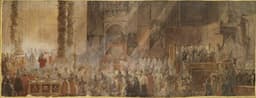
Gustavus III
Emperor · Modern
58.8Total
Basic Information
Born
1620
1746
Died
1688
1792
Era
Modern
Modern
Nationality
Prussia
Sweden
Occupation
Emperor
Emperor
Civilization
Western
Western
Score Comparison
Military (10%)
60.0
40.0
Political (20%)
82.0
72.0
Influence (20%)
56.7
60.0
Legacy (20%)
65.0
47.5
Leadership (15%)
72.0
74.0
Strategy (15%)
68.0
60.0
TOTAL
66.3
58.8
Frederick William the Great Elector — Complete Timeline
1655 AD
Established the General War CommissariatReform◆ Major
Frederick William created the General War Commissariat, a centralized tax and military administration. This institution allowed him to maintain a standing army independent of noble estates, laying the foundation for Prussian militarism and absolutist rule.
Military ReformAdministrationAbsolutism
Impact: nationalconstructive
1656 AD
Battle of Warsaw (1656)War◆ Major
Frederick William led Brandenburg-Prussian forces alongside Sweden to defeat the Polish-Lithuanian Commonwealth at the Battle of Warsaw. This victory secured his control over Ducal Prussia and demonstrated the military capability of his emerging state.
BattleSecond Northern WarPrussia
Impact: regional
1660 AD
Treaty of OlivaPolitical Action
Frederick William signed the Treaty of Oliva, which ended the Second Northern War. The treaty confirmed his full sovereignty over Ducal Prussia, freeing it from Polish vassalage and establishing Brandenburg-Prussia as an independent European power.
TreatySovereigntyPrussia
Impact: regionalconstructive
1685 AD
Edict of PotsdamPolitical Action◆ Major
Frederick William issued the Edict of Potsdam, inviting French Huguenot refugees to settle in Brandenburg-Prussia. This policy brought skilled artisans, merchants, and soldiers, boosting the economy and population, and strengthening the state's military and industrial capacity.
ImmigrationEconomyReligious Tolerance
Impact: nationalprogressive
Gustavus III — Complete Timeline
1772 AD
Coup d'état of 1772Political Action
Gustavus III staged a bloodless coup, using military force and popular support to abolish the parliamentary system dominated by the Caps and Hats parties. He imposed a new constitution that restored significant royal authority, ending the so-called Age of Liberty and establishing an enlightened absolutist regime.
SwedenCoupAbsolutismConstitution
Impact: national
1786 AD
Founding of the Swedish AcademyCultural◆ Major
Gustavus III founded the Swedish Academy, modeled on the French Academy, to promote the Swedish language and literature. The Academy became a central institution in Swedish cultural life, later responsible for awarding the Nobel Prize in Literature.
SwedenCultureAcademyLanguage
Impact: nationalconstructive
1788 AD
Russo-Swedish War of 1788–1790War◆ Major
Gustavus III launched a war against Russia, partly to rally national sentiment behind his monarchy. The war was indecisive, culminating in the naval Battle of Svensksund in 1790, a major Swedish victory. The Treaty of V
SwedenRussiaWarBattle of Svensksund
Impact: regional
1792 AD
Assassination at the masquerade ballPolitical Action
Gustavus III was shot in the back at a masquerade ball at the Royal Opera House in Stockholm by a disgruntled nobleman, Jacob Johan Anckarstr
SwedenAssassinationNobilityOpera
Impact: nationaltragic
Expert Analysis
Origins
Frederick William of Brandenburg (1620–1688) was born into the Hohenzollern dynasty, ruling scattered territories across northern Europe. His father, George William, left a fragmented state devastated by the Thirty Years' War. Frederick William's education emphasized military discipline and Calvinist piety, shaping his pragmatic worldview. In contrast, Gustavus III of Sweden (1746–1792) was born into the House of Holstein-Gottorp, raised in the opulent court of Stockholm. His mother, Louisa Ulrika of Prussia, instilled a love for French Enlightenment culture. Gustavus studied Rousseau and Voltaire, developing a taste for absolutism and theatrical governance. While Frederick William matured amid war and ruin, Gustavus grew up in a period of relative peace, though Sweden's parliamentary "Age of Liberty" had weakened royal authority.
Rise to Power
Frederick William became Elector in 1640 at age 20, inheriting a bankrupt state with no standing army. He immediately negotiated a truce with Sweden and began rebuilding. His rise was gradual, marked by the 1653 Diet of Brandenburg granting him new taxes for a permanent army. The 1656 Battle of Warsaw, where his forces fought alongside Sweden, secured his sovereignty over Ducal Prussia. The 1660 Treaty of Oliva confirmed this, granting full independence from Poland. Gustavus III, by contrast, seized power in a dramatic 1772 coup. At 26, he used the military to arrest the parliamentary leaders, forcing through a new constitution that restored royal authority. His rise was swift and theatrical, relying on popular support against the corrupt Caps and Hats parties. Frederick William built power through decades of patient state-building; Gustavus through a single night's coup.
Leadership & Governance
Frederick William's governance was methodical and institutional. He established the General War Commissariat in 1655, a centralized tax and military administration that became the backbone of Prussian bureaucracy. He issued the Edict of Potsdam in 1685, inviting 20,000 French Huguenot refugees, who boosted the economy and introduced advanced crafts. His leadership score of 72.0 reflects his ability to unify disparate territories under a single administration. Gustavus III ruled as an enlightened despot, founding the Swedish Academy in 1786 to promote language and arts. He patronized opera and theater, writing plays himself. However, his political score of 72.0 was undermined by his growing absolutism, which alienated the nobility. While Frederick William built durable institutions, Gustavus relied on personal charisma and cultural patronage, leaving few structural reforms.
Triumph & Tragedy
Frederick William's greatest triumph was creating the foundations of Prussian power: a standing army of 30,000 men and a centralized state. His tragedy was that his successor, Frederick I, squandered resources on courtly display. Frederick William's military score of 60.0 reflects his competent but not brilliant generalship. Gustavus III's triumph was the 1772 coup, which restored royal power and ended 50 years of parliamentary misrule. He also achieved a naval victory at the Battle of Svensksund in 1790, forcing Russia to accept the Treaty of Värälä without territorial losses. His tragedy was his assassination in 1792 at a masquerade ball, a dramatic end that cut short his reforms. The assassination destabilized Sweden, leading to a regency and eventual loss of Finland in 1809.
Character & Destiny
Frederick William was pragmatic, frugal, and relentless—nicknamed "the Great Elector" for his state-building. His character was shaped by the devastation of the Thirty Years' War, making him prioritize security above all. He scored 68.0 in strategy, reflecting his long-term planning. Gustavus III was charismatic, theatrical, and risk-prone. He staged lavish court events and personally led troops, but his love of drama extended to politics, where he alienated nobles through arbitrary arrests. His assassination was a direct result of his autocratic style and the conspiracy of disgruntled aristocrats. Frederick William died of old age in his bed; Gustavus fell to a bullet in a ballroom.
Legacy
Frederick William's legacy is the Prussian state itself. His institutions—the General War Commissariat, the standing army, the mercantilist policies—were the foundation upon which Frederick the Great built a European power. His influence score of 56.7 reflects his indirect impact, as his work enabled later Prussian and German unification. Gustavus III's legacy is cultural: the Swedish Academy, the Royal Opera, and the restoration of royal authority. However, his assassination led to a weak regency, and his constitutional changes were reversed by 1809. His legacy score of 47.5 is lower, as his achievements were more fragile. Frederick William's total score of 66.3 exceeds Gustavus's 58.8 by 7.5 points, reflecting greater concrete impact.
Conclusion
Frederick William the Great Elector had a greater impact than Gustavus III. While Gustavus's cultural patronage and coup were significant, they did not create lasting institutions. Frederick William built the Prussian state, which shaped European history for two centuries. His political score of 82.0 and legacy score of 65.0 dwarf Gustavus's 72.0 and 47.5. The Great Elector's work directly enabled the rise of Prussia as a great power, while Gustavus's Sweden declined after his death. The 7.5-point score gap is justified: Frederick William's foundations endured; Gustavus's reforms did not.
Rankings
🥇
Frederick William the Great ElectorLeader
Mil: 60.0Pol: 82.0Inf: 56.7
66.3
🥈
Gustavus III
Mil: 40.0Pol: 72.0Inf: 60.0
58.8
+7.5 behind
How This Comparison Works
Algorithm
Each figure is scored on 6 dimensions (0—100 scale) based on structured historical data: Military (10%), Political (20%), Influence (20%), Legacy (20%), Leadership (15%), Strategy (15%). The weighted total produces the final ranking.
Data Sources
Scores are computed from structured sub-indicators in the database. Scale factors adjust for era (Ancient ×0.85, Modern ×1.0) and civilization size (Eastern ×1.05, Other ×0.80) to account for differences in population and military scale.
Maximum 3 Figures
Comparisons are limited to 2—3 figures to ensure readability and statistical meaningfulness.
Error Margins
±5 points per dimension — Sub-scores are derived from historical records with inherent uncertainty. Two figures within 5 points on a dimension should be considered roughly equivalent in that area.
Total Score Accuracy
±3 points overall — The weighted combination of 6 dimensions produces a total score with approximately ±3 points of uncertainty. Differences of less than 3 points are not statistically significant— the figures are effectively tied.
Known Limitations
- Historical records are incomplete and uneven across civilizations
- Figures from oral-tradition societies may be underrepresented
- Occupation labels can misclassify multi-role figures
- Scores measure capability and impact, not moral character
- Quantitative scoring is a comparison tool, not absolute truth
Capability Radar
Military (10%) — Battles & Warfare
Battles
65
45
Win Rate
70
40
Expansion
75
25
Political (20%) — Governance & Reform
Reform
90
70
Diplomacy
85
55
Economy
80
50
Influence (20%) — Cultural & Global Reach
Cultural
55
65
Global
70
35
Legacy (20%) — Historical Impact
Historical
85
55
Longevity
80
40
Leadership (15%) — Power & Stability
Tenure
80
60
Stability
70
30
Strategy (15%) — Tactics & Innovation
Strategy
80
30
Tactics
75
35
Reform
85
50
Similar Comparisons
Comments & Discussion
No comments yet. Be the first to share your thoughts!