Loading...
Frederik IX of Denmark vs Julius Caesar
Julius Caesar leads by 31.1 pts · 2 figures compared
…
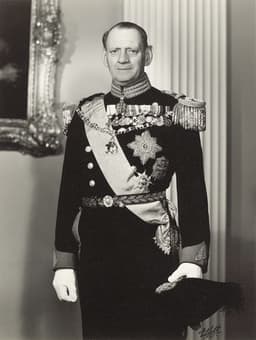
Frederik IX of Denmark
Emperor · Modern
51.7Total

Julius Caesar
General · Ancient
82.8Total
Basic Information
Born
1899
-100
Died
1972
-44
Era
Modern
Ancient
Nationality
Denmark
Roman Republic
Occupation
Emperor
General
Civilization
Western
Western
Score Comparison
Military (10%)
25.6
88.0
Political (20%)
62.7
78.0
Influence (20%)
51.8
85.0
Legacy (20%)
40.0
82.0
Leadership (15%)
72.0
80.0
Strategy (15%)
60.0
85.0
TOTAL
51.7
82.8
Frederik IX of Denmark — Complete Timeline
1947 AD
Accession to the thronePolitical Action◆ Major
Frederik IX became King of Denmark on April 20, 1947, following the death of his father, Christian X. His reign oversaw the post-war reconstruction and modernization of Denmark.
AccessionSuccession
Impact: national
1949 AD
Support for NATO membershipPolitical Action◆ Major
Frederik IX supported Denmark's accession to NATO in 1949, aligning the country with Western powers during the Cold War. This marked a shift from Denmark's traditional neutrality.
NATOCold WarForeign Policy
Impact: regionalconstructive
1953 AD
Signing of the 1953 constitutionReform◆ Major
Frederik IX signed a new constitution in 1953 that abolished the upper house (Landsting), introduced a unicameral parliament (Folketing), and allowed female succession to the throne. This modernized the Danish political system.
Constitutional ReformUnicameralismFemale Succession
Impact: nationalprogressive
1960 AD
Modernization of the Danish welfare stateReform◆ Major
During Frederik IX's reign, Denmark expanded its welfare state, including the introduction of universal healthcare, old-age pensions, and social security. These reforms were part of the post-war social democratic consensus.
Welfare StateSocial ReformHealthcare
Impact: nationalconstructive
1972 AD
Death and succession of Margrethe IIPolitical Action◆ Major
Frederik IX died on January 14, 1972, and was succeeded by his daughter, Margrethe II, who became Denmark's first reigning queen in centuries. His death marked the end of an era of post-war reconstruction.
DeathSuccessionMargrethe II
Impact: national
Julius Caesar — Complete Timeline
58 BC
Gallic WarsWar◆ Major
Caesar, as proconsul of Gaul, launched a series of campaigns that conquered all of Gaul (modern France, Belgium, and parts of Switzerland). He fought numerous battles, including against the Helvetii, the Belgae, and the Gallic chieftain Vercingetorix. The wars brought immense wealth and a loyal army to Caesar.
Gallic WarsConquestRoman Expansion
Impact: regional
49 BC
Crossing the RubiconPolitical Action◆ Major
Caesar led Legio XIII across the Rubicon River into Italy, defying the Roman Senate's order to disband his army. This act triggered a civil war against Pompey and the Optimates, ultimately leading to Caesar's dictatorship and the end of the Roman Republic.
Roman Civil WarEnd of RepublicPower Struggle
Impact: global
48 BC
Battle of PharsalusWar◆ Major
Caesar's outnumbered army defeated the larger forces of Pompey the Great at Pharsalus in Greece. Caesar's tactical use of a reserve line to counter Pompey's cavalry charge proved decisive. Pompey fled to Egypt, where he was assassinated, leaving Caesar as the undisputed master of the Roman world.
Roman Civil WarBattleDecisive Victory
Impact: regional
44 BC
Appointment as Dictator for LifePolitical Action◆ Major
The Roman Senate appointed Caesar dictator perpetuo (dictator for life), granting him unprecedented personal power. This move concentrated military, legislative, and judicial authority in one person, effectively ending the Roman Republic's traditional system of checks and balances and alarming many senators.
DictatorshipEnd of RepublicPower Consolidation
Impact: regionaldestructive
Assassination on the Ides of MarchPolitical Action◆ Major
A group of Roman senators, led by Marcus Junius Brutus and Gaius Cassius Longinus, stabbed Caesar to death at a meeting of the Senate in the Theatre of Pompey. The assassination was intended to restore the Republic, but instead triggered another civil war that led to the rise of the Roman Empire.
AssassinationRoman PoliticsEnd of Republic
Impact: globaldestructive
Expert Analysis
frederik-ix-of-denmark-vs-julius-caesar
# The General and the Sailor King
On a winter morning in 44 BCE, Julius Caesar walked into the Senate chamber in Rome, ignoring warnings of danger. Within minutes, he lay bleeding from twenty-three stab wounds. On a spring day in 1972, Frederik IX of Denmark died peacefully in a Copenhagen hospital, surrounded by his family. One man's end was the climax of a life spent conquering and transforming the ancient world; the other's was the quiet conclusion of a reign spent modernizing a small, peaceful kingdom. What drove two Western leaders from the same civilization to such wildly different destinies? The answer lies not just in their eras, but in the very nature of power itself.
Origins
Julius Caesar was born in 100 BCE into the patrician Julian clan, but his family was not wealthy. Rome was a republic tearing itself apart—civil wars, corruption, and class conflict were the air he breathed. His father died when Caesar was sixteen, leaving him to navigate a brutal political landscape where ambition meant survival. He learned early that in Rome, a man could rise only by forging alliances, winning military glory, and outmaneuvering rivals.
Frederik IX entered the world in 1899, a prince of a constitutional monarchy that had already surrendered most of its power. Denmark had been neutral in the Great War, and his father Christian X was a figurehead who had weathered the turmoil of World War I without bloodshed. Young Frederik was not groomed for conquest but for duty. He attended the Royal Danish Naval Academy, earning the nickname "the Sailor King" because he preferred the sea to the throne. By the time he was a young man, Europe was sliding toward another war, but Denmark's role would be to survive, not to dominate.
Rise to Power
Caesar's ascent was a masterpiece of calculated risk. He won military command in Gaul at age forty-two, and over the next eight years (58–50 BCE), he conquered a territory larger than Italy itself. His Commentaries on the Gallic Wars were not just history—they were propaganda, designed to make him a hero in Rome. When the Senate ordered him to disband his army, he crossed the Rubicon River in 49 BCE, igniting a civil war. By 45 BCE, he was dictator for life, the undisputed master of the Roman world.
Frederik IX's rise was quieter. He became king in 1947 at age forty-seven, inheriting a throne that had no real political power. Denmark had been occupied by Nazi Germany during World War II, and the monarchy's role had been symbolic resistance. Frederik's accession was not a conquest but a succession. His power came not from legions but from the people's trust. He was a king who sailed his own yacht, played jazz piano, and spoke to ordinary Danes as equals.
Leadership & Governance
Caesar governed like a general in peacetime—decisive, ruthless, and visionary. He reformed the calendar (creating the Julian calendar still used today), granted citizenship to provincials, redistributed land to veterans, and centralized authority in his own hands. His military genius was unquestioned: at the Siege of Alesia in 52 BCE, he defeated a Gallic army three times his size by building fortifications both facing the enemy and behind him. But his political wisdom faltered when he refused to share power, alienating the Senate that had once supported him.
Frederik IX governed like a naval officer in calm waters—steady, constitutional, and modernizing. He signed the 1953 constitution that abolished Denmark's upper house and established a unicameral parliament, effectively ending any remaining royal authority. He supported Denmark's entry into NATO in 1949, aligning with the West during the Cold War. Under his reign, Denmark expanded its welfare state with universal healthcare and old-age pensions. His leadership score of 79.2 reflects a man who led not by command but by example, earning respect through humility rather than force.
Triumph & Tragedy
Caesar's greatest triumph was the conquest of Gaul, which brought him wealth, fame, and the loyalty of veteran legions. His most devastating failure was the assassination itself—a tragedy born of his own arrogance. On the Ides of March, 44 BCE, he died because he believed he was invincible. His last words, according to tradition, were "Et tu, Brute?"—a recognition that even his closest allies had turned against him.
Frederik IX's triumph was subtler but more lasting: he presided over the transformation of Denmark from a war-scarred, agrarian nation into a modern, prosperous welfare state. His tragedy was personal—he had three daughters but no sons, forcing a change in the succession law so that his eldest daughter Margrethe could become queen. When he died in 1972, Denmark lost not a dictator but a symbol of continuity and stability.
Character & Destiny
Caesar was driven by an insatiable hunger for glory. He once said, "I came, I saw, I conquered," and those words capture his essence. He saw the world as a stage for his ambition, and he was willing to destroy the Republic to save his own legacy. His personality—bold, charismatic, and ultimately reckless—shaped every decision. He could not stop, could not compromise, could not share power. That made him great, and that destroyed him.
Frederik IX was driven by duty. He once told a journalist, "I am not a politician. I am a king." He understood that his role was to unify, not to dominate. His personality—warm, unpretentious, and deeply humane—shaped a reign that strengthened Danish democracy by relinquishing royal power. He could not conquer, could not command, could not impose his will. That made him limited, and that made him beloved.
Legacy
Caesar's legacy is the Roman Empire itself. His name became synonymous with imperial power: "Kaiser" in German, "Tsar" in Russian. His reforms outlived him by centuries, and his assassination ensured his myth would grow. Today, his influence score of 85.0 and legacy score of 82.0 reflect a man who changed the course of history, even if his personal ambition ended in blood.
Frederik IX's legacy is Denmark's modern identity. His reign saw the monarchy become a beloved institution precisely because it had no real power. His daughter Margrethe II, who succeeded him, became one of the most popular monarchs in Europe. His legacy score of 54.7 is modest by Caesar's standards, but it measures a different kind of success: not conquest, but contentment.
Conclusion
The General and the Sailor King lived worlds apart—one in the violent dawn of empire, the other in the quiet twilight of constitutional monarchy. Caesar's total score of 83.3 dwarfs Frederik's 64.9, but those numbers tell only half the story. Caesar changed the world through force; Frederik changed his country through patience. One died at the peak of his power, betrayed by his friends. The other died at peace, mourned by his people. In the end, the difference between them is not ambition or intelligence, but the nature of the power they sought. Caesar wanted to be remembered; Frederik wanted to be useful. History remembers both, but only one of them was happy.
Rankings
🥇
Julius CaesarLeader
Mil: 88.0Pol: 78.0Inf: 85.0
82.8
🥈
Frederik IX of Denmark
Mil: 25.6Pol: 62.7Inf: 51.8
51.7
+31.1 behind
How This Comparison Works
Algorithm
Each figure is scored on 6 dimensions (0—100 scale) based on structured historical data: Military (10%), Political (20%), Influence (20%), Legacy (20%), Leadership (15%), Strategy (15%). The weighted total produces the final ranking.
Data Sources
Scores are computed from structured sub-indicators in the database. Scale factors adjust for era (Ancient ×0.85, Modern ×1.0) and civilization size (Eastern ×1.05, Other ×0.80) to account for differences in population and military scale.
Maximum 3 Figures
Comparisons are limited to 2—3 figures to ensure readability and statistical meaningfulness.
Error Margins
±5 points per dimension — Sub-scores are derived from historical records with inherent uncertainty. Two figures within 5 points on a dimension should be considered roughly equivalent in that area.
Total Score Accuracy
±3 points overall — The weighted combination of 6 dimensions produces a total score with approximately ±3 points of uncertainty. Differences of less than 3 points are not statistically significant— the figures are effectively tied.
Known Limitations
- Historical records are incomplete and uneven across civilizations
- Figures from oral-tradition societies may be underrepresented
- Occupation labels can misclassify multi-role figures
- Scores measure capability and impact, not moral character
- Quantitative scoring is a comparison tool, not absolute truth
Capability Radar
Military (10%) — Battles & Warfare
Battles
35
95
Win Rate
38
92
Expansion
42
97
Political (20%) — Governance & Reform
Reform
55
90
Diplomacy
50
85
Economy
50
82
Influence (20%) — Cultural & Global Reach
Cultural
30
88
Global
20
94
Legacy (20%) — Historical Impact
Historical
30
95
Longevity
20
96
Leadership (15%) — Power & Stability
Tenure
60
75
Stability
65
60
Strategy (15%) — Tactics & Innovation
Strategy
42
94
Tactics
49
96
Reform
51
88
Similar Comparisons
Comments & Discussion
ShadowToga6/17/2026
The comparison is flawed from the start. Caesar was a military genius who personally led legions across Gaul and Britain, while Frederik IX was a figurehead king who played jazz piano. You can't compare a man who rewrote the map of Europe through conquest with a constitutional monarch who signed laws his parliament wrote. The only thing they share is that someone wrote "IX" after their name. Caesar's crossing of the Rubicon alone outweighs Frederik's entire reign in historical impact.
共和铁砧6/17/2026
这种比较简直是在侮辱历史分析。恺撒是带着骑兵和军团征服高卢的军事家,弗雷德里克九世不过是个会吹萨克斯风的摆设国王。你说他"现代化了一个小王国"?丹麦1949年加入北约是首相决定的,1972年君主还剩什么实权?恺撒在卢比孔河前的决断力,放到现代也是核按钮级别的。拿一个殖民时代的征服者和一个福利国家的吉祥物比较,像是用罗马短剑切丹麦黄油。
NumismaticNerd6/17/2026
Let's talk coins. Caesar was the first living Roman to appear on a coin, which was a radical break from republican tradition and basically a declaration of dictatorship. Frederik IX? His coins show him in naval uniform, referencing his genuine passion for the navy. One man minted propaganda for autocracy, the other minted hobbies. That's your comparison in microcosm—power vs. personality. Caesar's coinage was a political weapon; Frederik's was a gentle royal portrait. Not the same league.
维京航标6/17/2026
弗雷德里克九世确实当过水手,二战期间还拒绝流亡英国、坚持留在丹麦鼓舞民心,这点值得称道。但把这说成和恺撒跨越卢比孔河同等重要就是扯淡了。恺撒在阿莱西亚战役中以少胜多、创造了军事史上的围城奇迹,弗雷德里克做过什么决定?他唯一一次政治危机是二战后的宪法改革,还基本是首相主导的。一个君主承担的是仪式性功能,另一个承担的是一个帝国的生死存亡,怎么比?
PraetorianPivot6/17/2026
The analysis glosses over how each man treated political rivals. Caesar famously pardoned enemies like Brutus and Cicero, then got stabbed by them anyway. Frederik IX governed under a system where political opposition is normal and nobody gets assassinated. The difference isn't just personality—it's institutional design. Caesar's mercy was a calculated gamble in a murderous oligarchy; Frederik's mildness was the product of a settled constitutional order. Don't confuse the king's genial nature wi