Loading...
Gaafar Nimeiry vs Julius Caesar
Julius Caesar leads by 29.7 pts · 2 figures compared
…
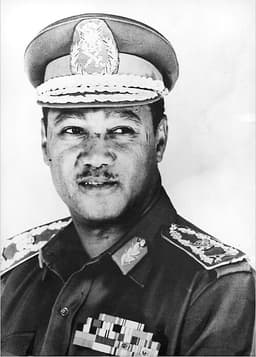
Gaafar Nimeiry
General · Modern
53.1Total

Julius Caesar
General · Ancient
82.8Total
Basic Information
Born
1930
-100
Died
—
-44
Era
Modern
Ancient
Nationality
Sudan
Roman Republic
Occupation
General
General
Civilization
Other
Western
Score Comparison
Military (10%)
45.0
88.0
Political (20%)
61.3
78.0
Influence (20%)
54.1
85.0
Legacy (20%)
42.5
82.0
Leadership (15%)
74.0
80.0
Strategy (15%)
41.7
85.0
TOTAL
53.1
82.8
Gaafar Nimeiry — Complete Timeline
1969 AD
1969 Sudanese coup d'étatPolitical Action◆ Major
Gaafar Nimeiry, then a colonel, led the Free Officers Movement in a bloodless coup that overthrew the civilian government of Prime Minister Mohamed Ahmed Mahgoub. Nimeiry established the Revolutionary Command Council (RCC) and declared Sudan a socialist state.
CoupMilitary RuleSocialism
Impact: national
1972 AD
Addis Ababa AgreementPolitical Action◆ Major
Nimeiry signed the Addis Ababa Agreement with the Anyanya rebel group, ending the First Sudanese Civil War (1955-1972). The agreement granted southern Sudan regional autonomy and ended 17 years of conflict, marking a major achievement in Nimeiry's early rule.
Peace AgreementCivil War EndAutonomy
Impact: nationalconstructive
1983 AD
Shift to IslamismReform◆ Major
Nimeiry abandoned his socialist policies and adopted Islamic Sharia law, imposing hudud punishments and dissolving the southern autonomy. This decision alienated the non-Muslim south and reignited civil war, leading to the formation of the Sudan People's Liberation Army (SPLA).
IslamizationShariaCivil War
Impact: nationaldestructive
1985 AD
1985 Sudanese coup d'étatPolitical Action◆ Major
Nimeiry was overthrown by a military coup led by General Abdel Rahman Swar al-Dahab while he was on a visit to the United States. The coup was triggered by widespread protests against economic hardship, corruption, and the ongoing civil war. Nimeiry went into exile in Egypt.
CoupRegime ChangeExile
Impact: national
Julius Caesar — Complete Timeline
58 BC
Gallic WarsWar◆ Major
Caesar, as proconsul of Gaul, launched a series of campaigns that conquered all of Gaul (modern France, Belgium, and parts of Switzerland). He fought numerous battles, including against the Helvetii, the Belgae, and the Gallic chieftain Vercingetorix. The wars brought immense wealth and a loyal army to Caesar.
Gallic WarsConquestRoman Expansion
Impact: regional
49 BC
Crossing the RubiconPolitical Action◆ Major
Caesar led Legio XIII across the Rubicon River into Italy, defying the Roman Senate's order to disband his army. This act triggered a civil war against Pompey and the Optimates, ultimately leading to Caesar's dictatorship and the end of the Roman Republic.
Roman Civil WarEnd of RepublicPower Struggle
Impact: global
48 BC
Battle of PharsalusWar◆ Major
Caesar's outnumbered army defeated the larger forces of Pompey the Great at Pharsalus in Greece. Caesar's tactical use of a reserve line to counter Pompey's cavalry charge proved decisive. Pompey fled to Egypt, where he was assassinated, leaving Caesar as the undisputed master of the Roman world.
Roman Civil WarBattleDecisive Victory
Impact: regional
44 BC
Appointment as Dictator for LifePolitical Action◆ Major
The Roman Senate appointed Caesar dictator perpetuo (dictator for life), granting him unprecedented personal power. This move concentrated military, legislative, and judicial authority in one person, effectively ending the Roman Republic's traditional system of checks and balances and alarming many senators.
DictatorshipEnd of RepublicPower Consolidation
Impact: regionaldestructive
Assassination on the Ides of MarchPolitical Action◆ Major
A group of Roman senators, led by Marcus Junius Brutus and Gaius Cassius Longinus, stabbed Caesar to death at a meeting of the Senate in the Theatre of Pompey. The assassination was intended to restore the Republic, but instead triggered another civil war that led to the rise of the Roman Empire.
AssassinationRoman PoliticsEnd of Republic
Impact: globaldestructive
Expert Analysis
gaafar-nimeiry-vs-julius-caesar
The Dictator’s Two Faces
On a spring morning in 44 BCE, Julius Caesar walked into the Senate chamber at the Theatre of Pompey, unarmed and surrounded by men he called friends. Moments later, he lay bleeding from twenty-three stab wounds, his body crumpled at the base of a statue of his old rival. Across the Mediterranean and two millennia later, on an April day in 1985, Gaafar Nimeiry boarded a plane in Cairo, heading home to Sudan. He never made it. While he was in the air, his own generals seized power in Khartoum, and the man who had ruled for sixteen years found himself a refugee. Two dictators, two falls—one immortalized in marble and verse, the other fading into the footnotes of history. What separates a Caesar from a Nimeiry is not merely time, but the shape of ambition, the weight of legacy, and the unforgiving judgment of posterity.
Origins
Julius Caesar was born into the patrician Julian clan, an ancient family that had lost much of its political clout by the first century BCE. His father died when he was sixteen, leaving him the head of a household with little money but a name that still carried weight. The Roman Republic was in crisis—corrupt senators, landless veterans, and slave revolts tore at its fabric. Caesar grew up in a world where survival meant maneuvering, where a man could rise by charm, debt, and military glory. He learned early that power was a game, and he was determined to win it.
Gaafar Nimeiry was born in 1930 in Wad Nubawi, a small village in northern Sudan, into a modest family of farmers and minor officials. Sudan was then under Anglo-Egyptian condominium, a colonial hybrid that left its people subject to distant rulers. Nimeiry’s world was one of poverty, ethnic division, and the simmering resentment of a country that had never truly been free. He joined the military academy, as many ambitious young men did, because the army offered the only ladder out of obscurity. Where Caesar inherited a name, Nimeiry inherited a grievance.
Rise to Power
Caesar’s path was slow and deliberate. He served as a military tribune, then quaestor, then aedile, spending vast sums on games and public works to win the people’s love. He forged an alliance with Pompey and Crassus—the First Triumvirate—and used it to secure command in Gaul. There, over eight years, he conquered a territory larger than Italy, wrote his own commentaries to shape public opinion, and built an army that loved him more than the Senate. When his enemies demanded he disband his legions, he crossed the Rubicon River in 49 BCE, a line that meant civil war. He gambled everything on a single march.
Nimeiry’s rise was swifter and bloodless. In 1969, as a colonel in the Sudanese army, he led the Free Officers Movement in a coup that overthrew the civilian government without a single shot fired. He was thirty-nine years old. Sudan was fractured—the Arab north dominated the African south, and a brutal civil war had raged since 1955. Nimeiry promised unity, socialism, and order. He had no Gaul to conquer, no rival generals to outmaneuver—only a country exhausted by chaos. He seized power not through years of patient ambition, but because the door was open and he walked through it.
Leadership & Governance
Caesar ruled as a reformer and a pragmatist. As dictator, he overhauled the calendar, granted citizenship to provincials, redistributed land to veterans, and curbed the power of corrupt tax collectors. He was a military genius—his siege of Alesia in 52 BCE remains a masterpiece of encirclement—but he also understood that victory meant little without political consolidation. He pardoned former enemies, appointed Gauls to the Senate, and tried to build a government that could survive him. His flaw was not incompetence but arrogance: he believed his own legend.
Nimeiry’s governance was a study in contradiction. In 1972, he signed the Addis Ababa Agreement with the Anyanya rebels, ending the First Sudanese Civil War and granting the south autonomy. It was a genuine achievement, a peace that held for a decade. But in 1983, he abandoned his socialist policies and imposed Islamic sharia law, dissolving the southern region and rekindling the war. He ordered amputations for theft, public floggings, and executions. His regime, once inclusive, became sectarian and brutal. Where Caesar centralized power to stabilize, Nimeiry centralized it to control—and in doing so, tore his country apart.
Triumph & Tragedy
Caesar’s greatest triumph was the conquest of Gaul, which brought Rome wealth, glory, and a buffer against barbarian tribes. His greatest tragedy was the Ides of March—not merely his own death, but the civil wars that followed, the collapse of the Republic he had tried to save, and the rise of an empire he had unwittingly enabled. He died believing he was indispensable, and in a way, he was right: without him, the old order could not stand.
Nimeiry’s triumph was the Addis Ababa Agreement, a rare moment of peace in a land that would later know genocide. His tragedy was the 1983 sharia decree, which undid everything. The Second Sudanese Civil War that followed lasted twenty-two years, killed two million people, and ended with the secession of South Sudan in 2011. Nimeiry did not die by the dagger; he died in exile in Khartoum in 2009, a forgotten old man in a country he had broken.
Character & Destiny
Caesar was audacious, charming, and ruthless. He wept when he saw a statue of Alexander the Great, because he had achieved nothing at the same age. He forgave his enemies but never forgot them. He believed in his own star—his *genius*—and that belief carried him across the Rubicon, through civil war, and into history. His character was his destiny: he could not stop, could not compromise, could not step back.
Nimeiry was cautious, adaptable, and ultimately weak. He shifted ideologies as the wind blew—from socialist to Islamist, from peacemaker to tyrant—because he lacked a core. He ruled by balancing factions, not by forging a vision. When the pressure came, he folded. His character was also his destiny: he could not commit, could not sustain, could not endure.
Legacy
Caesar’s legacy is the Roman Empire itself. His name became a title—*Kaiser*, *Tsar*—and his writings shaped Western literature. He is remembered as a genius, a tyrant, a martyr, a symbol of ambition’s price. His story is told in every language, studied in every war college, debated in every classroom.
Nimeiry’s legacy is the wreckage of Sudan. He is remembered, if at all, as the man who lit the fuse of a war that destroyed his country. His name appears in lists of African dictators, a footnote in a continent’s long struggle. No one builds statues to Gaafar Nimeiry.
Conclusion
The difference between Caesar and Nimeiry is not merely scale—it is the difference between a man who built an empire and a man who broke a nation. Caesar’s ambition was vast and coherent; Nimeiry’s was narrow and erratic. Caesar left a world transformed; Nimeiry left a world in ashes. Both were dictators, both fell, but one became a legend and the other a warning. History does not judge by intention alone, but by consequence. And consequence, in the end, is all that remains.
Rankings
🥇
Julius CaesarLeader
Mil: 88.0Pol: 78.0Inf: 85.0
82.8
🥈
Gaafar Nimeiry
Mil: 45.0Pol: 61.3Inf: 54.1
53.1
+29.7 behind
How This Comparison Works
Algorithm
Each figure is scored on 6 dimensions (0—100 scale) based on structured historical data: Military (10%), Political (20%), Influence (20%), Legacy (20%), Leadership (15%), Strategy (15%). The weighted total produces the final ranking.
Data Sources
Scores are computed from structured sub-indicators in the database. Scale factors adjust for era (Ancient ×0.85, Modern ×1.0) and civilization size (Eastern ×1.05, Other ×0.80) to account for differences in population and military scale.
Maximum 3 Figures
Comparisons are limited to 2—3 figures to ensure readability and statistical meaningfulness.
Error Margins
±5 points per dimension — Sub-scores are derived from historical records with inherent uncertainty. Two figures within 5 points on a dimension should be considered roughly equivalent in that area.
Total Score Accuracy
±3 points overall — The weighted combination of 6 dimensions produces a total score with approximately ±3 points of uncertainty. Differences of less than 3 points are not statistically significant— the figures are effectively tied.
Known Limitations
- Historical records are incomplete and uneven across civilizations
- Figures from oral-tradition societies may be underrepresented
- Occupation labels can misclassify multi-role figures
- Scores measure capability and impact, not moral character
- Quantitative scoring is a comparison tool, not absolute truth
Capability Radar
Military (10%) — Battles & Warfare
Battles
25
95
Win Rate
30
92
Expansion
20
97
Political (20%) — Governance & Reform
Reform
40
90
Diplomacy
45
85
Economy
30
82
Influence (20%) — Cultural & Global Reach
Cultural
30
88
Global
25
94
Legacy (20%) — Historical Impact
Historical
35
95
Longevity
20
96
Leadership (15%) — Power & Stability
Tenure
70
75
Stability
20
60
Strategy (15%) — Tactics & Innovation
Strategy
25
94
Tactics
20
96
Reform
30
88
Similar Comparisons
Comments & Discussion
CenturionSkeptic6/17/2026
Calling Nimeiry a "failed Caesar" is an insult to the Ides of March. Caesar's death was a political assassination by elite rivals after years of civil war and world conquest. Nimeiry? He got overthrown while flying home from Egypt because his own army got tired of his flip-flopping between communists and Islamists. One changed history forever; the other couldn't even hold onto Khartoum. Posterity remembers Caesar because he earned his tragedy. Nimeiry just earned a footnote.
数据流学者6/17/2026
单凭死亡方式就对比两人?太荒谬了。恺撒被23刀捅死,说明至少有23个元老敢动手,这是共和晚期政治深度的数据点。尼迈里呢?总统专机降落前政变已结束,连鲜血都没流。记住:统计学上,高密度刺杀事件往往预示制度性崩溃,而政变数量与政治成熟度成反比。非洲1970-1990年间有约70次政变,尼迈里只是平均数。别把暴死当勋章。
ClassicsOracle6/17/2026
You miss the core difference: Caesar transcended mere dictatorship to become a cultural archetype. His assassination birthed the "Et tu, Brute?" moment that echoes in every betrayal story since. Nimeiry's fall generated zero metaphors, zero lines memorized by schoolchildren. Caesar understood that power requires spectacle—his triumphs, his commentary on Gaul, even his death scene staged at Pompey's theater. Nimeiry ruled Sudan for sixteen years and left behind only failed irrigation projects and
历史辩证家6/17/2026
别美化恺撒了,他的"遗产"不过是巩固了帝制,消灭了罗马共和国。尼迈里至少尝试过南苏丹自治协议,1972年《亚的斯亚贝巴协定》结束了17年内战——这是非洲少有的和平成就。恺撒给世界带来了三年内战的混乱,而尼迈里最终因经济崩溃被推翻——他犯的错误其实更"普通",也更诚实。那些崇拜暴力的历史爱好者,从来不愿意承认治理比征服更难。
RepublicRat6/17/2026
Nimeiry was never a dictator in the classical Roman sense—he was a product of Cold War patronage, surviving by switching superpower sponsors. Caesar built his own power from scratch: conquered Gaul, crossed the Rubicon, defeated Pompey's faction. Nimeiry came to power in a 1969 coup with no military credentials beyond being a young officer who shot his way into the radio station. One man rewrote the political rules of an empire; the other was a placeholder whose statue was torn down the day he f