Loading...
Gabriel Garcia Moreno vs R. Venkataraman
R. Venkataraman leads by 5.3 pts · 2 figures compared
…
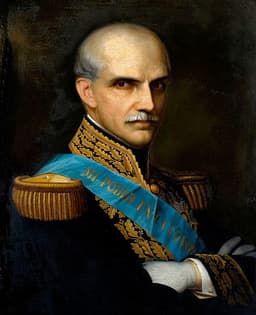
Gabriel Garcia Moreno
Politician · Modern
49.3Total

R. Venkataraman
Politician · Modern
54.6Total
Basic Information
Born
1821
1910
Died
1875
2009
Era
Modern
Modern
Nationality
Ecuador
India
Occupation
Politician
Politician
Civilization
Western
Indian
Score Comparison
Military (10%)
21.2
36.7
Political (20%)
62.7
62.7
Influence (20%)
54.9
55.7
Legacy (20%)
47.5
46.7
Leadership (15%)
53.2
66.0
Strategy (15%)
42.3
60.0
TOTAL
49.3
54.6
Gabriel Garcia Moreno — Complete Timeline
1861 AD
Modernization of InfrastructureReform
García Moreno initiated major infrastructure projects, including the construction of roads, bridges, and the Quito-Guayaquil railway. These projects aimed to integrate Ecuador's regions and boost economic development, though they were financed through heavy borrowing.
InfrastructureRailwayDevelopment
Impact: nationalconstructive
Presidency of EcuadorPolitical Action◆ Major
García Moreno was elected President of Ecuador in 1861, serving until 1865 and again from 1869 to 1875. His administrations were characterized by authoritarian rule, centralization of power, and a strong alliance with the Catholic Church.
PresidencyAuthoritarianismCatholicism
Impact: national
1862 AD
Concordat with the VaticanPolitical Action◆ Major
García Moreno signed a concordat with the Vatican in 1862, granting the Catholic Church control over education and religious affairs in Ecuador. This agreement strengthened church-state ties and made Ecuador a confessional state, aligning with his conservative ideology.
Church-State RelationsConcordatCatholicism
Impact: national
1869 AD
Suppression of Liberal OppositionPolitical Action◆ Major
After returning to power in 1869, Garc
RepressionAuthoritarianismConstitution
Impact: nationaldestructive
1875 AD
Assassination of Gabriel García MorenoPolitical Action
García Moreno was assassinated on August 6, 1875, on the steps of the presidential palace in Quito. His death was carried out by liberal opponents, ending his conservative regime and plunging Ecuador into a period of political instability.
AssassinationPolitical ViolenceEnd of Regime
Impact: nationaltragic
R. Venkataraman — Complete Timeline
1980 AD
Appointed Minister of FinancePolitical Action◆ Major
R. Venkataraman was appointed as India's Finance Minister under Prime Minister Indira Gandhi. He presented the Union Budget and focused on economic stabilization during a period of high inflation.
FinanceBudgetCongress
Impact: nationalconstructive
1982 AD
Appointed Defence MinisterPolitical Action◆ Major
R. Venkataraman was appointed as India's Defence Minister, overseeing the modernization of the Indian armed forces. He served during the Sri Lankan civil war and India's peacekeeping mission there.
DefenceMilitaryCongress
Impact: nationalconstructive
1987 AD
Elected President of IndiaPolitical Action◆ Major
R. Venkataraman was elected as the 8th President of India, serving from 1987 to 1992. His presidency coincided with the rise of coalition governments and the end of Congress dominance.
PresidencyElectionCoalition
Impact: nationalconstructive
1989 AD
Presided over formation of V.P. Singh governmentPolitical Action◆ Major
President R. Venkataraman invited V.P. Singh to form the government after the 1989 general election, leading to the first non-Congress coalition government at the centre. This marked a shift in Indian politics.
CoalitionGovernment FormationConstitutional
Impact: national
1998 AD
Awarded Bharat RatnaCultural◆ Major
R. Venkataraman was awarded the Bharat Ratna, India's highest civilian award, in recognition of his distinguished service as a statesman and president. The award was conferred by the Government of India.
AwardHonorCivilian
Impact: nationalconstructive
Expert Analysis
Origins
Gabriel Garcia Moreno was born on December 24, 1821, in Guayaquil, Ecuador, into a prominent Spanish-descended family. He studied law at the University of Quito, earning his doctorate in 1844. His early career included journalism and political activism, strongly influenced by his devout Catholic faith. Moreno's formative years coincided with Ecuador's turbulent post-independence period, marked by regional conflicts and weak central authority.
Ramaswamy Venkataraman was born on December 4, 1910, in Rajamadam, Madras Presidency, British India, into a Tamil Brahmin family. He studied law at the University of Madras and was deeply influenced by the Indian independence movement. Venkataraman began his career as a lawyer and later became involved in politics through the Indian National Congress. His early life was shaped by the struggle against colonial rule and the vision of a secular, democratic India.
Rise to Power
Garcia Moreno entered politics in the 1850s, serving as a senator and later as a delegate to the Constitutional Convention of 1850. He emerged as a leader of the Conservative Party, opposing liberal reforms. His major turning point came in 1860 when he led a successful rebellion against the liberal government of President Francisco Robles. In 1861, he was elected president, consolidating power through a new constitution that strengthened the executive.
Venkataraman rose through the ranks of the Indian National Congress. He served as a member of the Constituent Assembly (1946-1950) and later held various ministerial positions in independent India. His ascent was steady: he became a Rajya Sabha member in 1950, served as Union Minister of Finance (1980-1982) and Defence Minister (1982-1984). His key turning point was his election as the eighth President of India in 1987, a largely ceremonial role that gained political significance during coalition politics.
Leadership & Governance
Garcia Moreno governed Ecuador with an authoritarian hand, prioritizing Catholic orthodoxy and central control. He signed a concordat with the Vatican in 1862, giving the Church control over education. He suppressed liberal opposition through censorship, exile, and execution. His regime modernized infrastructure, building roads and the Quito-Guayaquil railway, but at the cost of political freedom. His political score of 62.7 reflects his effective consolidation of power, but his strategy score of 42.3 indicates rigid ideological governance.
Venkataraman, in contrast, presided over a democratic system. As president, he played a key role in forming governments after hung parliaments, notably inviting V.P. Singh in 1989. His leadership was characterized by constitutional propriety and consensus-building. As finance minister, he focused on economic stability, and as defence minister, he modernized the armed forces. His leadership score of 66.0 and strategy score of 60.0 reflect his pragmatic, rule-bound approach. However, his influence was limited by the ceremonial nature of the presidency, scoring 55.7.
Triumph & Tragedy
Garcia Moreno's greatest success was unifying Ecuador under a strong central government and advancing infrastructure. However, his authoritarianism and suppression of dissent created deep divisions. His tragic end came on August 6, 1875, when he was assassinated on the steps of the presidential palace by liberal opponents, a violent death that underscored the failure of his repressive policies.
Venkataraman's triumph was his role in stabilizing India's coalition politics during a turbulent period. He was awarded the Bharat Ratna, India's highest civilian award, for his statesmanship. His tragedy is that his legacy is relatively obscure; his presidency is often overshadowed by more charismatic leaders. His military score of 36.7 reflects limited direct involvement in security matters.
Character & Destiny
Garcia Moreno was a devout Catholic who believed his rule was divinely ordained. His inflexible character led him to oppose any liberal reform, making him a polarizing figure. This rigidity ultimately sealed his fate: his assassination was a direct result of his uncompromising stance.
Venkataraman was a meticulous legal mind, valuing process over personality. His calm, measured demeanor helped him navigate India's fractious politics. His destiny was to be a steady hand during transitions, but his lack of personal ambition meant he did not leave a distinct ideological mark.
Legacy
Garcia Moreno's legacy is deeply contested. To his supporters, he is a defender of Catholic values and a nation-builder. To critics, he is a theocratic dictator. His infrastructure projects endured, but his political model died with him. His total score of 49.3 reflects a polarizing figure with limited lasting influence.
Venkataraman's legacy is that of a constitutional guardian. He is remembered for upholding democratic norms during India's shift to coalition politics. The Bharat Ratna and his role in the V.P. Singh government are his key contributions. His total score of 54.6 indicates a modest but positive impact.
Conclusion
While both figures operated in different contexts, R. Venkataraman had a greater overall impact due to his role in preserving democratic stability in the world's largest democracy. His political and leadership scores (62.7 and 66.0) match or exceed Garcia Moreno's, and his strategy score (60.0) is significantly higher. Garcia Moreno's authoritarianism and religious extremism limited his legacy, whereas Venkataraman's constitutionalism had enduring value. Therefore, R. Venkataraman emerges as the more effective and influential leader.
Rankings
🥇
R. VenkataramanLeader
Mil: 36.7Pol: 62.7Inf: 55.7
54.6
🥈
Gabriel Garcia Moreno
Mil: 21.2Pol: 62.7Inf: 54.9
49.3
+5.3 behind
How This Comparison Works
Algorithm
Each figure is scored on 6 dimensions (0—100 scale) based on structured historical data: Military (10%), Political (20%), Influence (20%), Legacy (20%), Leadership (15%), Strategy (15%). The weighted total produces the final ranking.
Data Sources
Scores are computed from structured sub-indicators in the database. Scale factors adjust for era (Ancient ×0.85, Modern ×1.0) and civilization size (Eastern ×1.05, Other ×0.80) to account for differences in population and military scale.
Maximum 3 Figures
Comparisons are limited to 2—3 figures to ensure readability and statistical meaningfulness.
Error Margins
±5 points per dimension — Sub-scores are derived from historical records with inherent uncertainty. Two figures within 5 points on a dimension should be considered roughly equivalent in that area.
Total Score Accuracy
±3 points overall — The weighted combination of 6 dimensions produces a total score with approximately ±3 points of uncertainty. Differences of less than 3 points are not statistically significant— the figures are effectively tied.
Known Limitations
- Historical records are incomplete and uneven across civilizations
- Figures from oral-tradition societies may be underrepresented
- Occupation labels can misclassify multi-role figures
- Scores measure capability and impact, not moral character
- Quantitative scoring is a comparison tool, not absolute truth
Capability Radar
Military (10%) — Battles & Warfare
Battles
20
45
Win Rate
25
49
Expansion
15
47
Political (20%) — Governance & Reform
Reform
70
55
Diplomacy
40
65
Economy
60
50
Influence (20%) — Cultural & Global Reach
Cultural
40
30
Global
30
35
Legacy (20%) — Historical Impact
Historical
50
40
Longevity
35
30
Leadership (15%) — Power & Stability
Tenure
55
60
Stability
45
55
Strategy (15%) — Tactics & Innovation
Strategy
20
55
Tactics
15
55
Reform
30
56
Similar Comparisons
Comments & Discussion
No comments yet. Be the first to share your thoughts!