Loading...
Gabriel Garcia Moreno vs Napoleon Bonaparte
Napoleon Bonaparte leads by 21.6 pts · 2 figures compared
…
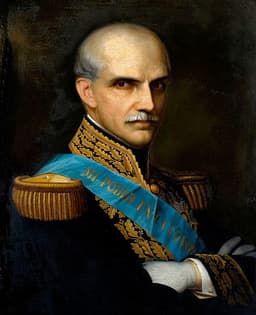
Gabriel Garcia Moreno
Politician · Modern
49.3Total

Napoleon Bonaparte
General · Modern
70.9Total
Basic Information
Born
1821
1769
Died
1875
1821
Era
Modern
Modern
Nationality
Ecuador
France
Occupation
Politician
General
Civilization
Western
Western
Score Comparison
Military (10%)
21.2
94.0
Political (20%)
62.7
72.0
Influence (20%)
54.9
40.0
Legacy (20%)
47.5
80.0
Leadership (15%)
53.2
78.0
Strategy (15%)
42.3
90.0
TOTAL
49.3
70.9
Gabriel Garcia Moreno — Complete Timeline
1861 AD
Modernization of InfrastructureReform
García Moreno initiated major infrastructure projects, including the construction of roads, bridges, and the Quito-Guayaquil railway. These projects aimed to integrate Ecuador's regions and boost economic development, though they were financed through heavy borrowing.
InfrastructureRailwayDevelopment
Impact: nationalconstructive
Presidency of EcuadorPolitical Action◆ Major
García Moreno was elected President of Ecuador in 1861, serving until 1865 and again from 1869 to 1875. His administrations were characterized by authoritarian rule, centralization of power, and a strong alliance with the Catholic Church.
PresidencyAuthoritarianismCatholicism
Impact: national
1862 AD
Concordat with the VaticanPolitical Action◆ Major
García Moreno signed a concordat with the Vatican in 1862, granting the Catholic Church control over education and religious affairs in Ecuador. This agreement strengthened church-state ties and made Ecuador a confessional state, aligning with his conservative ideology.
Church-State RelationsConcordatCatholicism
Impact: national
1869 AD
Suppression of Liberal OppositionPolitical Action◆ Major
After returning to power in 1869, Garc
RepressionAuthoritarianismConstitution
Impact: nationaldestructive
1875 AD
Assassination of Gabriel García MorenoPolitical Action
García Moreno was assassinated on August 6, 1875, on the steps of the presidential palace in Quito. His death was carried out by liberal opponents, ending his conservative regime and plunging Ecuador into a period of political instability.
AssassinationPolitical ViolenceEnd of Regime
Impact: nationaltragic
Napoleon Bonaparte — Complete Timeline
1799 AD
Coup of 18 BrumaireOther◆ Major
Napoleon Bonaparte, with support from his brother Lucien and key political figures, overthrew the Directory in a bloodless coup. He established the Consulate with himself as First Consul, effectively becoming the ruler of France. This event ended the French Revolution's most unstable period.
French RevolutionCoupRise to Power
Impact: regional
1804 AD
Promulgation of the Napoleonic CodeOther◆ Major
Napoleon enacted the Civil Code of the French, known as the Napoleonic Code, a comprehensive set of laws that replaced the fragmented feudal legal systems. The code established legal equality, protected property rights, and secularized law. It became the basis for legal systems in many European and world countries.
Legal ReformNapoleonic CodeCivil Law
Impact: globalconstructive
1805 AD
Battle of AusterlitzWar◆ Major
Napoleon's Grande Arm
Napoleonic WarsBattleDecisive Victory
Impact: global
1812 AD
Invasion of RussiaWar◆ Major
Napoleon led the Grande Arm
Napoleonic WarsInvasionDisaster
Impact: globaldestructive
1815 AD
Battle of WaterlooWar◆ Major
Napoleon's French army was defeated by the combined forces of the Duke of Wellington's Anglo-Allied army and Gebhard Leberecht von Bl
Napoleonic WarsBattleFinal Defeat
Impact: globaldestructive
Expert Analysis
gabriel-garcia-moreno-vs-napoleon-bonaparte
# The Conqueror and the Theocrat
On a June morning in 1815, Napoleon Bonaparte stood on a muddy field near Waterloo, watching his Imperial Guard march into cannon fire for the last time. Half a century later and an ocean away, on an August evening in 1875, Gabriel García Moreno knelt on the steps of his presidential palace in Quito, struck down by machete-wielding assassins. One died in exile, a prisoner of the British on a remote Atlantic island. The other died in prayer, his last words reportedly "God does not die." Both men sought to reshape their worlds through sheer force of will—yet their paths, their triumphs, and their ruins could not have been more different.
Origins
Napoleon Bonaparte was born in 1769 on Corsica, an island that had just passed from Italian to French control. His family was minor nobility, poor enough that young Napoleon wore hand-me-down uniforms at military academy, mocked by wealthier classmates for his accent and provincial manners. The French Revolution, which erupted when he was twenty, was his great opportunity—it swept away the old aristocracy and opened command to talent. He was a child of upheaval, shaped by chaos and hunger for order.
Gabriel García Moreno was born in 1821 in Guayaquil, Ecuador, the same year Napoleon died. His father was a Spanish merchant, his mother from a Creole family. Ecuador had just won independence from Spain, and the new nation was fractured between coastal liberals and highland conservatives. García Moreno studied law in Quito and theology in Europe, returning home with a single burning conviction: only the Catholic Church could hold his fragmented country together. Where Napoleon saw himself as the heir of the Revolution, García Moreno saw himself as the sword of the Counter-Reformation.
Rise to Power
Napoleon's ascent was meteoric and military. At twenty-four, he drove the British out of Toulon. At twenty-six, he crushed a royalist uprising in Paris with a "whiff of grapeshot." At twenty-seven, he led a ragged army across the Alps into Italy and won six victories in as many months. His political genius matched his military brilliance: he understood that in post-revolutionary France, legitimacy came from success, not birth. By 1799, he staged a coup and made himself First Consul. By 1804, he crowned himself Emperor in Notre Dame, taking the crown from the Pope's hands and placing it on his own head.
García Moreno's rise was slower and more political. He entered public life as a journalist and mayor of Quito, then served as senator and diplomat. In 1861, at age forty, he was elected president of Ecuador—a country so unstable that it had seen sixteen presidents in its first thirty years. His path was not conquest but persuasion, not battlefield glory but constitutional maneuvering. Where Napoleon seized power, García Moreno was voted into it, though he would rewrite the constitution to suit his purposes once elected.
Leadership & Governance
Napoleon governed through energy, speed, and centralization. He reformed French law into the Napoleonic Code, a clear, rational system that abolished feudal privileges and established equality before the law. He built roads, standardized education, created the Bank of France, and negotiated the Concordat of 1801 with the Pope—restoring religious peace after the Revolution's anti-clerical excesses. His military strategy was revolutionary: he used rapid marches, concentrated artillery, and the corps system to defeat larger armies. At Austerlitz in 1805, he destroyed a combined Russian and Austrian force with a feigned retreat that remains a textbook maneuver. His political score of 75.0 reflects genuine administrative genius—but also a fatal arrogance that made enemies of entire nations.
García Moreno governed through faith, infrastructure, and repression. He built the first road connecting Quito to Guayaquil, opened the first railway, established technical schools, and balanced Ecuador's budget for the first time. He signed a concordat with the Vatican in 1862, giving the Church control over education and requiring that presidents be Catholic. He suppressed liberal opposition with censorship and exile. His military score of 13.3 is almost comically low compared to Napoleon's 94.0—he was no soldier—but his political score of 82.5 reflects a coherent vision. He believed that democracy without virtue was anarchy, and that virtue required a moral authority higher than the state.
Triumph & Tragedy
Napoleon's greatest triumph was the Empire at its height in 1810—from Spain to Poland, from the Baltic to the Adriatic, he had remade Europe. His greatest tragedy was the invasion of Russia in 1812. He marched 600,000 men into the Russian winter; fewer than 100,000 came back. He never recovered. Exiled to Elba, he escaped, raised another army, and met his final defeat at Waterloo in 1815. His leadership score of 80.0 captures his brilliance—and his inability to stop when winning.
García Moreno's triumph was the relative stability he brought to Ecuador. By 1875, he had built roads, schools, and a functioning treasury. His tragedy was that his methods bred hatred. On August 6, 1875, as he left the cathedral after Mass, a group of liberal assassins attacked him with knives and machetes. He died on the palace steps, having reportedly said, "God does not die." His death plunged Ecuador back into chaos.
Character & Destiny
Napoleon was restless, brilliant, and insatiable. "I am not a man," he once said, "I am a thing." He saw himself as the instrument of history, driven by ambition that had no limit. His character was his destiny: the same energy that conquered Europe also destroyed his empire. He could not stop, could not share power, could not accept that any force—weather, distance, national sentiment—could resist his will.
García Moreno was devout, disciplined, and uncompromising. He saw himself as the instrument of God. "I would rather die than consent to the triumph of impiety," he wrote. His character was also his destiny: the same faith that gave him the courage to reform his country also made him a target. He could not compromise with secular liberalism, could not tolerate opposition, could not see that his vision of a Catholic state was as absolute as Napoleon's vision of a European empire.
Legacy
Napoleon left the Napoleonic Code, the modern French state, and a template for military strategy studied in every war college. His legacy score of 78.0 is complicated—he is remembered as both liberator and tyrant, genius and cautionary tale. His name still appears in histories, novels, films, and arguments about power.
García Moreno left a legacy of Catholic nationalism that still divides Ecuador. His score of 65.3 reflects a figure revered by conservatives as a saintly reformer and reviled by liberals as a theocratic dictator. He is less known outside Latin America, but within it, he represents a persistent question: can a nation be built on religious unity, and at what cost?
Conclusion
Standing at the distance of two centuries, what strikes the observer is not how different these men were, but how similar in their fundamental conviction: that one man's will, rightly applied, could remake a world. Napoleon's world was Europe, García Moreno's was Ecuador, but both believed in the power of a single, determined soul to impose order on chaos. One died in a cold Atlantic exile, the other on blood-soaked palace steps. One conquered an empire and lost it; the other built a nation and died for it. Neither succeeded in the way they intended—but both left marks that centuries have not erased. Perhaps the deepest lesson is not about power or faith, but about the tragic grandeur of human ambition, which drives men to remake the world even when the world refuses to be remade.
Rankings
🥇
Napoleon BonaparteLeader
Mil: 94.0Pol: 72.0Inf: 40.0
70.9
🥈
Gabriel Garcia Moreno
Mil: 21.2Pol: 62.7Inf: 54.9
49.3
+21.6 behind
How This Comparison Works
Algorithm
Each figure is scored on 6 dimensions (0—100 scale) based on structured historical data: Military (10%), Political (20%), Influence (20%), Legacy (20%), Leadership (15%), Strategy (15%). The weighted total produces the final ranking.
Data Sources
Scores are computed from structured sub-indicators in the database. Scale factors adjust for era (Ancient ×0.85, Modern ×1.0) and civilization size (Eastern ×1.05, Other ×0.80) to account for differences in population and military scale.
Maximum 3 Figures
Comparisons are limited to 2—3 figures to ensure readability and statistical meaningfulness.
Error Margins
±5 points per dimension — Sub-scores are derived from historical records with inherent uncertainty. Two figures within 5 points on a dimension should be considered roughly equivalent in that area.
Total Score Accuracy
±3 points overall — The weighted combination of 6 dimensions produces a total score with approximately ±3 points of uncertainty. Differences of less than 3 points are not statistically significant— the figures are effectively tied.
Known Limitations
- Historical records are incomplete and uneven across civilizations
- Figures from oral-tradition societies may be underrepresented
- Occupation labels can misclassify multi-role figures
- Scores measure capability and impact, not moral character
- Quantitative scoring is a comparison tool, not absolute truth
Capability Radar
Military (10%) — Battles & Warfare
Battles
20
95
Win Rate
25
90
Expansion
15
95
Political (20%) — Governance & Reform
Reform
70
95
Diplomacy
40
80
Economy
60
85
Influence (20%) — Cultural & Global Reach
Cultural
40
85
Global
30
90
Legacy (20%) — Historical Impact
Historical
50
95
Longevity
35
90
Leadership (15%) — Power & Stability
Tenure
55
85
Stability
45
70
Strategy (15%) — Tactics & Innovation
Strategy
20
95
Tactics
15
98
Reform
30
92
Similar Comparisons
Comments & Discussion
NapoleonRules6/17/2026
Calling this a comparison is like comparing a hurricane to a church bell. Napoleon reshaped the map of Europe, codified laws that still govern millions, and almost conquered a continent. García Moreno? He turned Ecuador into a theocratic police state and got hacked to death outside his own cathedral. One altered the course of history; the other is a footnote in a Spanish-language textbook. Waterloo at least gave us drama.
历史计量师6/17/2026
拿破仑打了60场战役,加西亚·莫雷诺打了0场。数据不会说谎。前者从科西嘉穷小子做到欧洲霸主,后者一辈子没出过安第斯山脉方圆几百公里。拿一个大陆征服者和一个地方宗教狂热者比较,就像拿鲸鱼和蝌蚪比游泳。莫雷诺连自己的首都秩序都维持不了,最后死在自家台阶上,拿破仑却让整个欧洲发抖。
ClassicistQuill6/17/2026
Both were reactionaries in disguise. Napoleon restored the monarchy and crowned himself emperor while preaching revolutionary ideals; García Moreno literally wanted to be the Pope’s viceroy in the Andes. But here’s the irony: Napoleon’s civil code secularized Europe, while Moreno’s constitution made Catholicism the only legal faith. One created modern bureaucracy, the other built a confessional state. Which legacy do you want to live under?
塞外孤狼6/17/2026
你们都在夸拿破仑,可别忘了他的结局——圣赫勒拿岛上囚徒,连矛尖的铜都被英国刮走。莫雷诺至少死得像个人,跪在教堂前喊“上帝不死”。拿破仑的帝国不是沙子堆的吗?维也纳会议后一切回到起点。莫雷诺的“天主教国家”梦想虽然荒诞,但至少他真信。拿破仑信什么?权力。最后权力抛弃了他。
ModernEagle6/17/2026
Let’s be blunt: García Moreno was a medieval throwback in a world that was industrializing and secularizing. Napoleon, for all his flaws, dragged Europe into modern statehood—centralized administration, meritocracy, secular law. Moreno executed liberals, censored science, and wanted Ecuador to be a Vatican satellite. If you’re ranking by historical impact, it’s not even close. Napoleon is top-tier; Moreno is regional trivia with a tragic ending.