Loading...
Galba vs Ptolemy XIII
Ptolemy XIII leads by 5.2 pts · 2 figures compared
…
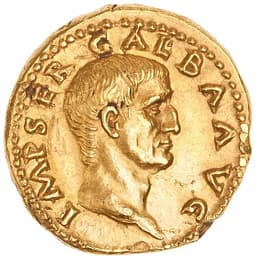
Galba
Emperor · Ancient
33.8Total
Ptolemy XIII
Emperor · Ancient
39.0Total
Basic Information
Born
-3
-62
Died
69
-47
Era
Ancient
Ancient
Nationality
Roman Empire
Egypt
Occupation
Emperor
Emperor
Civilization
Western
Middle Eastern
Score Comparison
Military (10%)
22.6
47.5
Political (20%)
27.9
27.9
Influence (20%)
42.4
42.4
Legacy (20%)
35.0
32.5
Leadership (15%)
36.9
49.9
Strategy (15%)
25.0
38.6
TOTAL
33.8
39.0
Galba — Complete Timeline
68 AD
Proclamation as EmperorPolitical Action◆ Major
Galba was proclaimed emperor by the Roman Senate after the suicide of Nero. He was governor of Hispania Tarraconensis and had rebelled against Nero. His accession ended the Julio-Claudian dynasty and began the Year of the Four Emperors.
Year of the Four EmperorsNeroProclamation
Impact: national
69 AD
Assassination of GalbaPolitical Action◆ Major
Galba was murdered by Praetorian Guards in the Roman Forum after adopting Lucius Calpurnius Piso as his successor. His unpopularity and failure to pay the Praetorians led to his overthrow by Otho. This event triggered a series of civil wars.
AssassinationPraetorian GuardOtho
Impact: nationaltragic
Ptolemy XIII — Complete Timeline
51 BC
Accession as Co-Ruler of EgyptPolitical Action◆ Major
Ptolemy XIII became co-ruler of Egypt with his older sister Cleopatra VII after the death of their father Ptolemy XII. He was about 11 years old, and his advisors quickly marginalized Cleopatra. This led to a power struggle between the siblings.
AccessionCo-RulershipPower Struggle
Impact: regional
48 BC
Involvement in the Alexandrian WarWar◆ Major
Ptolemy XIII's forces besieged Julius Caesar and Cleopatra VII in the royal palace of Alexandria. The conflict, known as the Alexandrian War, lasted several months. Ptolemy's army was eventually defeated by Roman reinforcements.
SiegeAlexandrian WarCaesar
Impact: regionaldestructive
Expulsion of Cleopatra VIIPolitical Action◆ Major
Ptolemy XIII's advisors, led by the eunuch Pothinus, expelled Cleopatra VII from Alexandria. She fled to Syria and raised an army to reclaim the throne. This act triggered a civil war in Egypt and drew the attention of Julius Caesar.
ExpulsionCivil WarRoman Intervention
Impact: regionaldestructive
47 BC
Death at the Battle of the NileWar◆ Major
Ptolemy XIII drowned in the Nile River while attempting to flee after his defeat at the Battle of the Nile. His death ended the civil war and allowed Cleopatra VII to become sole ruler of Egypt, with Caesar's support.
BattleDeathCleopatra VII
Impact: regionaltragic
Expert Analysis
Origins
Galba was born in 3 BC into an ancient patrician family, the Sulpicii. His father, Gaius Sulpicius Galba, was a consul and historian. Galba was raised by his stepmother Livia Ocellina after his father's death. He inherited vast wealth and was known for his strict discipline and frugality. He served as praetor and governor of Aquitania, and later as consul in 33 AD. His military career included commanding legions in Upper Germany and serving as governor of Africa.
Ptolemy XIII was born around 61 BC, the son of Ptolemy XII Auletes. He was a member of the Ptolemaic dynasty, of Macedonian Greek descent. His father was a weak ruler who relied on Roman support. Ptolemy XIII became co-ruler with his older sister Cleopatra VII after their father's death in 51 BC. He was about 11 years old, while Cleopatra was 18. The young pharaoh was controlled by a group of powerful advisors, including the eunuch Pothinus and the general Achillas.
Rise to Power
Galba rose to prominence through a combination of noble birth, competent administration, and military command. He gained favor with Emperor Claudius, who appointed him governor of Africa in 45 AD. He later served as governor of Hispania Tarraconensis under Nero. In 68 AD, after Nero's suicide, Galba was proclaimed emperor by the Senate. He was the first emperor to be proclaimed by the Senate without being a member of the Julio-Claudian dynasty. His rise was swift, but he lacked the support of the Praetorian Guard and the legions.
Ptolemy XIII became pharaoh at age 11 due to his father's will, which stipulated joint rule with Cleopatra. However, his advisors quickly marginalized Cleopatra, expelling her from Alexandria in 48 BC. Cleopatra fled to Syria and raised an army. Ptolemy XIII's forces, led by Achillas, confronted Cleopatra's army at Pelusium. The conflict escalated when Julius Caesar arrived in Alexandria, seeking to collect debts owed by Ptolemy XII. Caesar attempted to mediate, but Ptolemy's advisors opposed Cleopatra's reinstatement. This led to the Alexandrian War, where Ptolemy's forces besieged Caesar and Cleopatra in the palace.
Leadership & Governance
Galba's leadership was marked by austerity and a lack of political acumen. He refused to pay the Praetorian Guard the promised donative, earning their enmity. He also alienated the legions by not rewarding them for their support. His governance focused on restoring discipline and punishing Nero's favorites, but he was indecisive and slow. He adopted Lucius Calpurnius Piso as his successor, a move that angered Otho, who had hoped to be adopted himself. Galba's political score of 27.9 reflects his inability to secure power.
Ptolemy XIII, being a minor, did not govern directly. His advisors, especially Pothinus, ran the administration. They pursued a policy of anti-Roman sentiment and sought to eliminate Cleopatra. Their governance was characterized by intrigue and miscalculation. They underestimated Caesar's military prowess and overestimated their own strength. Ptolemy's leadership score of 49.9 is higher than Galba's 36.9, but this is largely due to the military command of his generals.
Triumph & Tragedy
Galba's greatest success was his proclamation as emperor, ending the Julio-Claudian dynasty. He also managed to secure recognition from the Senate and most provinces. However, his failure to consolidate power led to his assassination after only seven months. His tragedy was his inability to adapt to the political realities of imperial Rome. His military score of 22.6 is the lowest among the emperors of the Year of the Four Emperors.
Ptolemy XIII's greatest success was expelling Cleopatra and initially resisting Caesar. He held the upper hand in the Alexandrian War for several months. However, his tragedy was his defeat and death at the Battle of the Nile in 47 BC, where he drowned at age 14. His military score of 47.5 reflects the strength of his forces, but his political score of 27.9 matches Galba's, showing similar ineptitude in strategy.
Character & Destiny
Galba was known for his strictness and frugality, but also for his cruelty and indecisiveness. He was described by Tacitus as 'capable of ruling if he had never ruled.' His character led to his downfall: he refused to buy loyalty, and his adoption of Piso alienated Otho, who then bribed the Praetorians to murder him. Galba's destiny was sealed by his inability to compromise.
Ptolemy XIII was a pawn of his advisors. His character is difficult to assess due to his youth, but his actions show a willingness to defy Rome. His destiny was tied to the power struggle between Cleopatra and Caesar. He chose war over diplomacy, leading to his death. His total score of 39.0 is slightly higher than Galba's 33.8, but both were ultimately failures.
Legacy
Galba's legacy is minimal. He is remembered as a transitional figure in the chaotic Year of the Four Emperors. His brief reign demonstrated the weakness of the Senate's authority and the importance of military support in imperial succession. His influence score of 42.4 is moderate, but his legacy score of 35.0 is low.
Ptolemy XIII's legacy is also limited. He is remembered as Cleopatra's brother and opponent. His death allowed Cleopatra to become sole ruler and ally with Caesar, leading to the end of the Ptolemaic dynasty. His influence score of 42.4 is identical to Galba's, but his legacy score of 32.5 is slightly lower. Neither left a lasting positive impact.
Conclusion
Between Galba and Ptolemy XIII, neither had a significant positive impact. However, based on the data, Ptolemy XIII scores higher overall (39.0 vs 33.8), largely due to his military score (47.5 vs 22.6). His involvement in the Alexandrian War and his confrontation with Caesar had more historical significance than Galba's seven-month reign. While both were failures, Ptolemy XIII's actions directly influenced the rise of Cleopatra and the Roman annexation of Egypt. Therefore, Ptolemy XIII had a greater impact, even if negative. Galba's rule was a footnote in Roman history, while Ptolemy XIII played a role in the end of the Ptolemaic kingdom.
Rankings
🥇
Ptolemy XIIILeader
Mil: 47.5Pol: 27.9Inf: 42.4
39.0
🥈
Galba
Mil: 22.6Pol: 27.9Inf: 42.4
33.8
+5.2 behind
How This Comparison Works
Algorithm
Each figure is scored on 6 dimensions (0—100 scale) based on structured historical data: Military (10%), Political (20%), Influence (20%), Legacy (20%), Leadership (15%), Strategy (15%). The weighted total produces the final ranking.
Data Sources
Scores are computed from structured sub-indicators in the database. Scale factors adjust for era (Ancient ×0.85, Modern ×1.0) and civilization size (Eastern ×1.05, Other ×0.80) to account for differences in population and military scale.
Maximum 3 Figures
Comparisons are limited to 2—3 figures to ensure readability and statistical meaningfulness.
Error Margins
±5 points per dimension — Sub-scores are derived from historical records with inherent uncertainty. Two figures within 5 points on a dimension should be considered roughly equivalent in that area.
Total Score Accuracy
±3 points overall — The weighted combination of 6 dimensions produces a total score with approximately ±3 points of uncertainty. Differences of less than 3 points are not statistically significant— the figures are effectively tied.
Known Limitations
- Historical records are incomplete and uneven across civilizations
- Figures from oral-tradition societies may be underrepresented
- Occupation labels can misclassify multi-role figures
- Scores measure capability and impact, not moral character
- Quantitative scoring is a comparison tool, not absolute truth
Capability Radar
Military (10%) — Battles & Warfare
Battles
10
5
Win Rate
10
5
Expansion
5
0
Political (20%) — Governance & Reform
Reform
5
0
Diplomacy
10
10
Economy
5
5
Influence (20%) — Cultural & Global Reach
Cultural
5
5
Global
5
5
Legacy (20%) — Historical Impact
Historical
15
10
Longevity
5
5
Leadership (15%) — Power & Stability
Tenure
5
10
Stability
5
5
Strategy (15%) — Tactics & Innovation
Strategy
15
5
Tactics
15
5
Reform
5
0
Similar Comparisons
Comments & Discussion
No comments yet. Be the first to share your thoughts!