Loading...
Gaston Browne vs Julius Caesar
Julius Caesar leads by 33.1 pts · 2 figures compared
…
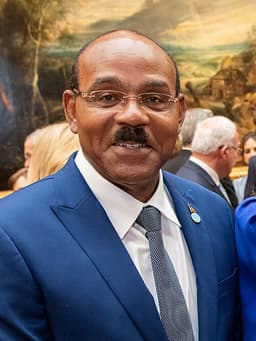
Gaston Browne
Politician · Modern
49.7Total

Julius Caesar
General · Ancient
82.8Total
Basic Information
Born
1967
-100
Died
—
-44
Era
Modern
Ancient
Nationality
Antigua and Barbuda
Roman Republic
Occupation
Politician
General
Civilization
Other
Western
Score Comparison
Military (10%)
24.9
88.0
Political (20%)
68.0
78.0
Influence (20%)
50.2
85.0
Legacy (20%)
40.0
82.0
Leadership (15%)
68.0
80.0
Strategy (15%)
42.9
85.0
TOTAL
49.7
82.8
Gaston Browne — Complete Timeline
1999 AD
Elected to Antigua and Barbuda ParliamentPolitical Action
Gaston Browne was elected to the Parliament of Antigua and Barbuda as a member of the Antigua Labour Party (ALP), beginning his political career. He had previously worked in banking.
ParliamentALPPolitical Career
Impact: national
2014 AD
Became Prime Minister of Antigua and BarbudaPolitical Action◆ Major
Gaston Browne led the ALP to victory in the 2014 general election, becoming Prime Minister. He succeeded Baldwin Spencer and focused on economic recovery and tourism.
Prime MinisterALPElection
Impact: nationalconstructive
2015 AD
Advocated for reparations for slaveryPolitical Action◆ Major
Browne became a vocal advocate for reparations for slavery from European nations. He raised the issue at CARICOM and international forums, calling for a formal apology and compensation.
ReparationsSlaveryCARICOM
Impact: regionalconstructive
2018 AD
Won 2018 general electionPolitical Action◆ Major
Browne led the ALP to a landslide victory in the 2018 general election, winning 15 of 17 seats. His government continued policies focused on tourism, investment, and social programs.
ElectionLandslideALP
Impact: nationalconstructive
2023 AD
Won 2023 general electionPolitical Action◆ Major
Browne led the ALP to a third consecutive victory in the 2023 general election, winning 9 of 17 seats. The election was marked by a reduced majority and continued economic challenges.
ElectionALPRe-election
Impact: national
Julius Caesar — Complete Timeline
58 BC
Gallic WarsWar◆ Major
Caesar, as proconsul of Gaul, launched a series of campaigns that conquered all of Gaul (modern France, Belgium, and parts of Switzerland). He fought numerous battles, including against the Helvetii, the Belgae, and the Gallic chieftain Vercingetorix. The wars brought immense wealth and a loyal army to Caesar.
Gallic WarsConquestRoman Expansion
Impact: regional
49 BC
Crossing the RubiconPolitical Action◆ Major
Caesar led Legio XIII across the Rubicon River into Italy, defying the Roman Senate's order to disband his army. This act triggered a civil war against Pompey and the Optimates, ultimately leading to Caesar's dictatorship and the end of the Roman Republic.
Roman Civil WarEnd of RepublicPower Struggle
Impact: global
48 BC
Battle of PharsalusWar◆ Major
Caesar's outnumbered army defeated the larger forces of Pompey the Great at Pharsalus in Greece. Caesar's tactical use of a reserve line to counter Pompey's cavalry charge proved decisive. Pompey fled to Egypt, where he was assassinated, leaving Caesar as the undisputed master of the Roman world.
Roman Civil WarBattleDecisive Victory
Impact: regional
44 BC
Appointment as Dictator for LifePolitical Action◆ Major
The Roman Senate appointed Caesar dictator perpetuo (dictator for life), granting him unprecedented personal power. This move concentrated military, legislative, and judicial authority in one person, effectively ending the Roman Republic's traditional system of checks and balances and alarming many senators.
DictatorshipEnd of RepublicPower Consolidation
Impact: regionaldestructive
Assassination on the Ides of MarchPolitical Action◆ Major
A group of Roman senators, led by Marcus Junius Brutus and Gaius Cassius Longinus, stabbed Caesar to death at a meeting of the Senate in the Theatre of Pompey. The assassination was intended to restore the Republic, but instead triggered another civil war that led to the rise of the Roman Empire.
AssassinationRoman PoliticsEnd of Republic
Impact: globaldestructive
Expert Analysis
gaston-browne-vs-julius-caesar
# The Crossing That Changed the World
On a January morning in 49 BCE, Julius Caesar stood at the banks of a small river in northern Italy called the Rubicon. He knew that crossing it with his army would mean civil war—an act of treason against the Roman Republic. He hesitated, then reportedly declared, *"Alea iacta est"*—the die is cast. He crossed. The world never looked back.
Two thousand years later, on a warm Caribbean afternoon in June 2014, Gaston Browne walked into the Parliament of Antigua and Barbuda as its newly sworn Prime Minister. There was no river to cross, no legions at his back. Only a mandate from a small island nation of fewer than 100,000 people. The contrast between these two men—one who toppled a republic, the other who won a peaceful election—is not merely a matter of scale. It is a story of how power, ambition, and circumstance shape history in radically different ways.
Origins
Julius Caesar was born into the patrician Julian clan, one of Rome's oldest families, but the Republic of the 1st century BCE was a violent, unstable place. His father died when Caesar was sixteen, and the young aristocrat was caught in the crossfire of Rome's civil wars. He fled the dictator Sulla's purges, lost his family fortune, and spent years as a fugitive. These early hardships forged a man who understood that survival required cunning, ruthlessness, and an unshakable belief in his own destiny.
Gaston Browne was born in 1967 in the port town of St. John's, Antigua, into a world far removed from Roman marble and bloodshed. He grew up in a modest household, the son of a domestic worker. The island had only recently gained independence from Britain in 1981, and its economy relied on tourism, sugar, and a lingering colonial hangover. Browne worked his way into banking, eventually becoming a manager at the Antigua and Barbuda Development Bank. Where Caesar learned to wield a sword, Browne learned to balance a ledger.
Rise to Power
Caesar's ascent was a masterpiece of strategic ambition. He forged the First Triumvirate with Pompey and Crassus, then secured the governorship of Gaul. Between 58 and 50 BCE, he conquered the entire region—modern France, Belgium, and parts of Switzerland—in a series of campaigns so brutal and brilliant that his own *Commentaries* remain military textbooks today. The Gallic Wars made him staggeringly rich, gave him a loyal army, and made him a legend. When the Senate ordered him to disband his forces, he refused. The Rubicon was the result.
Browne's path was quieter but no less determined. He was elected to Parliament in 1999 as a member of the Antigua Labour Party, then spent fifteen years in opposition, watching his party lose election after election. In 2014, at age 47, he led the ALP to victory, becoming Prime Minister. His rise was not a conquest but a campaign of patience, local politics, and economic messaging. He won again in 2018 with a landslide—15 of 17 seats—and secured a third term in 2023 in a closer race. His power came from the ballot box, not the battlefield.
Leadership & Governance
Caesar governed as a revolutionary. As dictator, he reformed the calendar (the Julian calendar we still use), granted citizenship to provincials, rebuilt Carthage and Corinth, and launched massive public works. His military genius was undeniable—he won the civil war against Pompey's larger forces through speed, deception, and audacity. But his political wisdom had limits. He centralized power, packed the Senate with his supporters, and accepted the title "dictator for life." This broke the Republic's fragile balance. The Senate, humiliated and fearful, conspired to kill him.
Browne governs as a pragmatist. He has focused on tourism development, debt reduction, and infrastructure. His most notable international move was advocating for reparations for slavery from European nations, raising the issue at CARICOM and international forums. His leadership score of 72.0 reflects solid but unspectacular governance. He has no military record to speak of—his score of 30.2 in that category is a reminder that modern democratic leaders rarely need to command armies. His strategy score of 56.4 suggests a cautious, incremental approach rather than grand gambles.
Triumph & Tragedy
Caesar's greatest triumph was the conquest of Gaul—annexing a territory larger than Italy itself. His most devastating failure was his own assassination on the Ides of March, 44 BCE, stabbed 23 times by senators he had pardoned. His last words, according to tradition, were *"Et tu, Brute?"*—a cry of betrayal. He died believing he had saved Rome, but his murder plunged the Republic into another civil war, from which his adopted heir Octavian emerged as the first emperor.
Browne's triumphs are quieter. He won three consecutive elections, a rare feat in Caribbean politics. He has kept his small nation stable and economically afloat. His tragedy? There is none yet—no assassination, no dramatic fall. He remains in power as of 2025. But his legacy is still being written, and the scale of his impact is necessarily limited by the size of his stage.
Character & Destiny
Caesar was driven by an almost supernatural confidence. He believed he was destined for greatness—his family claimed descent from the goddess Venus. He was generous to his soldiers, ruthless to his enemies, and incapable of sharing power. His personality made him brilliant but also blind: he could not imagine that the old Republic would fight back. His destiny was to destroy the very system that raised him.
Browne is a different breed. He is a technocrat, not a visionary. His personality is shaped by the constraints of democracy and the realities of a small island economy. He cannot cross a Rubicon because there is no Rubicon to cross—only budgets, elections, and international summits. His destiny is to manage, not to transform.
Legacy
Caesar's legacy is immeasurable. He ended the Roman Republic and began the Roman Empire. His name became a title—*Kaiser*, *Tsar*, *Caesar*—used by emperors for centuries. His military tactics are still studied. His assassination is one of history's most famous moments. His total score of 83.3 reflects a figure who changed the course of Western civilization.
Browne's legacy is local. He will be remembered as a competent prime minister of a small Caribbean nation, a voice for reparative justice, and a leader who kept his country stable in a volatile region. His score of 60.6 is respectable but modest. He is not a world-historical figure—and he never tried to be.
Conclusion
The difference between Caesar and Browne is not just one of time and place. It is a difference in the very nature of power. Caesar lived in an era when a single man could cross a river and change the fate of millions. Browne lives in an era when power is diffused, checked, and negotiated. Caesar's ambition was limitless; Browne's is contained by institutions and elections. One died by the sword; the other may retire peacefully.
Yet both men remind us that leadership is always a product of its age. Caesar could not have been a modern prime minister. Browne could not have conquered Gaul. The Rubicon, it turns out, is not a river you cross once. It is a question every leader must answer: How far will you go? Caesar went all the way, and it destroyed him. Browne went as far as his people allowed, and it sustained him. Which is the wiser path? History, as always, leaves us to decide.
Rankings
🥇
Julius CaesarLeader
Mil: 88.0Pol: 78.0Inf: 85.0
82.8
🥈
Gaston Browne
Mil: 24.9Pol: 68.0Inf: 50.2
49.7
+33.1 behind
How This Comparison Works
Algorithm
Each figure is scored on 6 dimensions (0—100 scale) based on structured historical data: Military (10%), Political (20%), Influence (20%), Legacy (20%), Leadership (15%), Strategy (15%). The weighted total produces the final ranking.
Data Sources
Scores are computed from structured sub-indicators in the database. Scale factors adjust for era (Ancient ×0.85, Modern ×1.0) and civilization size (Eastern ×1.05, Other ×0.80) to account for differences in population and military scale.
Maximum 3 Figures
Comparisons are limited to 2—3 figures to ensure readability and statistical meaningfulness.
Error Margins
±5 points per dimension — Sub-scores are derived from historical records with inherent uncertainty. Two figures within 5 points on a dimension should be considered roughly equivalent in that area.
Total Score Accuracy
±3 points overall — The weighted combination of 6 dimensions produces a total score with approximately ±3 points of uncertainty. Differences of less than 3 points are not statistically significant— the figures are effectively tied.
Known Limitations
- Historical records are incomplete and uneven across civilizations
- Figures from oral-tradition societies may be underrepresented
- Occupation labels can misclassify multi-role figures
- Scores measure capability and impact, not moral character
- Quantitative scoring is a comparison tool, not absolute truth
Capability Radar
Military (10%) — Battles & Warfare
Battles
20
95
Win Rate
24
92
Expansion
26
97
Political (20%) — Governance & Reform
Reform
50
90
Diplomacy
55
85
Economy
60
82
Influence (20%) — Cultural & Global Reach
Cultural
20
88
Global
20
94
Legacy (20%) — Historical Impact
Historical
20
95
Longevity
20
96
Leadership (15%) — Power & Stability
Tenure
55
75
Stability
50
60
Strategy (15%) — Tactics & Innovation
Strategy
32
94
Tactics
34
96
Reform
35
88
Similar Comparisons
Comments & Discussion
CaesarConqueror6/17/2026
This comparison is absurd. Browne won an election in a tiny nation of 90,000. Caesar crossed the Rubicon and sparked five centuries of empire. One's a footnote, the other's a seismic event. The only thing they share is ambition—but Caesar’s reshaped the known world. Browne's biggest legacy is a sand dredging scheme. Call me elitist, but history measures impact, not sentiment.
鲁比孔爷爷6/17/2026
拿高卢英雄传里的角色跟现实小岛政客比?凯撒跨过卢比孔河时是带着老兵军团去押注共和国的命脉,布朗不过是个在阁楼里签了一堆旅游合同的地方官。这就像拿亚历山大大帝跟村长比——不客观,甚至有点侮辱历史。别用“象征性”来糊弄我,真正的改变需要刀刃见血。
SkepticalMarcus6/17/2026
The claim that Caesar "toppled a republic" is overblown. The republic was already a corpse—corrupt, run by oligarchs. Caesar just gave it a shove. And Browne? His "peaceful election" occurred in a nation where politics is often dominated by family feuds and banana exports. Let's stop romanticizing both: one was a power-hungry general, the other a local power broker. Neither deserve epic framing.
青史钓客6/17/2026
你这对比最大的问题:把两个时空、权力完全不沾边的人硬拉到一块,无非想制造戏剧性。凯撒的野心是为个人权位,但客观上催生了罗马帝国的行政基础,比如历法改革和行省治理。布朗呢?他推动加勒比共同体合作不错,但说到底他治理的是个四十八万人的小岛国。凯撒是翻江倒海,布朗最多是划个小船,这能相提并论?别闹了。
LegionnaireLars6/17/2026
As a military historian, I can tell you this: Caesar’s crossing was a high-stakes gamble that required flawless logistics—moving 5,000 legionaries, cavalry, and supply lines across a swollen river in winter. Browne’s “crossing” into parliament was just a walk down a carpeted hallway. Scale matters. Ambition needs a stage. Caesar’s stage was the Mediterranean; Browne’s was a legislative chamber with stained carpets. No comparison.