Loading...
Gaston Browne vs Tulišen
Gaston Browne leads by 3.7 pts · 2 figures compared
…
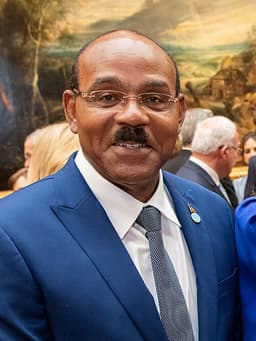
Gaston Browne
Politician · Modern
49.7Total

Tulišen
Politician · Modern
46.0Total
Basic Information
Born
1967
1667
Died
—
1741
Era
Modern
Modern
Nationality
Antigua and Barbuda
China
Occupation
Politician
Politician
Civilization
Other
Eastern
Score Comparison
Military (10%)
24.9
12.9
Political (20%)
68.0
43.7
Influence (20%)
50.2
57.2
Legacy (20%)
40.0
43.3
Leadership (15%)
68.0
62.2
Strategy (15%)
42.9
37.2
TOTAL
49.7
46.0
Gaston Browne — Complete Timeline
1999 AD
Elected to Antigua and Barbuda ParliamentPolitical Action
Gaston Browne was elected to the Parliament of Antigua and Barbuda as a member of the Antigua Labour Party (ALP), beginning his political career. He had previously worked in banking.
ParliamentALPPolitical Career
Impact: national
2014 AD
Became Prime Minister of Antigua and BarbudaPolitical Action◆ Major
Gaston Browne led the ALP to victory in the 2014 general election, becoming Prime Minister. He succeeded Baldwin Spencer and focused on economic recovery and tourism.
Prime MinisterALPElection
Impact: nationalconstructive
2015 AD
Advocated for reparations for slaveryPolitical Action◆ Major
Browne became a vocal advocate for reparations for slavery from European nations. He raised the issue at CARICOM and international forums, calling for a formal apology and compensation.
ReparationsSlaveryCARICOM
Impact: regionalconstructive
2018 AD
Won 2018 general electionPolitical Action◆ Major
Browne led the ALP to a landslide victory in the 2018 general election, winning 15 of 17 seats. His government continued policies focused on tourism, investment, and social programs.
ElectionLandslideALP
Impact: nationalconstructive
2023 AD
Won 2023 general electionPolitical Action◆ Major
Browne led the ALP to a third consecutive victory in the 2023 general election, winning 9 of 17 seats. The election was marked by a reduced majority and continued economic challenges.
ElectionALPRe-election
Impact: national
Tulišen — Complete Timeline
1712 AD
Led Diplomatic Mission to RussiaPolitical Action◆ Major
Tulišen led a Qing diplomatic mission to the Russian Empire and the Kalmyk Khanate in Central Asia. The mission aimed to secure alliances and gather intelligence on Russian activities. His journey was recorded in his travelogue, providing valuable geographic and cultural information.
DiplomacyExplorationQing-Russia Relations
Impact: regionalconstructive
1723 AD
Published 'Narrative of the Chinese Embassy to the Torguts'Cultural
Tulišen published a detailed account of his diplomatic mission to the Torgut Mongols and Russia. The work described the geography, customs, and political conditions of Central Asia and Siberia, becoming a key source for Qing knowledge of the region.
TravelogueGeographyCultural Exchange
Impact: regional
1725 AD
Appointed to the Grand CouncilPolitical Action◆ Major
Tulišen was appointed to the Grand Council, the highest policy-making body of the Qing Empire, under the Yongzheng Emperor. This position allowed him to influence foreign policy and military strategy.
AppointmentGovernmentYongzheng Era
Impact: national
Expert Analysis
Origins
Gaston Browne was born on February 9, 1967, in Potters Village, Antigua and Barbuda. He grew up in a modest household and later pursued a career in banking, working at the Antigua and Barbuda Investment Bank and becoming a senior executive. His background in finance shaped his pragmatic approach to governance. Browne entered politics as a member of the Antigua Labour Party (ALP), winning a seat in Parliament in 1999.
Tulišen (also known as Tulišen) was a Manchu official of the Qing dynasty, born in the late 17th century. He served under the Kangxi and Yongzheng emperors, rising through the ranks due to his administrative skills and knowledge of frontier affairs. His early career involved managing border issues and relations with Mongol tribes, which prepared him for diplomatic missions.
Rise to Power
Browne's political ascent began with his election to Parliament in 1999. He served in various ministerial roles, including Minister of Tourism and Civil Aviation, before challenging the party leadership. In 2014, he led the ALP to victory in the general election, defeating incumbent Prime Minister Baldwin Spencer. Browne won 15 of 17 seats, a landslide that reflected public desire for economic reform. He consolidated power by winning subsequent elections in 2018 (15 of 17 seats) and 2023 (9 of 17 seats), though the latter saw a reduced majority due to voter fatigue.
Tulišen rose to prominence as a diplomat under the Yongzheng Emperor. He was appointed to the Grand Council, the highest policy-making body, in 1725. His key achievement was leading a diplomatic mission to the Russian Empire and the Kalmyk Khanate in 1712-1715, which aimed to secure an alliance against the Dzungar Mongols. This mission demonstrated his strategic acumen and earned him imperial favor. However, his rise was limited by the hierarchical nature of the Qing bureaucracy; he never held supreme power.
Leadership & Governance
Browne's leadership style is characterized by directness and a focus on economic growth. He has prioritized tourism, infrastructure, and financial services, leveraging his banking expertise. For example, he implemented tax incentives for foreign investment and expanded the airport. Critics note his authoritarian tendencies, including crackdowns on press freedom and opposition. His governance scores 68.0 in political and 68.0 in leadership, reflecting effectiveness but also controversy.
Tulišen governed as a diplomat and administrator, not as a head of state. His leadership score of 62.2 reflects his competence in negotiation and intelligence-gathering. He published 'Narrative of the Chinese Embassy to the Torguts', a detailed account that provided the Qing court with valuable geographic and political data. However, his influence was constrained by the emperor's authority. His political score of 43.7 indicates limited independent power.
Triumph & Tragedy
Browne's greatest success is his electoral dominance: winning three consecutive general elections (2014, 2018, 2023) and maintaining stability in a small island nation. He also gained international attention for advocating reparations for slavery, raising the issue at CARICOM and UN forums. His failures include a declining majority in 2023, suggesting public discontent, and allegations of corruption. His total score of 49.7 reflects mixed achievements.
Tulišen's triumph was his successful mission to Russia and the Kalmyks, which improved Qing intelligence on Central Asia and delayed Dzungar expansion. His published account remains a valuable historical source. His tragedy lies in his limited legacy; after his death, his work was largely forgotten outside academic circles. His political score of 43.7 and legacy of 43.3 reflect this.
Character & Destiny
Browne is a confident, outspoken leader who thrives on confrontation. His banking background gives him a technocratic edge, but his combative style has alienated some allies. His destiny is tied to Antigua's economic performance; if tourism declines, his political future may falter. He has a strategy score of 42.9, indicating moderate long-term planning.
Tulišen was meticulous and observant, traits essential for a diplomat in a vast empire. His willingness to travel dangerous routes showed courage. However, his destiny was shaped by the Qing court's isolationist tendencies; his mission did not lead to a lasting alliance. His strategy score of 37.2 suggests limited impact on grand strategy.
Legacy
Browne's legacy is ongoing. He has modernized Antigua's economy and elevated its voice on reparations. If his policies sustain growth, he may be remembered as a transformative figure. Currently, his influence score of 50.2 and legacy of 40.0 are modest.
Tulišen's legacy is primarily historical. His narrative provides insight into 18th-century Sino-Russian relations. He is remembered by scholars but not widely known. His influence score of 57.2 is slightly higher than Browne's due to the enduring value of his writings.
Conclusion
Gaston Browne has had greater impact than Tulišen. Despite a modest total score of 49.7 versus 46.0, Browne wields tangible political power and shapes policy for a sovereign nation. Tulišen, while a skilled diplomat, operated within a rigid imperial system and left no lasting institutional change. Browne's electoral victories and advocacy for reparations demonstrate active influence, whereas Tulišen's legacy is passive. Thus, Browne's political and leadership scores (68.0 each) outweigh Tulišen's higher influence (57.2).
Rankings
🥇
Gaston BrowneLeader
Mil: 24.9Pol: 68.0Inf: 50.2
49.7
🥈
Tulišen
Mil: 12.9Pol: 43.7Inf: 57.2
46.0
+3.7 behind
How This Comparison Works
Algorithm
Each figure is scored on 6 dimensions (0—100 scale) based on structured historical data: Military (10%), Political (20%), Influence (20%), Legacy (20%), Leadership (15%), Strategy (15%). The weighted total produces the final ranking.
Data Sources
Scores are computed from structured sub-indicators in the database. Scale factors adjust for era (Ancient ×0.85, Modern ×1.0) and civilization size (Eastern ×1.05, Other ×0.80) to account for differences in population and military scale.
Maximum 3 Figures
Comparisons are limited to 2—3 figures to ensure readability and statistical meaningfulness.
Error Margins
±5 points per dimension — Sub-scores are derived from historical records with inherent uncertainty. Two figures within 5 points on a dimension should be considered roughly equivalent in that area.
Total Score Accuracy
±3 points overall — The weighted combination of 6 dimensions produces a total score with approximately ±3 points of uncertainty. Differences of less than 3 points are not statistically significant— the figures are effectively tied.
Known Limitations
- Historical records are incomplete and uneven across civilizations
- Figures from oral-tradition societies may be underrepresented
- Occupation labels can misclassify multi-role figures
- Scores measure capability and impact, not moral character
- Quantitative scoring is a comparison tool, not absolute truth
Capability Radar
Military (10%) — Battles & Warfare
Battles
20
12
Win Rate
24
19
Expansion
26
21
Political (20%) — Governance & Reform
Reform
50
20
Diplomacy
55
65
Economy
60
20
Influence (20%) — Cultural & Global Reach
Cultural
20
25
Global
20
30
Legacy (20%) — Historical Impact
Historical
20
30
Longevity
20
20
Leadership (15%) — Power & Stability
Tenure
55
30
Stability
50
30
Strategy (15%) — Tactics & Innovation
Strategy
32
21
Tactics
34
24
Reform
35
29
Similar Comparisons
Comments & Discussion
No comments yet. Be the first to share your thoughts!