Loading...
Geiseric vs Nectanebo I
Geiseric leads by 20.0 pts · 2 figures compared
…

Geiseric
Emperor · Ancient
74.7Total
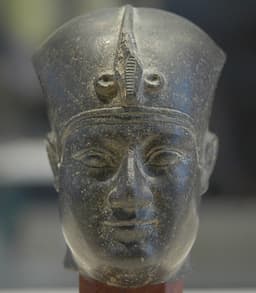
Nectanebo I
Emperor · Ancient
54.7Total
Basic Information
Born
389
-380
Died
477
-362
Era
Ancient
Ancient
Nationality
Vandals
Egypt
Occupation
Emperor
Emperor
Civilization
Western
Middle Eastern
Score Comparison
Military (10%)
65.0
55.0
Political (20%)
70.0
45.0
Influence (20%)
82.0
56.4
Legacy (20%)
72.0
48.3
Leadership (15%)
79.8
68.0
Strategy (15%)
72.0
60.7
TOTAL
74.7
54.7
Geiseric — Complete Timeline
439 AD
Conquest of CarthageWar
Geiseric captured Carthage from the Roman Empire, making it the capital of the Vandal Kingdom. This conquest gave the Vandals control of North Africa's grain supply and a powerful naval base, enabling Mediterranean raids.
ConquestNorth AfricaVandal Kingdom
Impact: regionaldestructive
442 AD
Treaty with the Roman EmpirePolitical Action◆ Major
Geiseric signed a treaty with the Roman Empire that recognized Vandal control over North Africa. The treaty granted the Vandals legitimacy and a period of peace, allowing Geiseric to consolidate his kingdom.
TreatyDiplomacyVandal Kingdom
Impact: regionalconstructive
455 AD
Sack of RomeWar
Geiseric led the Vandal fleet to Rome and sacked the city for 14 days. Unlike earlier barbarian sacks, the Vandals systematically looted treasures, including the spoils of the Temple of Jerusalem, and took hostages. This event symbolized the decline of Roman power.
Sack of RomeVandal KingdomRoman Decline
Impact: globaldestructive
468 AD
Battle of Cape BonWar◆ Major
Geiseric defeated a massive Roman fleet at Cape Bon using fireships. The victory destroyed the Roman attempt to reconquer North Africa, securing Vandal independence for decades.
Naval BattleRoman-Vandal WarDefense
Impact: regionalconstructive
Nectanebo I — Complete Timeline
380 BC
Foundation of the 30th dynastyPolitical Action◆ Major
Nectanebo I overthrew the Persian-backed ruler and established the 30th dynasty, the last native Egyptian dynasty. He seized power after the death of Pharaoh Nepherites II. This marked the beginning of a period of renewed Egyptian independence from Persian rule.
DynastyIndependencePersia
Impact: globalconstructive
373 BC
Defense against Persian invasion (373 BC)War◆ Major
Nectanebo I successfully repelled a Persian invasion led by Pharnabazus and Iphicrates. The Persian army was delayed by the flooding of the Nile and Egyptian defenses. The invasion failed due to poor coordination and the Egyptians' effective use of the terrain. This victory preserved Egyptian independence.
PersiaInvasionDefense
Impact: regional
370 BC
Construction of the temple of Isis at PhilaeCultural◆ Major
Nectanebo I began the construction of the temple of Isis at Philae, one of the most important religious sites in Egypt. The temple complex was expanded by later rulers and became a major center of the cult of Isis. This project demonstrated his patronage of traditional Egyptian religion.
TempleIsisReligion
Impact: regionalconstructive
Building program across EgyptCultural
Nectanebo I undertook an extensive building program, including additions to the temples at Karnak, Luxor, and Heliopolis. He also constructed a large naos for the temple of Amun at Karnak. These projects revived Egyptian monumental architecture after a period of decline.
ArchitectureTemplesRevival
Impact: nationalconstructive
Expert Analysis
Origins
Geiseric (c. 389–477 CE) was born into the royal family of the Hasdingi Vandals, a Germanic tribe that migrated across Europe. His early life was shaped by the Vandal journey from Pannonia to Gaul and then to Hispania. He was the son of King Godegisel and became king in 428 after the death of his half-brother Gunderic. Geiseric was known for his strategic mind and ruthless pragmatism, traits that would define his reign.
Nectanebo I (reigned 380–362 BCE) was a native Egyptian general from Sebennytos in the Nile Delta. He rose to power after the death of Nepherites II, the last pharaoh of the 29th dynasty. Egypt had been under Persian control for decades, and Nectanebo capitalized on the weakness of the Persian Empire to establish the 30th dynasty, the last native Egyptian dynasty before the conquests of Alexander the Great.
Rise to Power
Geiseric took the throne of the Vandals in 428 when the tribe was in southern Hispania. He quickly realized the vulnerability of the Vandals to Visigothic and Roman pressure. In 429, he led the entire Vandal people—estimated at 80,000—across the Strait of Gibraltar into North Africa. Over the next decade, he fought Roman forces and Berber tribes, capturing Hippo Regius in 431 after a 14-month siege. His decisive conquest of Carthage in 439 gave the Vandals a capital and control of the grain-rich province. This move transformed the Vandals from a nomadic tribe into a Mediterranean power.
Nectanebo I seized power in 380 BCE after the death of Nepherites II, who had ruled only four months. He was a general who defeated a rival named Muthis and was proclaimed pharaoh. His claim was challenged by the Persians, who had controlled Egypt intermittently since 525 BCE. To secure his throne, Nectanebo quickly fortified the eastern frontier and built alliances with Greek mercenaries and the Saite nobility. His rise was not the result of a long campaign but rather a swift coup that exploited the instability after the 29th dynasty.
Leadership & Governance
Geiseric ruled the Vandal Kingdom from 428 to 477. He established a centralized monarchy in Carthage, modeling his court on Roman imperial structures. He enforced Arian Christianity and suppressed Nicene Christians, confiscating church properties. He also built a powerful navy, which allowed him to raid coasts across the Mediterranean. His governance was pragmatic: he allowed Roman landowners to keep their estates if they paid tribute, but he also used forced labor for building projects. Geiseric's leadership scored 79.8 in leadership, reflecting his ability to hold together a diverse kingdom of Vandals, Romans, and Berbers.
Nectanebo I reigned for 18 years (380–362 BCE). He focused on restoring Egyptian cultural traditions and temple building. He initiated construction at the temple of Isis at Philae, which became a major religious center. He also added to the Karnak and Luxor temples. Politically, he maintained independence from Persia through a combination of diplomacy and military readiness. He employed Greek mercenaries, notably the Athenian general Chabrias, to train his army. However, his political score of 45.0 indicates limited success in expanding Egypt's influence beyond its borders.
Triumph & Tragedy
Geiseric's greatest triumph was the Sack of Rome in 455. Leading a fleet to Ostia, he captured the city and systematically looted it for 14 days, stripping it of treasures, including the Temple of Jerusalem spoils taken by Titus. This event cemented the Vandals' reputation. His greatest failure was the inability to hold onto Sicily and Sardinia permanently; his naval raids provoked Roman counterattacks that eventually weakened his kingdom. Also, his persecution of Catholics created internal divisions.
Nectanebo I's triumph was repelling the Persian invasion of 373 BCE. The Persian general Pharnabazus and the Athenian Iphicrates led a large army, but Nectanebo used the flooding Nile to delay them and then defeated them at the Battle of Mendes. His tragedy was that his dynasty did not last; his son Teos was overthrown in 360 BCE, and within a decade, Egypt fell to the Persians again. Nectanebo's building projects, while culturally significant, drained resources that could have strengthened the military.
Character & Destiny
Geiseric was calculating and ruthless. He was known for his strategic patience, waiting for the right moment to attack. He was also duplicitous, often breaking treaties when convenient. His decision to move the Vandals to Africa was a masterstroke that saved his people from extinction. His character shaped his destiny: his success was due to his ability to adapt and his willingness to use brutality to achieve goals. Historical assessments note that he was the most successful of the Germanic invaders in terms of founding a lasting kingdom.
Nectanebo I was a conservative pharaoh who sought to revive Egypt's past glory. He was cautious and focused on internal consolidation rather than expansion. His reliance on Greek mercenaries showed a pragmatic acceptance of foreign help, but his failure to secure a stable succession led to the dynasty's collapse. His character—diplomatic and pious—may have limited his ambition. He is remembered as the last great native Egyptian ruler, but his reign was ultimately a temporary respite from foreign domination.
Legacy
Geiseric's legacy is mixed: he sacked Rome and created a Vandal kingdom that lasted until 534 CE. The term "vandalism" derives from his actions, though modern historians note that his kingdom was not more destructive than others. His naval power influenced later Mediterranean piracy. In terms of scores, Geiseric's legacy is 72.0, reflecting the lasting impact of his kingdom on North African history and the Roman collapse.
Nectanebo I's legacy is primarily cultural. The temple of Isis at Philae remained a religious site until the 6th century CE. He is remembered as the founder of the last native Egyptian dynasty, a symbol of Egyptian resilience. However, his political and military achievements were short-lived; Egypt fell to the Persians in 343 BCE. His legacy score of 48.3 indicates limited long-term political influence.
Conclusion
Geiseric had a greater historical impact than Nectanebo I. With a total score of 74.7 against Nectanebo's 54.7, Geiseric's military and political achievements reshaped the Western Mediterranean. He directly contributed to the fall of the Western Roman Empire by cutting off its grain supply and sacking Rome. Nectanebo, while important for Egyptian cultural continuity, failed to establish a durable state. Geiseric's Vandal kingdom lasted nearly a century and influenced the course of European history, whereas Nectanebo's dynasty collapsed within two generations. The evidence clearly supports Geiseric as the more consequential figure.
Rankings
🥇
GeisericLeader
Mil: 65.0Pol: 70.0Inf: 82.0
74.7
🥈
Nectanebo I
Mil: 55.0Pol: 45.0Inf: 56.4
54.7
+20.0 behind
How This Comparison Works
Algorithm
Each figure is scored on 6 dimensions (0—100 scale) based on structured historical data: Military (10%), Political (20%), Influence (20%), Legacy (20%), Leadership (15%), Strategy (15%). The weighted total produces the final ranking.
Data Sources
Scores are computed from structured sub-indicators in the database. Scale factors adjust for era (Ancient ×0.85, Modern ×1.0) and civilization size (Eastern ×1.05, Other ×0.80) to account for differences in population and military scale.
Maximum 3 Figures
Comparisons are limited to 2—3 figures to ensure readability and statistical meaningfulness.
Error Margins
±5 points per dimension — Sub-scores are derived from historical records with inherent uncertainty. Two figures within 5 points on a dimension should be considered roughly equivalent in that area.
Total Score Accuracy
±3 points overall — The weighted combination of 6 dimensions produces a total score with approximately ±3 points of uncertainty. Differences of less than 3 points are not statistically significant— the figures are effectively tied.
Known Limitations
- Historical records are incomplete and uneven across civilizations
- Figures from oral-tradition societies may be underrepresented
- Occupation labels can misclassify multi-role figures
- Scores measure capability and impact, not moral character
- Quantitative scoring is a comparison tool, not absolute truth
Capability Radar
Military (10%) — Battles & Warfare
Battles
85
45
Win Rate
90
50
Expansion
85
40
Political (20%) — Governance & Reform
Reform
70
60
Diplomacy
85
65
Economy
75
55
Influence (20%) — Cultural & Global Reach
Cultural
65
45
Global
75
35
Legacy (20%) — Historical Impact
Historical
80
50
Longevity
70
40
Leadership (15%) — Power & Stability
Tenure
80
55
Stability
70
50
Strategy (15%) — Tactics & Innovation
Strategy
92
60
Tactics
88
55
Reform
75
65
Similar Comparisons
Comments & Discussion
No comments yet. Be the first to share your thoughts!