Loading...
This comparison has not been analyzed yet.
One-time AI generation (~1 minute). Scores and timeline are already available below.
George I of Great Britain vs Sultan Husayn
George I of Great Britain leads by 7.0 pts · 2 figures compared
…
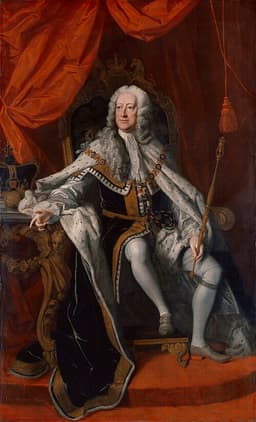
George I of Great Britain
Emperor · Modern
52.2Total

Sultan Husayn
Emperor · Modern
45.2Total
Basic Information
Born
1660
1668
Died
1727
1726
Era
Modern
Modern
Nationality
United Kingdom
Persia
Occupation
Emperor
Emperor
Civilization
Western
Middle Eastern
Score Comparison
Military (10%)
21.2
21.2
Political (20%)
68.0
33.6
Influence (20%)
53.3
51.0
Legacy (20%)
45.0
39.2
Leadership (15%)
72.0
67.0
Strategy (15%)
45.0
54.8
TOTAL
52.2
45.2
George I of Great Britain — Complete Timeline
1714 AD
Accession to the British ThronePolitical Action◆ Major
George I became king of Great Britain and Ireland following the death of Queen Anne. He was the first Hanoverian monarch, succeeding under the Act of Settlement 1701. His accession established the House of Hanover on the British throne.
AccessionHanoverian DynastySuccession
Impact: national
1715 AD
Jacobite Rising of 1715War◆ Major
George I faced a Jacobite rebellion aimed at restoring the Stuart claimant James Francis Edward Stuart. The rebellion was suppressed by government forces at the Battle of Preston and the Battle of Sheriffmuir. This defeat secured George's throne.
Jacobite RebellionCivil WarStuart Claimant
Impact: national
1717 AD
Development of Cabinet GovernmentPolitical Action
George I ceased attending Cabinet meetings due to his limited English and lack of interest. This led to the development of the cabinet system under a chief minister, Sir Robert Walpole, who became the first de facto Prime Minister. This shift strengthened parliamentary governance.
Cabinet GovernmentPrime MinisterConstitutional Evolution
Impact: nationalconstructive
1727 AD
Death in HanoverOther
George I died of a stroke while traveling to Hanover. He was buried in the Leineschloss church in Hanover. His death passed the throne to his son George II. His reign established the Hanoverian dynasty in Britain.
DeathHanoverSuccession
Impact: national
Sultan Husayn — Complete Timeline
1722 AD
Siege of IsfahanWar
Afghan forces under Mahmud Hotak besieged Isfahan, the Safavid capital, for seven months. Sultan Husayn surrendered after the city faced severe famine and disease, marking the end of effective Safavid rule. The Afghans captured the city and executed many Safavid officials.
Afghan InvasionSiegeFall of Safavids
Impact: nationaltragic
Abdicated the ThronePolitical Action◆ Major
After the fall of Isfahan, Sultan Husayn abdicated the Safavid throne in favor of Mahmud Hotak, the Afghan leader. This abdication formally ended the Safavid dynasty's rule over Persia, though later Safavid claimants continued resistance.
AbdicationDynastic EndAfghan Rule
Impact: nationaltragic
1726 AD
Executed by the AfghansPolitical Action◆ Major
Sultan Husayn was executed by the Afghan ruler Ashraf Hotak after being accused of plotting rebellion. His death eliminated the last Safavid shah and further destabilized Persia, leading to continued conflict between Afghan, Ottoman, and Russian forces.
ExecutionAfghan RuleSafavid End
Impact: nationaltragic
This comparison has not been analyzed yet.
One-time AI generation (~1 minute). Scores and timeline are already available below.
Rankings
🥇
George I of Great BritainLeader
Mil: 21.2Pol: 68.0Inf: 53.3
52.2
🥈
Sultan Husayn
Mil: 21.2Pol: 33.6Inf: 51.0
45.2
+7.0 behind
How This Comparison Works
Algorithm
Each figure is scored on 6 dimensions (0—100 scale) based on structured historical data: Military (10%), Political (20%), Influence (20%), Legacy (20%), Leadership (15%), Strategy (15%). The weighted total produces the final ranking.
Data Sources
Scores are computed from structured sub-indicators in the database. Scale factors adjust for era (Ancient ×0.85, Modern ×1.0) and civilization size (Eastern ×1.05, Other ×0.80) to account for differences in population and military scale.
Maximum 3 Figures
Comparisons are limited to 2—3 figures to ensure readability and statistical meaningfulness.
Error Margins
±5 points per dimension — Sub-scores are derived from historical records with inherent uncertainty. Two figures within 5 points on a dimension should be considered roughly equivalent in that area.
Total Score Accuracy
±3 points overall — The weighted combination of 6 dimensions produces a total score with approximately ±3 points of uncertainty. Differences of less than 3 points are not statistically significant— the figures are effectively tied.
Known Limitations
- Historical records are incomplete and uneven across civilizations
- Figures from oral-tradition societies may be underrepresented
- Occupation labels can misclassify multi-role figures
- Scores measure capability and impact, not moral character
- Quantitative scoring is a comparison tool, not absolute truth
Capability Radar
Military (10%) — Battles & Warfare
Battles
10
15
Win Rate
10
10
Expansion
10
5
Political (20%) — Governance & Reform
Reform
40
15
Diplomacy
50
20
Economy
40
20
Influence (20%) — Cultural & Global Reach
Cultural
20
30
Global
30
15
Legacy (20%) — Historical Impact
Historical
40
25
Longevity
30
20
Leadership (15%) — Power & Stability
Tenure
60
60
Stability
50
10
Strategy (15%) — Tactics & Innovation
Strategy
10
10
Tactics
10
10
Reform
10
5
Similar Comparisons
Comments & Discussion
No comments yet. Be the first to share your thoughts!