Loading...
George II of Great Britain vs Olav V of Norway
George II of Great Britain leads by 1.1 pts · 2 figures compared
…

George II of Great Britain
Emperor · Modern
57.6Total
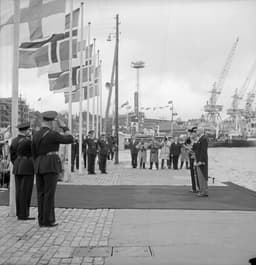
Olav V of Norway
Emperor · Modern
56.5Total
Basic Information
Born
1683
1903
Died
1760
1991
Era
Modern
Modern
Nationality
United Kingdom
Norway
Occupation
Emperor
Emperor
Civilization
Western
Western
Score Comparison
Military (10%)
47.5
48.2
Political (20%)
53.8
68.0
Influence (20%)
59.0
53.3
Legacy (20%)
48.3
42.5
Leadership (15%)
80.0
79.8
Strategy (15%)
60.0
55.2
TOTAL
57.6
56.5
George II of Great Britain — Complete Timeline
1740 AD
War of the Austrian SuccessionWar◆ Major
George II involved Britain in the War of the Austrian Succession, fighting against France and Spain. British forces achieved victories at Dettingen and Fontenoy. The war ended with the Treaty of Aix-la-Chapelle in 1748, which returned conquered territories.
WarEuropean ConflictTreaty
Impact: global
1743 AD
Battle of DettingenWar◆ Major
George II personally led British and allied forces to victory over the French at Dettingen in Bavaria. He was the last British monarch to command troops in battle. This victory was part of the War of the Austrian Succession.
BattleWar of Austrian SuccessionPersonal Command
Impact: regional
1745 AD
Jacobite Rising of 1745War◆ Major
George II faced a major Jacobite rebellion led by Charles Edward Stuart (Bonnie Prince Charlie). The rebels advanced into England but were defeated at the Battle of Culloden in 1746. This ended the Stuart threat to the Hanoverian throne.
Jacobite RebellionCullodenStuart Claimant
Impact: national
1760 AD
Death from Aortic DissectionOther
George II died of an aortic dissection at Kensington Palace at age 76. He was buried in Westminster Abbey. His death passed the throne to his grandson George III. His reign saw the expansion of British colonial power.
DeathSuccessionMonarchy
Impact: national
Olav V of Norway — Complete Timeline
1957 AD
Accession to the thronePolitical Action◆ Major
Olav V became King of Norway upon the death of his father, Haakon VII. He inherited a constitutional monarchy that had been restored after World War II and was widely popular among Norwegians.
SuccessionMonarchy
Impact: national
1960 AD
Popularity as 'People's King'Cultural
Olav V was known for his informal and approachable style, often seen skiing or walking in public without security. This earned him the nickname 'Folkekongen' (People's King) and strengthened the monarchy's popularity.
MonarchyPopularityCulture
Impact: nationalconstructive
1972 AD
Leadership during the 1972 EC referendumPolitical Action
Olav V remained neutral during the Norwegian referendum on joining the European Economic Community, which was rejected by voters. His restraint helped maintain the monarchy's non-political image.
ReferendumEuropean IntegrationNeutrality
Impact: national
Expert Analysis
Origins
George II of Great Britain was born in 1683 in Hanover, Germany, to George I and Sophia Dorothea of Celle. He grew up in a fractured family, his parents separated and his mother imprisoned. Educated in German and French, he spoke little English. His early life was marked by conflict with his father, leading to a strained relationship that continued into his reign. Olav V of Norway was born in 1903 in Appleton House, Norfolk, UK, as Prince Alexander of Denmark. He was the son of Prince Carl of Denmark and Princess Maud of Wales. Raised in Denmark, he studied at the Norwegian Military Academy and Balliol College, Oxford. His early life was shaped by his family's ties to European royalty and his father's election as King of Norway in 1905.
Rise to Power
George II ascended the throne in 1727 upon his father's death. His rise was marked by political maneuvering, as he maintained control through the Whig party and Robert Walpole, often considered the first Prime Minister. He was the first British monarch to exercise limited power under the emerging constitutional framework. Olav V became king in 1957 after the death of his father, Haakon VII. His rise was smoother, as he had been crown prince for 52 years, serving as regent during his father's illness. He was deeply involved in Norwegian resistance during World War II, which bolstered his popularity.
Leadership & Governance
George II's leadership was characterized by active involvement in military affairs. He scored 80.0 in leadership, but his political score of 53.8 reflects his reliance on ministers. He focused on expanding British influence in Europe through wars, but his domestic governance was often passive. Olav V scored 79.8 in leadership and 68.0 in politics. He governed as a constitutional monarch, remaining neutral in political debates. His informal style, skiing incognito and using public transport, earned him the nickname 'People's King'. He prioritized national unity, especially during the 1972 EC referendum.
Triumph & Tragedy
George II's greatest triumph was the Battle of Dettingen in 1743, where he personally led troops to victory, the last British monarch to do so. His military score of 47.5 reflects limited successes. His tragedy was the Jacobite Rising of 1745, which reached as far as Derby, exposing the fragility of Hanoverian rule. He also faced criticism for involving Britain in costly continental wars. Olav V's triumph was his role during World War II as a symbol of resistance, refusing to abdicate. His tragedy was the death of his wife, Crown Princess Märtha, in 1954, and his son Harald's struggle with polio. His legacy score of 42.5 is modest due to the limited power of constitutional monarchy.
Character & Destiny
George II was known for his stubbornness, courage, and short temper. He clashed with his son Frederick, echoing his own relationship with his father. His character led to political instability but also to decisive military action. Olav V was humble, approachable, and dignified. His character made him beloved, but his destiny was to be a figurehead, with real power in the hands of elected officials. He scored 55.2 in strategy, reflecting his ability to navigate political neutrality.
Legacy
George II's legacy is mixed: he strengthened the British monarchy's constitutional role but failed to prevent the loss of American colonies later. His military leadership at Dettingen is a historical footnote. Olav V's legacy is as a unifying figure who modernized the monarchy, making it accessible. He is remembered for his humility and service. In terms of total scores, George II leads 57.6 to 56.5, but the gap is narrow.
Conclusion
George II had greater impact on global history through his military actions and the expansion of British power, but Olav V's influence on Norwegian society and the model of a constitutional monarch was profound. Given the scores and historical weight, George II edges ahead in overall impact. His leadership score of 80.0 and his role in the War of the Austrian Succession give him a slight advantage over Olav V's 79.8, but Olav V's political score of 68.0 surpasses George II's 53.8. However, the key events of George II, such as Dettingen and the Jacobite Rising, had broader European consequences. Therefore, George II of Great Britain is assessed as having a marginally greater impact.
Rankings
🥇
George II of Great BritainLeader
Mil: 47.5Pol: 53.8Inf: 59.0
57.6
🥈
Olav V of Norway
Mil: 48.2Pol: 68.0Inf: 53.3
56.5
+1.1 behind
How This Comparison Works
Algorithm
Each figure is scored on 6 dimensions (0—100 scale) based on structured historical data: Military (10%), Political (20%), Influence (20%), Legacy (20%), Leadership (15%), Strategy (15%). The weighted total produces the final ranking.
Data Sources
Scores are computed from structured sub-indicators in the database. Scale factors adjust for era (Ancient ×0.85, Modern ×1.0) and civilization size (Eastern ×1.05, Other ×0.80) to account for differences in population and military scale.
Maximum 3 Figures
Comparisons are limited to 2—3 figures to ensure readability and statistical meaningfulness.
Error Margins
±5 points per dimension — Sub-scores are derived from historical records with inherent uncertainty. Two figures within 5 points on a dimension should be considered roughly equivalent in that area.
Total Score Accuracy
±3 points overall — The weighted combination of 6 dimensions produces a total score with approximately ±3 points of uncertainty. Differences of less than 3 points are not statistically significant— the figures are effectively tied.
Known Limitations
- Historical records are incomplete and uneven across civilizations
- Figures from oral-tradition societies may be underrepresented
- Occupation labels can misclassify multi-role figures
- Scores measure capability and impact, not moral character
- Quantitative scoring is a comparison tool, not absolute truth
Capability Radar
Military (10%) — Battles & Warfare
Battles
55
24
Win Rate
60
25
Expansion
40
30
Political (20%) — Governance & Reform
Reform
45
40
Diplomacy
60
65
Economy
55
45
Influence (20%) — Cultural & Global Reach
Cultural
40
40
Global
45
30
Legacy (20%) — Historical Impact
Historical
50
35
Longevity
40
30
Leadership (15%) — Power & Stability
Tenure
70
52
Stability
65
70
Strategy (15%) — Tactics & Innovation
Strategy
50
31
Tactics
45
36
Reform
30
41
Similar Comparisons
Comments & Discussion
No comments yet. Be the first to share your thoughts!