Loading...
This comparison has not been analyzed yet.
One-time AI generation (~1 minute). Scores and timeline are already available below.
George IV vs Margrethe II of Denmark
Margrethe II of Denmark leads by 16.7 pts · 2 figures compared
…
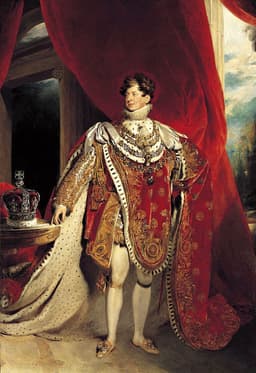
George IV
Emperor · Modern
38.0Total

Margrethe II of Denmark
Emperor · Modern
54.7Total
Basic Information
Born
1762
1940
Died
1830
—
Era
Modern
Modern
Nationality
United Kingdom
Denmark
Occupation
Emperor
Emperor
Civilization
Western
Western
Score Comparison
Military (10%)
12.4
13.6
Political (20%)
27.9
60.0
Influence (20%)
50.2
60.0
Legacy (20%)
37.5
48.3
Leadership (15%)
31.2
75.0
Strategy (15%)
60.0
60.0
TOTAL
38.0
54.7
George IV — Complete Timeline
1811 AD
Regency PeriodPolitical Action◆ Major
George IV became Prince Regent after his father George III was declared mentally unfit. He ruled as regent for nine years, overseeing the final years of the Napoleonic Wars and the Congress of Vienna. The Regency era was marked by cultural and architectural developments.
RegencyNapoleonic WarsCultural Era
Impact: national
1820 AD
Accession to the ThronePolitical Action◆ Major
George IV became king upon the death of his father George III. His accession was overshadowed by his attempt to divorce his wife Caroline of Brunswick, leading to a public scandal. He was crowned in a lavish ceremony at Westminster Abbey.
AccessionScandalCoronation
Impact: national
1829 AD
Catholic EmancipationPolitical Action◆ Major
George IV reluctantly gave royal assent to the Catholic Relief Act, which removed most restrictions on Catholics in the United Kingdom. This act allowed Catholics to sit in Parliament and hold public office. It was a major step toward religious equality.
Catholic EmancipationReligious ReformParliament
Impact: nationalconstructive
1830 AD
Death from Gastrointestinal IllnessOther
George IV died of gastrointestinal illness at Windsor Castle at age 67. He was buried in St George's Chapel. His death ended the Regency era and passed the throne to his brother William IV. His reign was marked by extravagance and scandal.
DeathSuccessionMonarchy
Impact: national
Margrethe II of Denmark — Complete Timeline
1972 AD
Accession to the Danish thronePolitical Action
Margrethe II became Queen of Denmark on January 14, 1972, following the death of her father, King Frederik IX. She was the first female Danish monarch since Margrethe I in the 14th century, and her accession was marked by a constitutional change allowing female succession.
Danish MonarchySuccessionConstitutional Change
Impact: nationalprogressive
2022 AD
Celebration of 50th jubileeCultural◆ Major
Margrethe II celebrated her Golden Jubilee on January 14, 2022, marking 50 years on the throne. The event included public celebrations, a gala performance, and a speech to the nation, highlighting her role as a unifying figure in Denmark.
Danish MonarchyJubileeCelebration
Impact: national
2024 AD
Abdication of the Danish thronePolitical Action
Margrethe II abdicated the throne on January 14, 2024, after 52 years of reign. She was succeeded by her son, Crown Prince Frederik, who became King Frederik X. The abdication was the first voluntary abdication of a Danish monarch since 1146.
Danish MonarchyAbdicationSuccession
Impact: national
This comparison has not been analyzed yet.
One-time AI generation (~1 minute). Scores and timeline are already available below.
Rankings
🥇
Margrethe II of DenmarkLeader
Mil: 13.6Pol: 60.0Inf: 60.0
54.7
🥈
George IV
Mil: 12.4Pol: 27.9Inf: 50.2
38.0
+16.7 behind
How This Comparison Works
Algorithm
Each figure is scored on 6 dimensions (0—100 scale) based on structured historical data: Military (10%), Political (20%), Influence (20%), Legacy (20%), Leadership (15%), Strategy (15%). The weighted total produces the final ranking.
Data Sources
Scores are computed from structured sub-indicators in the database. Scale factors adjust for era (Ancient ×0.85, Modern ×1.0) and civilization size (Eastern ×1.05, Other ×0.80) to account for differences in population and military scale.
Maximum 3 Figures
Comparisons are limited to 2—3 figures to ensure readability and statistical meaningfulness.
Error Margins
±5 points per dimension — Sub-scores are derived from historical records with inherent uncertainty. Two figures within 5 points on a dimension should be considered roughly equivalent in that area.
Total Score Accuracy
±3 points overall — The weighted combination of 6 dimensions produces a total score with approximately ±3 points of uncertainty. Differences of less than 3 points are not statistically significant— the figures are effectively tied.
Known Limitations
- Historical records are incomplete and uneven across civilizations
- Figures from oral-tradition societies may be underrepresented
- Occupation labels can misclassify multi-role figures
- Scores measure capability and impact, not moral character
- Quantitative scoring is a comparison tool, not absolute truth
Capability Radar
Military (10%) — Battles & Warfare
Battles
38
37
Win Rate
38
39
Expansion
45
43
Political (20%) — Governance & Reform
Reform
5
60
Diplomacy
15
70
Economy
10
65
Influence (20%) — Cultural & Global Reach
Cultural
30
55
Global
10
45
Legacy (20%) — Historical Impact
Historical
20
50
Longevity
15
50
Leadership (15%) — Power & Stability
Tenure
10
85
Stability
5
80
Strategy (15%) — Tactics & Innovation
Strategy
48
43
Tactics
48
46
Reform
50
54
Similar Comparisons
Comments & Discussion
No comments yet. Be the first to share your thoughts!