Loading...
George Marshall vs Seishiro Itagaki
George Marshall leads by 11.4 pts · 2 figures compared
…
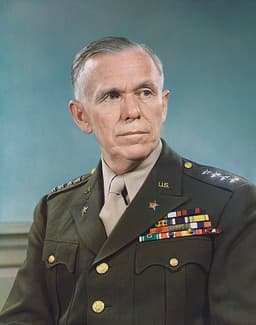
George Marshall
General · Modern
70.0Total

Seishiro Itagaki
General · Modern
58.6Total
Basic Information
Born
1880
1885
Died
1959
1948
Era
Modern
Modern
Nationality
United States
Japan
Occupation
General
General
Civilization
Western
Eastern
Score Comparison
Military (10%)
47.5
63.3
Political (20%)
86.0
54.7
Influence (20%)
65.0
59.0
Legacy (20%)
70.0
52.0
Leadership (15%)
78.0
64.5
Strategy (15%)
69.1
66.3
TOTAL
70.0
58.6
George Marshall — Complete Timeline
1939 AD
Appointed US Army Chief of StaffPolitical Action◆ Major
Marshall was appointed Chief of Staff of the United States Army, overseeing its expansion from a small peacetime force to the world's largest army. He was instrumental in preparing the US for World War II.
World War IIUS ArmyPreparation
Impact: globalconstructive
1947 AD
Developed the Marshall PlanPolitical Action
As Secretary of State, Marshall proposed the European Recovery Program, known as the Marshall Plan. The plan provided over $12 billion in economic aid to rebuild Western Europe, stabilizing economies and countering Soviet influence.
Cold WarEconomic AidEurope
Impact: globalconstructive
1953 AD
Received the Nobel Peace PrizeCultural◆ Major
Marshall was awarded the Nobel Peace Prize for his role in the Marshall Plan. He was the only professional soldier ever to receive the prize, recognizing his contribution to post-war reconstruction and peace.
Nobel PrizePeaceReconstruction
Impact: globalconstructive
Seishiro Itagaki — Complete Timeline
1931 AD
Mukden IncidentWar◆ Major
As Chief of Staff of the Kwantung Army, Itagaki, along with Ishiwara Kanji, planned and executed the Mukden Incident. This act of sabotage provided the justification for Japan's invasion and occupation of Manchuria.
ManchuriaWorld War IIInvasion
Impact: regionaldestructive
1948 AD
Executed as War CriminalOther◆ Major
Itagaki was convicted by the International Military Tribunal for the Far East for crimes against peace and war crimes, including his role in the invasion of Manchuria and subsequent atrocities. He was executed by hanging.
War CrimesExecutionTokyo Trial
Impact: globaltragic
Expert Analysis
Origins
George Catlett Marshall Jr. was born on December 31, 1880, in Uniontown, Pennsylvania, into a middle-class family. His father owned a coal and coke business. Marshall attended the Virginia Military Institute (VMI), graduating in 1901. He showed early leadership potential but lacked the connections of West Point graduates. His formative experiences included service in the Philippines and World War I, where he distinguished himself as a staff officer.
Seishiro Itagaki was born on January 21, 1885, in Morioka, Iwate Prefecture, Japan, into a samurai family. He graduated from the Imperial Japanese Army Academy in 1904 and later from the Army War College. His early career included service in the Russo-Japanese War, where he experienced the harsh realities of combat. Itagaki became involved in the radical nationalist movements within the Kwantung Army, advocating for Japanese expansion in Manchuria.
Rise to Power
Marshall's rise was methodical. He served as a key planner in World War I, earning praise from General John J. Pershing. After the war, he held various staff and command positions. In 1939, President Franklin D. Roosevelt appointed him as Army Chief of Staff, bypassing several senior officers. Marshall oversaw the expansion of the U.S. Army from 200,000 to 8 million soldiers. His strategic acumen and organizational skills were critical in coordinating the Allied war effort.
Itagaki rose through the Kwantung Army, the Japanese force in China. In 1931, as Chief of Staff of the Kwantung Army, he collaborated with Colonel Kanji Ishiwara to plan the Mukden Incident (September 18, 1931). This staged explosion on a railway near Mukden provided a pretext for Japan to invade and occupy Manchuria. The incident catapulted Itagaki to prominence, and he later served as Minister of War in 1938-1939, pushing for aggressive expansion.
Leadership & Governance
Marshall's leadership was defined by his integrity, selflessness, and strategic vision. He was known for his blunt honesty with political leaders, including Roosevelt. As Chief of Staff, he prioritized building a cohesive command structure and selecting competent generals like Dwight D. Eisenhower. After the war, as Secretary of State, he proposed the European Recovery Program (Marshall Plan), which provided over $12 billion (approximately $130 billion today) in economic aid to rebuild Western Europe. The plan was designed to prevent the spread of communism and stabilize democracies.
Itagaki's leadership was characterized by militarism and nationalist fervor. He was a key figure in the Kwantung Army's radical faction that sought to expand Japanese territory through force. As Minister of War, he supported the invasion of China and the escalation of the Second Sino-Japanese War. His governance approach relied on intimidation and military coercion, contributing to atrocities such as the Nanking Massacre. Itagaki scored 64.5 in leadership, reflecting his effectiveness within the Japanese military system but his catastrophic moral failure.
Triumph & Tragedy
Marshall's greatest triumph was the Marshall Plan, which rebuilt Western Europe and fostered economic integration. He also successfully managed the largest military expansion in U.S. history. His tragedy lies in the Cold War tensions that followed, though he had limited control over that. He never achieved his personal desire to command troops in battle; instead, he served as an administrator and strategist.
Itagaki's triumph was the swift conquest of Manchuria and the establishment of the puppet state Manchukuo. However, his tragedy was total: his actions led to war crimes, the deaths of millions, and his own execution. At the Tokyo War Crimes Tribunal, he was convicted of crimes against peace and conventional war crimes, and hanged on December 23, 1948. His legacy is one of destruction and dishonor.
Character & Destiny
Marshall was disciplined, reserved, and principled. He avoided self-promotion and focused on duty. His character earned him the trust of both Democrats and Republicans. His destiny was to be a statesman-soldier, bridging military and diplomatic spheres. He scored 78.0 in leadership and 86.0 in political acumen.
Itagaki was ambitious, nationalistic, and ruthless. He believed in Japan's divine right to dominate Asia. His character drove him to conspire and manipulate events, leading to his rise but also his downfall. His destiny was to be a war criminal, his name synonymous with aggression. His military score of 63.3 reflects tactical competence but strategic shortsightedness.
Legacy
Marshall's legacy is overwhelmingly positive. The Marshall Plan is considered one of the most successful foreign aid programs in history, influencing U.S. policy for decades. He received the Nobel Peace Prize in 1953, the only professional soldier ever to do so. His name endures in institutions like the George C. Marshall Foundation and the Marshall Space Flight Center. He scored 70.0 in legacy.
Itagaki's legacy is negative. He is remembered as a war criminal and an architect of Japanese imperialism. His actions contributed to the militarization of Japan and the Pacific War. In modern Japan, he is largely condemned, though some ultranationalists view him as a patriot. His legacy score is 52.0, reflecting his infamy.
Conclusion
George Marshall had a far greater and more positive impact on history than Seishiro Itagaki. Marshall's total score of 70.0 versus Itagaki's 58.6 reflects this disparity. Marshall rebuilt nations, while Itagaki destroyed them. Marshall's vision and integrity created a framework for peace and prosperity; Itagaki's aggression led to death and devastation. In the judgment of history, Marshall stands as a model of constructive leadership, while Itagaki serves as a cautionary tale of militarism. The choice between architect of peace and architect of war is clear: Marshall's legacy endures as a force for good.
Rankings
🥇
George MarshallLeader
Mil: 47.5Pol: 86.0Inf: 65.0
70.0
🥈
Seishiro Itagaki
Mil: 63.3Pol: 54.7Inf: 59.0
58.6
+11.4 behind
How This Comparison Works
Algorithm
Each figure is scored on 6 dimensions (0—100 scale) based on structured historical data: Military (10%), Political (20%), Influence (20%), Legacy (20%), Leadership (15%), Strategy (15%). The weighted total produces the final ranking.
Data Sources
Scores are computed from structured sub-indicators in the database. Scale factors adjust for era (Ancient ×0.85, Modern ×1.0) and civilization size (Eastern ×1.05, Other ×0.80) to account for differences in population and military scale.
Maximum 3 Figures
Comparisons are limited to 2—3 figures to ensure readability and statistical meaningfulness.
Error Margins
±5 points per dimension — Sub-scores are derived from historical records with inherent uncertainty. Two figures within 5 points on a dimension should be considered roughly equivalent in that area.
Total Score Accuracy
±3 points overall — The weighted combination of 6 dimensions produces a total score with approximately ±3 points of uncertainty. Differences of less than 3 points are not statistically significant— the figures are effectively tied.
Known Limitations
- Historical records are incomplete and uneven across civilizations
- Figures from oral-tradition societies may be underrepresented
- Occupation labels can misclassify multi-role figures
- Scores measure capability and impact, not moral character
- Quantitative scoring is a comparison tool, not absolute truth
Capability Radar
Military (10%) — Battles & Warfare
Battles
45
60
Win Rate
60
55
Expansion
40
75
Political (20%) — Governance & Reform
Reform
95
30
Diplomacy
90
45
Economy
95
35
Influence (20%) — Cultural & Global Reach
Cultural
60
30
Global
85
55
Legacy (20%) — Historical Impact
Historical
85
60
Longevity
75
40
Leadership (15%) — Power & Stability
Tenure
70
50
Stability
85
20
Strategy (15%) — Tactics & Innovation
Strategy
85
70
Tactics
55
65
Reform
90
40
Similar Comparisons
Comments & Discussion
No comments yet. Be the first to share your thoughts!