Loading...
George Monck vs Julius Caesar
Julius Caesar leads by 27.6 pts · 2 figures compared
…
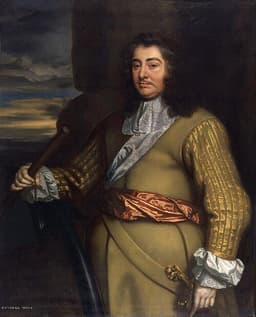
George Monck
General · Modern
55.2Total

Julius Caesar
General · Ancient
82.8Total
Basic Information
Born
1608
-100
Died
1670
-44
Era
Modern
Ancient
Nationality
England
Roman Republic
Occupation
General
General
Civilization
Western
Western
Score Comparison
Military (10%)
30.0
88.0
Political (20%)
45.0
78.0
Influence (20%)
59.0
85.0
Legacy (20%)
52.0
82.0
Leadership (15%)
78.0
80.0
Strategy (15%)
60.0
85.0
TOTAL
55.2
82.8
George Monck — Complete Timeline
1650 AD
Battle of DunbarWar◆ Major
George Monck commanded a parliamentary army at the Battle of Dunbar, defeating a Scottish force loyal to Charles II. The victory secured English control over Scotland and demonstrated Monck's military effectiveness.
BattleEnglish Civil WarScotland
Impact: regional
1660 AD
March on LondonPolitical Action
George Monck marched his army from Scotland to London, where he forced the Rump Parliament to readmit excluded members and call for new elections. This action paved the way for the Restoration of the monarchy.
RestorationPolitical ActionMonarchy
Impact: national
Restoration of Charles IIPolitical Action
Monck facilitated the return of Charles II from exile, negotiating the terms of the Restoration. He was appointed Captain-General of the army and created Duke of Albemarle for his role in restoring the monarchy.
RestorationCharles IIMonarchy
Impact: nationalconstructive
Julius Caesar — Complete Timeline
58 BC
Gallic WarsWar◆ Major
Caesar, as proconsul of Gaul, launched a series of campaigns that conquered all of Gaul (modern France, Belgium, and parts of Switzerland). He fought numerous battles, including against the Helvetii, the Belgae, and the Gallic chieftain Vercingetorix. The wars brought immense wealth and a loyal army to Caesar.
Gallic WarsConquestRoman Expansion
Impact: regional
49 BC
Crossing the RubiconPolitical Action◆ Major
Caesar led Legio XIII across the Rubicon River into Italy, defying the Roman Senate's order to disband his army. This act triggered a civil war against Pompey and the Optimates, ultimately leading to Caesar's dictatorship and the end of the Roman Republic.
Roman Civil WarEnd of RepublicPower Struggle
Impact: global
48 BC
Battle of PharsalusWar◆ Major
Caesar's outnumbered army defeated the larger forces of Pompey the Great at Pharsalus in Greece. Caesar's tactical use of a reserve line to counter Pompey's cavalry charge proved decisive. Pompey fled to Egypt, where he was assassinated, leaving Caesar as the undisputed master of the Roman world.
Roman Civil WarBattleDecisive Victory
Impact: regional
44 BC
Appointment as Dictator for LifePolitical Action◆ Major
The Roman Senate appointed Caesar dictator perpetuo (dictator for life), granting him unprecedented personal power. This move concentrated military, legislative, and judicial authority in one person, effectively ending the Roman Republic's traditional system of checks and balances and alarming many senators.
DictatorshipEnd of RepublicPower Consolidation
Impact: regionaldestructive
Assassination on the Ides of MarchPolitical Action◆ Major
A group of Roman senators, led by Marcus Junius Brutus and Gaius Cassius Longinus, stabbed Caesar to death at a meeting of the Senate in the Theatre of Pompey. The assassination was intended to restore the Republic, but instead triggered another civil war that led to the rise of the Roman Empire.
AssassinationRoman PoliticsEnd of Republic
Impact: globaldestructive
Expert Analysis
george-monck-vs-julius-caesar
# The General and the Kingmaker
On a January morning in 49 BCE, Julius Caesar stood at the banks of the Rubicon River, a small stream separating his province of Gaul from Italy proper. To cross was to declare war on the Roman Republic. He paused, then uttered the words that would echo through history: *"Alea iacta est"*—the die is cast. More than seventeen centuries later, in the winter of 1660, another general, George Monck, marched his army south from Scotland toward London. He carried no such dramatic phrase, only a quiet resolve. Both men held the fate of their nations in their hands. One would remake the world in his image; the other would restore a throne that had been shattered by civil war. Why did Caesar’s path lead to empire and assassination, while Monck’s led to a bloodless restoration and a quiet retirement? The answer lies not only in their ambitions but in the worlds that shaped them.
Origins
Julius Caesar was born into the twilight of the Roman Republic, a world of crumbling institutions and soaring individual ambition. His family, the Julii, claimed descent from the goddess Venus, but they were not among the ruling elite. The Republic was tearing itself apart—slave revolts, street violence between factions, and generals who used their armies as personal instruments. Caesar’s Rome was a cauldron of competition where the only law was power. He grew up watching his uncle Marius and his rival Sulla march armies into the city, and he learned early that the old rules no longer applied.
George Monck was born in 1608, into an England still recovering from the Spanish Armada, yet about to be shattered by its own demons. His father was a minor Devonshire gentleman, and Monck grew up in a world of rigid hierarchy but deep uncertainty. The English Civil War was not yet born, but the religious and constitutional tensions that would ignite it were already simmering. Unlike Caesar, Monck did not inherit a mythic lineage; he inherited a world where loyalty to crown, parliament, and God were tangled into impossible knots.
Rise to Power
Caesar’s rise was a masterclass in calculated risk. He climbed the political ladder with a combination of bribery, marriage alliances, and military glory. His conquest of Gaul (58–50 BCE) was not merely a campaign—it was a personal empire-building project. He fought over 800 battles, subdued hundreds of tribes, and amassed a fortune that made him the most powerful man in the Republic. His *Commentaries on the Gallic Wars* were both a military record and a political manifesto, written to keep his name before the Roman public. By 50 BCE, Caesar commanded a veteran army of 50,000 men, loyal not to Rome but to him.
Monck’s rise was slower and more ambiguous. He fought for King Charles I in Ireland and against the Scots, then switched sides to serve Parliament when the Royalist cause collapsed. At the Battle of Dunbar in 1650, he commanded a parliamentary army that crushed a Scottish force loyal to Charles II. But Monck was no ideologue—he was a soldier who followed orders. Under Oliver Cromwell, he became a trusted commander, but he never built a personal following. His army was Cromwell’s army, not his own. When Cromwell died and the Protectorate unraveled, Monck found himself in command of a force in Scotland, watching England descend into chaos.
Leadership & Governance
Caesar governed as he fought—decisively, ruthlessly, and with an eye on the grand stage. As dictator, he reformed the calendar, extended citizenship to provincials, launched massive building projects, and centralized power in his own hands. He was a military genius who could win battles against impossible odds, as at Alesia in 52 BCE, where he besieged a Gallic army while simultaneously fighting off a relief force. Yet his political wisdom was flawed: he pardoned his enemies, expecting gratitude, but received only daggers. He believed his personal charisma could replace institutional legitimacy.
Monck governed with a different kind of genius—the genius of restraint. When he marched on London in February 1660, he did not seize power for himself. Instead, he forced the Rump Parliament to readmit excluded members, then called for free elections. He facilitated the Restoration of Charles II not by conquering, but by negotiating. He became Captain-General of the army, but his real power lay in his refusal to use it. His strategy was not to win a battle but to end a war—the long, bitter war between crown and parliament that had lasted two decades.
Triumph & Tragedy
Caesar’s greatest triumph was his conquest of Gaul, which doubled the size of the Republic’s territory and made him the wealthiest man in the Mediterranean. His greatest tragedy was his assassination on the Ides of March, 44 BCE, stabbed twenty-three times by senators he had pardoned. He had centralized power so completely that his death did not restore the Republic—it unleashed another civil war that ended with his adopted heir, Octavian, becoming the first Roman emperor.
Monck’s greatest triumph was the Restoration itself. On May 29, 1660, Charles II entered London to the roar of crowds, and Monck rode beside him. The kingdom was restored without a single battle. His tragedy was more subtle: he had spent his life serving parliaments and protectors, and in the end, he restored a king who would slowly dismantle the very parliamentary supremacy Monck had fought for. Yet Monck died in his bed in 1670, a duke and a hero, not a martyr.
Character & Destiny
Caesar’s character was that of a man who believed he was destined to rule. His clemency was genuine, but it was the clemency of a master toward his subjects. He could not imagine a world where he was not at the center. This hubris—the fatal flaw of every tragic hero—drove him to accept the title of dictator for life, to reject the crown but wear its power openly, and to walk unarmed into the Senate on that March morning. His destiny was shaped by his belief that the old Republic was dead and only he could give it new life.
Monck was the opposite. He was famously taciturn, cautious, and pragmatic. His contemporaries called him "Honest George," not because he was morally pure, but because he was predictable. He did not want to be king; he wanted order. He understood that England’s crisis was not a failure of monarchy but a failure of trust. By marching slowly, negotiating carefully, and never reaching for the ultimate prize, he restored what Caesar had destroyed: a stable, legitimate government.
Legacy
Caesar’s legacy is the Roman Empire itself. Every emperor who followed—Augustus, Trajan, Constantine—ruled in the shadow of his ambition. His name became synonymous with autocracy: *Kaiser* in German, *Tsar* in Russian. He is remembered as a military genius, a political revolutionary, and a warning about the price of unchecked power. His scores reflect this: Military 88, Political 78, Influence 85, Legacy 82.
Monck’s legacy is quieter but no less profound. He is remembered, when he is remembered at all, as the general who restored the monarchy without a fight. His score of 70.2 reflects a life of service rather than glory. Yet the English constitutional settlement of 1660—with its delicate balance between crown and parliament—owed more to Monck’s restraint than to any king’s wisdom. He proved that sometimes the greatest power lies in not using it.
Conclusion
Caesar and Monck stand at opposite ends of the same question: what does a soldier do when the state collapses? Caesar answered by becoming the state. Monck answered by rebuilding it. One was a comet that burned across the sky and vanished; the other was a steady hand that guided a ship back to harbor. Their different outcomes were not accidents of fate but reflections of their times. Caesar’s Rome was ready for a master; Monck’s England was ready for a settlement. The general who understands his age, and his own limits, may not be remembered as a god—but he might just save his country.
Rankings
🥇
Julius CaesarLeader
Mil: 88.0Pol: 78.0Inf: 85.0
82.8
🥈
George Monck
Mil: 30.0Pol: 45.0Inf: 59.0
55.2
+27.6 behind
How This Comparison Works
Algorithm
Each figure is scored on 6 dimensions (0—100 scale) based on structured historical data: Military (10%), Political (20%), Influence (20%), Legacy (20%), Leadership (15%), Strategy (15%). The weighted total produces the final ranking.
Data Sources
Scores are computed from structured sub-indicators in the database. Scale factors adjust for era (Ancient ×0.85, Modern ×1.0) and civilization size (Eastern ×1.05, Other ×0.80) to account for differences in population and military scale.
Maximum 3 Figures
Comparisons are limited to 2—3 figures to ensure readability and statistical meaningfulness.
Error Margins
±5 points per dimension — Sub-scores are derived from historical records with inherent uncertainty. Two figures within 5 points on a dimension should be considered roughly equivalent in that area.
Total Score Accuracy
±3 points overall — The weighted combination of 6 dimensions produces a total score with approximately ±3 points of uncertainty. Differences of less than 3 points are not statistically significant— the figures are effectively tied.
Known Limitations
- Historical records are incomplete and uneven across civilizations
- Figures from oral-tradition societies may be underrepresented
- Occupation labels can misclassify multi-role figures
- Scores measure capability and impact, not moral character
- Quantitative scoring is a comparison tool, not absolute truth
Capability Radar
Military (10%) — Battles & Warfare
Battles
45
95
Win Rate
55
92
Expansion
20
97
Political (20%) — Governance & Reform
Reform
55
90
Diplomacy
70
85
Economy
40
82
Influence (20%) — Cultural & Global Reach
Cultural
30
88
Global
35
94
Legacy (20%) — Historical Impact
Historical
60
95
Longevity
40
96
Leadership (15%) — Power & Stability
Tenure
65
75
Stability
75
60
Strategy (15%) — Tactics & Innovation
Strategy
60
94
Tactics
50
96
Reform
30
88
Similar Comparisons
Comments & Discussion
RubiconRaider6/17/2026
Caesar's crossing of the Rubicon was a calculated gamble, but Monck's march to London was a calculated risk of a different kind. Caesar bet on his own legend—his legions worshipped him as a god-king. Monck bet on a ghost, the restored monarchy. Caesar's gamble paid off with a dictatorship; Monck's paid off with a quiet estate and a dukedom. Monck understood that the English hated another civil war more than they loved any faction. Caesar misunderstood how much Rome hated kings. That's the differ
狮心数据狂6/17/2026
你们都在吹什么“将军的抉择”?数据不会撒谎:凯撒在高卢杀了100万人,卖了100万奴隶,他的军队靠抢掠养肥自己。蒙克呢?他带着1.2万苏格兰驻军南下,全程几乎零伤亡,连伦敦市民都没反抗。这不是什么英雄主义,这是凯撒碰到了头铁的罗马元老院,而蒙克正巧赶上了英国人的政治疲劳。把这两个人放一起比,简直是用原子弹和鞭炮比威力。
ClassicistCritic6/17/2026
The comparison misses the fundamental structural difference: Caesar was dismantling a functioning republic that had lasted five centuries; Monck was restoring a monarchy that had been abolished only eleven years prior. Caesar's contemporaries had living memory of the Republic's glories—Cicero was still giving speeches. Monck's England had already tried Cromwell's "Commonwealth" and found it wanting. Monck didn't need to invent a new system; he just needed to hit the reset button. Caesar had to b
茶馆说书人6/17/2026
你们这些书呆子就知道吹罗马!我给你们讲个真事儿:凯撒过卢比孔河前,元老院给了他两个选择——要么解散军队当个平头百姓,要么等着被审判。他选了第三个选项:内战。蒙克呢?克伦威尔死了,他女婿跟个废物似的,军队都烂了,议会也吵成一锅粥。蒙克不过是去伦敦把查理二世请回来,就跟请个客人似的。凯撒那是推倒一栋楼,蒙克是修了扇门。能一样吗?
SkepticalStrategist6/17/2026
Let's be honest, the comparison flatters Monck. Caesar's military campaigns spanned continents and redefined warfare—Alesia, Pharsalus, the siege of Alexandria. Monck's claim to fame is a single march that barely qualifies as a campaign. He fought at the Battle of Dunbar, sure, but that was under Cromwell's command. His real genius was political timing: he arrived in London when everyone was exhausted and desperate for stability. That's not generalship, that's being in the right pub at the right