Loading...
George Weah vs Julius Caesar
Julius Caesar leads by 35.8 pts · 2 figures compared
…
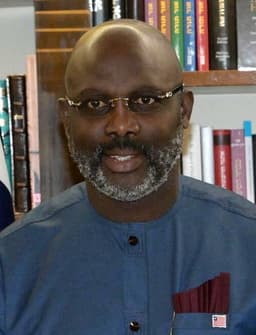
George Weah
Politician · Modern
47.0Total

Julius Caesar
General · Ancient
82.8Total
Basic Information
Born
1966
-100
Died
—
-44
Era
Modern
Ancient
Nationality
Liberia
Roman Republic
Occupation
Politician
General
Civilization
Other
Western
Score Comparison
Military (10%)
43.3
88.0
Political (20%)
30.8
78.0
Influence (20%)
56.7
85.0
Legacy (20%)
49.2
82.0
Leadership (15%)
48.4
80.0
Strategy (15%)
43.0
85.0
TOTAL
47.0
82.8
George Weah — Complete Timeline
1995 AD
Won FIFA World Player of the YearCultural◆ Major
Weah was awarded the FIFA World Player of the Year, becoming the first and only African player to win the award. This recognized his exceptional performance for AC Milan and the Liberian national team, elevating his global profile.
FootballAwardAfrican Achievement
Impact: globalconstructive
2005 AD
Elected President of LiberiaPolitical Action
Weah was elected President of Liberia in a runoff election, defeating Ellen Johnson Sirleaf. His victory marked a transition from a football career to political leadership, though he was defeated in the 2011 election.
ElectionLiberiaPolitical Career
Impact: nationalconstructive
2011 AD
Defeated in 2011 Presidential ElectionPolitical Action◆ Major
Weah lost the presidential election to incumbent Ellen Johnson Sirleaf. The defeat ended his first bid for re-election and highlighted the challenges of transitioning from celebrity to sustained political leadership.
ElectionDefeatLiberia
Impact: national
2017 AD
Elected President of Liberia (Second Term)Political Action
Weah was elected President of Liberia in a second attempt, defeating incumbent Vice President Joseph Boakai. His victory marked a return to power after a six-year hiatus and a consolidation of his political influence.
ElectionLiberiaPolitical Comeback
Impact: nationalconstructive
Julius Caesar — Complete Timeline
58 BC
Gallic WarsWar◆ Major
Caesar, as proconsul of Gaul, launched a series of campaigns that conquered all of Gaul (modern France, Belgium, and parts of Switzerland). He fought numerous battles, including against the Helvetii, the Belgae, and the Gallic chieftain Vercingetorix. The wars brought immense wealth and a loyal army to Caesar.
Gallic WarsConquestRoman Expansion
Impact: regional
49 BC
Crossing the RubiconPolitical Action◆ Major
Caesar led Legio XIII across the Rubicon River into Italy, defying the Roman Senate's order to disband his army. This act triggered a civil war against Pompey and the Optimates, ultimately leading to Caesar's dictatorship and the end of the Roman Republic.
Roman Civil WarEnd of RepublicPower Struggle
Impact: global
48 BC
Battle of PharsalusWar◆ Major
Caesar's outnumbered army defeated the larger forces of Pompey the Great at Pharsalus in Greece. Caesar's tactical use of a reserve line to counter Pompey's cavalry charge proved decisive. Pompey fled to Egypt, where he was assassinated, leaving Caesar as the undisputed master of the Roman world.
Roman Civil WarBattleDecisive Victory
Impact: regional
44 BC
Appointment as Dictator for LifePolitical Action◆ Major
The Roman Senate appointed Caesar dictator perpetuo (dictator for life), granting him unprecedented personal power. This move concentrated military, legislative, and judicial authority in one person, effectively ending the Roman Republic's traditional system of checks and balances and alarming many senators.
DictatorshipEnd of RepublicPower Consolidation
Impact: regionaldestructive
Assassination on the Ides of MarchPolitical Action◆ Major
A group of Roman senators, led by Marcus Junius Brutus and Gaius Cassius Longinus, stabbed Caesar to death at a meeting of the Senate in the Theatre of Pompey. The assassination was intended to restore the Republic, but instead triggered another civil war that led to the rise of the Roman Empire.
AssassinationRoman PoliticsEnd of Republic
Impact: globaldestructive
Expert Analysis
george-weah-vs-julius-caesar
# The General and the Goal-Scorer: Two Paths to Power
On a January morning in 44 BCE, a fifty-five-year-old Roman stood before the Senate, blood streaming from twenty-three stab wounds, his body crumpled at the base of Pompey's statue. On a January morning in 2018, a fifty-one-year-old Liberian stood before a crowd in Monrovia, hand on a Bible, taking the oath of office as president. Julius Caesar and George Weah—one a conqueror of Gaul, the other a conqueror of football fields—both reached the pinnacle of political power. But their journeys, their tools, and their endings could not have been more different. What does it mean to rise from nothing, to command armies or crowds, to reshape a nation? And why did one die at the hands of his peers while the other left office peacefully, defeated at the ballot box?
Origins
Caesar was born into the chaos of the late Roman Republic, a world of civil wars, senatorial intrigue, and crumbling traditions. His family, the Julii, claimed descent from the goddess Venus, but they were politically marginal. His father died when Caesar was sixteen, leaving him to navigate a brutal system where survival meant patronage, debts, and ruthless ambition. He learned early that in Rome, glory and gold came from the sword.
George Weah was born in 1966 in the slums of Clara Town, Monrovia, in a Liberia still recovering from its founding by freed American slaves. His father was a mechanic, his mother a market vendor. There were no divine ancestors, no family name—only poverty and the raw talent of a boy who could outrun and out-dribble anyone. In Liberia, football was the only ladder out of the gutter. Weah climbed it.
Rise to Power
Caesar’s ascent was a masterpiece of calculated risk. He borrowed fortunes to fund spectacles, bribed the right men, and married into the powerful populares faction. His military command in Gaul from 58 to 50 BCE was not just a conquest—it was a personal empire-building project. He wrote his own commentaries, controlled his own narrative, and built an army loyal to him, not to Rome. When the Senate ordered him to disband, he crossed the Rubicon River in 49 BCE, sparking a civil war that ended with him as dictator.
Weah’s rise was different. He did not conquer provinces; he conquered stadiums. In 1995, he won the FIFA World Player of the Year, the first and only African ever to do so. His fame was global, his image untarnished by politics. When he returned to Liberia, a country shattered by fourteen years of civil war, he was a hero. In 2005, he ran for president against Ellen Johnson Sirleaf—a Harvard-educated economist and Nobel laureate—and lost. He did not stage a coup. He waited, studied, and ran again in 2017, this time winning by promising jobs, roads, and schools.
Leadership & Governance
Caesar governed as a military autocrat. He reformed the calendar, granted citizenship to Gauls, initiated public works, and centralized power in his own hands. His military genius was undeniable: at the Siege of Alesia in 52 BCE, he defeated a Gallic army three times his size through brilliant fortification and timing. But his political wisdom was flawed. He pardoned his enemies, yet they plotted anyway. He refused to restore the Republic, and that refusal cost him his life.
Weah governed as a former star, not a general. His military score of 30.2 reflects no battlefield experience. His political score of 49.2 reveals a leader who struggled with the mechanics of governance. Corruption persisted, infrastructure lagged, and the economy stagnated. He was not a reformer like Caesar; he was a symbol. His greatest strength was his connection to the people—but symbols cannot fix roads. By 2023, his approval had eroded, and he lost re-election to Joseph Boakai in 2024.
Triumph & Tragedy
Caesar’s greatest moment was his triumph over Pompey in 45 BCE, when he returned to Rome as master of the known world. His tragedy was that he could not stop there. He accepted a dictatorship for life, wore royal purple, and let himself be worshipped. The Ides of March—March 15, 44 BCE—was the collision of his ambition and the Republic’s fear.
Weah’s greatest moment was his 1995 FIFA award, a triumph that transcended sport. His tragedy was that he could not translate that magic into effective governance. He was a beloved figure who could not deliver. Yet his ending was peaceful. He left office, conceded defeat, and returned to private life—a quiet dignity that Caesar never had.
Character & Destiny
Caesar was driven by a relentless need for glory. He famously said, “It is better to be the first in a village than second in Rome.” That hunger made him unstoppable—and blind. He saw the Senate as tools, not threats. His character forged his destiny: he rose by daring, and he fell by daring too far.
Weah’s character was shaped by humility and patience. He did not seize power; he earned it through votes. He did not destroy his enemies; he lost to them and tried again. His destiny was not to be a Caesar, but a symbol of possibility—and limitation.
Legacy
Caesar’s legacy is the Roman Empire itself. His name became a title: Kaiser, Tsar. He changed the course of Western civilization, for better and worse. His assassination did not restore the Republic; it destroyed it.
Weah’s legacy is more modest. He is remembered as a football legend who became president—a rare transition from sports to politics. But his presidency did not transform Liberia. He leaves behind a mixed record: inspiration without execution, hope without infrastructure.
Conclusion
One man conquered nations with legions; the other conquered hearts with a ball. One died on the Senate floor; the other walked out of the presidential palace. Caesar’s story is about the danger of absolute power. Weah’s story is about the limits of soft power. Both rose from marginal beginnings to the highest office. But where Caesar’s ambition ended in blood, Weah’s ended in a ballot box. Perhaps the difference is not in their brilliance, but in their era: one lived when power was taken by the sword, the other when power was given by the people. The Rubicon and the ballot box—two rivers, two fates.
Rankings
🥇
Julius CaesarLeader
Mil: 88.0Pol: 78.0Inf: 85.0
82.8
🥈
George Weah
Mil: 43.3Pol: 30.8Inf: 56.7
47.0
+35.8 behind
How This Comparison Works
Algorithm
Each figure is scored on 6 dimensions (0—100 scale) based on structured historical data: Military (10%), Political (20%), Influence (20%), Legacy (20%), Leadership (15%), Strategy (15%). The weighted total produces the final ranking.
Data Sources
Scores are computed from structured sub-indicators in the database. Scale factors adjust for era (Ancient ×0.85, Modern ×1.0) and civilization size (Eastern ×1.05, Other ×0.80) to account for differences in population and military scale.
Maximum 3 Figures
Comparisons are limited to 2—3 figures to ensure readability and statistical meaningfulness.
Error Margins
±5 points per dimension — Sub-scores are derived from historical records with inherent uncertainty. Two figures within 5 points on a dimension should be considered roughly equivalent in that area.
Total Score Accuracy
±3 points overall — The weighted combination of 6 dimensions produces a total score with approximately ±3 points of uncertainty. Differences of less than 3 points are not statistically significant— the figures are effectively tied.
Known Limitations
- Historical records are incomplete and uneven across civilizations
- Figures from oral-tradition societies may be underrepresented
- Occupation labels can misclassify multi-role figures
- Scores measure capability and impact, not moral character
- Quantitative scoring is a comparison tool, not absolute truth
Capability Radar
Military (10%) — Battles & Warfare
Battles
23
95
Win Rate
23
92
Expansion
27
97
Political (20%) — Governance & Reform
Reform
20
90
Diplomacy
25
85
Economy
15
82
Influence (20%) — Cultural & Global Reach
Cultural
60
88
Global
65
94
Legacy (20%) — Historical Impact
Historical
55
95
Longevity
40
96
Leadership (15%) — Power & Stability
Tenure
30
75
Stability
10
60
Strategy (15%) — Tactics & Innovation
Strategy
28
94
Tactics
36
96
Reform
37
88
Similar Comparisons
Comments & Discussion
CaesarSlayer6/17/2026
Caesar didn't "rise from nothing"—his family was patrician and he inherited a network of elite connections. Weah literally grew up in a Monrovia slum playing with rolled-up rags. This comparison is like saying a trust-fund CEO and a street vendor both "climbed the ladder." Weah's story is genuinely more impressive: no divine ancestry, no silver spoon, just raw talent and focus. Let's not romanticize Caesar's "humble beginnings" when he was literally related to a goddess.
战术考古学家6/17/2026
把Caesar和Weah硬凑一起的对比真让我这个数据控上火。Caesar统治时期的税收系统极度腐败,Gaul战争屠杀超过百万人口;Weah执政期间虽然没建树什么高铁医保,但至少没发动侵略战争。你告诉我谁更"伟大"?历史地位和道德高低是两码事,别用"征服"和"进球"这种浪漫包装混淆视听。数据不会撒谎:Weah离任时GDP增速0.4%,Caesar离任时血流成河。
ClassicCounter6/17/2026
The real shock here isn't their origins—it's their endings. Caesar died a violent death because he refused to share power, packing the Senate with his cronies and declaring himself dictator for life. Weah lost a democratic election and left office peacefully, conceding defeat. That's the most Roman thing about Caesar: his fatal inability to compromise. Weah understood what Caesar never did—that power isn't about how high you climb, but how gracefully you step down.
江湖历史人6/17/2026
你们这些学院派总爱拿"民主"说事。Weah输掉选举是2023年,但他任期内Liberia的经济增长是中规中矩还是惨淡?油价、外债、失业率——这些数据呢?而Caesar死前一个月还在改革税法、推行历法、给罗马公民发土地。谁真实改变了民生?别拿"暴力死亡"给Caesar贴标签,二十三年刀伤里藏着的是元老院的恐惧:他知道无法被控制,所以被清除。历史不是选择题,是残酷的博弈。
RebelReader6/17/2026
This comparison is like comparing a cat to a spaceship—both exist, but why? Caesar dismantled a 500-year-old republic in his lifetime; Weah played football really well and then became president of a country that's still figuring out basic infrastructure. The only meaningful overlap is "charisma." Otherwise, Weah's trajectory is a modern sports-to-politics story (see: Pelé, Maradona), while Caesar literally changed the course of Western civilization. Two different galaxies of impact, no matter ho