Loading...
This comparison has not been analyzed yet.
One-time AI generation (~1 minute). Scores and timeline are already available below.
George Weah vs Viktor Orban
Viktor Orban leads by 11.5 pts · 2 figures compared
…
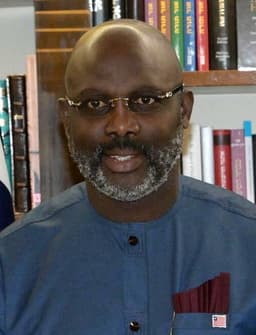
George Weah
Politician · Modern
47.0Total

Viktor Orban
Politician · Modern
58.5Total
Basic Information
Born
1966
1963
Died
—
—
Era
Modern
Modern
Nationality
Liberia
Hungary
Occupation
Politician
Politician
Civilization
Other
Western
Score Comparison
Military (10%)
43.3
50.0
Political (20%)
30.8
70.3
Influence (20%)
56.7
58.3
Legacy (20%)
49.2
52.0
Leadership (15%)
48.4
75.0
Strategy (15%)
43.0
40.9
TOTAL
47.0
58.5
George Weah — Complete Timeline
1995 AD
Won FIFA World Player of the YearCultural◆ Major
Weah was awarded the FIFA World Player of the Year, becoming the first and only African player to win the award. This recognized his exceptional performance for AC Milan and the Liberian national team, elevating his global profile.
FootballAwardAfrican Achievement
Impact: globalconstructive
2005 AD
Elected President of LiberiaPolitical Action
Weah was elected President of Liberia in a runoff election, defeating Ellen Johnson Sirleaf. His victory marked a transition from a football career to political leadership, though he was defeated in the 2011 election.
ElectionLiberiaPolitical Career
Impact: nationalconstructive
2011 AD
Defeated in 2011 Presidential ElectionPolitical Action◆ Major
Weah lost the presidential election to incumbent Ellen Johnson Sirleaf. The defeat ended his first bid for re-election and highlighted the challenges of transitioning from celebrity to sustained political leadership.
ElectionDefeatLiberia
Impact: national
2017 AD
Elected President of Liberia (Second Term)Political Action
Weah was elected President of Liberia in a second attempt, defeating incumbent Vice President Joseph Boakai. His victory marked a return to power after a six-year hiatus and a consolidation of his political influence.
ElectionLiberiaPolitical Comeback
Impact: nationalconstructive
Viktor Orban — Complete Timeline
1988 AD
Fidesz party foundingPolitical Action◆ Major
Orban was a founding member of Fidesz, initially a liberal student movement opposing the communist regime. The party later shifted to a right-wing nationalist platform under his leadership.
Party FoundingHungarian Politics
Impact: nationalconstructive
1998 AD
First term as Prime MinisterPolitical Action◆ Major
Orban became Prime Minister of Hungary at age 35, leading a center-right coalition government from 1998 to 2002. His government pursued economic reforms and closer ties with NATO.
Prime MinisterHungarian Politics
Impact: nationalconstructive
2010 AD
Second term and constitutional changesPolitical Action◆ Major
Orban returned to power with a supermajority, enabling his government to pass a new constitution in 2011. Critics argued it concentrated power in the executive and weakened checks and balances.
Constitutional ReformIlliberal Democracy
Impact: nationaldestructive
Media law crackdownPolitical Action
Orban's government passed a media law that established a new authority with power to fine outlets for content deemed unbalanced. The law was criticized by the EU and press freedom groups as restricting media independence.
Media FreedomPress Crackdown
Impact: nationaldestructive
2015 AD
Migration crisis responsePolitical Action◆ Major
During the European migrant crisis, Orban ordered the construction of a border fence with Serbia and implemented strict anti-immigration policies. This stance defined his nationalist agenda and drew both domestic support and international criticism.
Migration CrisisBorder Fence
Impact: regionaldestructive
2018 AD
EU rule of law proceedingsPolitical Action◆ Major
The European Parliament triggered Article 7 proceedings against Hungary over concerns about rule of law, corruption, and democratic backsliding. Orban's government faced ongoing tensions with EU institutions.
EU RelationsRule of Law
Impact: regionaldestructive
This comparison has not been analyzed yet.
One-time AI generation (~1 minute). Scores and timeline are already available below.
Rankings
🥇
Viktor OrbanLeader
Mil: 50.0Pol: 70.3Inf: 58.3
58.5
🥈
George Weah
Mil: 43.3Pol: 30.8Inf: 56.7
47.0
+11.5 behind
How This Comparison Works
Algorithm
Each figure is scored on 6 dimensions (0—100 scale) based on structured historical data: Military (10%), Political (20%), Influence (20%), Legacy (20%), Leadership (15%), Strategy (15%). The weighted total produces the final ranking.
Data Sources
Scores are computed from structured sub-indicators in the database. Scale factors adjust for era (Ancient ×0.85, Modern ×1.0) and civilization size (Eastern ×1.05, Other ×0.80) to account for differences in population and military scale.
Maximum 3 Figures
Comparisons are limited to 2—3 figures to ensure readability and statistical meaningfulness.
Error Margins
±5 points per dimension — Sub-scores are derived from historical records with inherent uncertainty. Two figures within 5 points on a dimension should be considered roughly equivalent in that area.
Total Score Accuracy
±3 points overall — The weighted combination of 6 dimensions produces a total score with approximately ±3 points of uncertainty. Differences of less than 3 points are not statistically significant— the figures are effectively tied.
Known Limitations
- Historical records are incomplete and uneven across civilizations
- Figures from oral-tradition societies may be underrepresented
- Occupation labels can misclassify multi-role figures
- Scores measure capability and impact, not moral character
- Quantitative scoring is a comparison tool, not absolute truth
Capability Radar
Military (10%) — Battles & Warfare
Battles
23
28
Win Rate
23
30
Expansion
27
36
Political (20%) — Governance & Reform
Reform
20
75
Diplomacy
25
70
Economy
15
65
Influence (20%) — Cultural & Global Reach
Cultural
60
55
Global
65
55
Legacy (20%) — Historical Impact
Historical
55
60
Longevity
40
50
Leadership (15%) — Power & Stability
Tenure
30
85
Stability
10
60
Strategy (15%) — Tactics & Innovation
Strategy
28
37
Tactics
36
40
Reform
37
41
Similar Comparisons
Comments & Discussion
No comments yet. Be the first to share your thoughts!