Loading...
Georges Clemenceau vs Julius Caesar
Julius Caesar leads by 19.0 pts · 2 figures compared
…
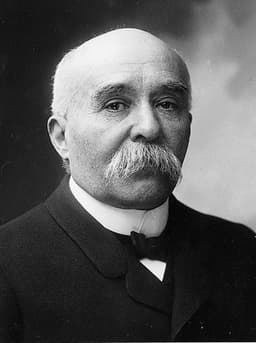
Georges Clemenceau
Politician · Modern
63.8Total

Julius Caesar
General · Ancient
82.8Total
Basic Information
Born
1841
-100
Died
1929
-44
Era
Modern
Ancient
Nationality
France
Roman Republic
Occupation
Politician
General
Civilization
Western
Western
Score Comparison
Military (10%)
49.1
88.0
Political (20%)
70.3
78.0
Influence (20%)
65.0
85.0
Legacy (20%)
65.0
82.0
Leadership (15%)
78.0
80.0
Strategy (15%)
41.4
85.0
TOTAL
63.8
82.8
Georges Clemenceau — Complete Timeline
1917 AD
Became Prime Minister of France for the second timePolitical Action◆ Major
Clemenceau was appointed premier during a critical phase of World War I, after the failure of the Nivelle Offensive and mutinies in the French army. He formed a war government and vowed to pursue the war to victory, restoring morale and discipline.
World War ILeadershipWar Government
Impact: global
Suppressed the French army mutinies of 1917Political Action◆ Major
Clemenceau took a hard line against mutineers, ordering arrests and courts-martial. He also improved soldiers' conditions and leave. His actions restored order in the French army, allowing it to continue fighting effectively for the remainder of the war.
World War IMutinyDiscipline
Impact: nationaldestructive
1919 AD
Played a leading role in the Paris Peace ConferencePolitical Action◆ Major
Clemenceau chaired the Paris Peace Conference and was a key figure in drafting the Treaty of Versailles. He insisted on harsh terms for Germany, including reparations, territorial losses, and military restrictions, to ensure French security.
World War IPeace TreatyVersailles
Impact: global
1920 AD
Resigned as Prime MinisterPolitical Action
Clemenceau lost the presidential election to Paul Deschanel and subsequently resigned as prime minister. His departure marked the end of his wartime leadership. He retired from politics, having achieved his goal of victory and a punitive peace.
ResignationPoliticsPost-War
Impact: national
Julius Caesar — Complete Timeline
58 BC
Gallic WarsWar◆ Major
Caesar, as proconsul of Gaul, launched a series of campaigns that conquered all of Gaul (modern France, Belgium, and parts of Switzerland). He fought numerous battles, including against the Helvetii, the Belgae, and the Gallic chieftain Vercingetorix. The wars brought immense wealth and a loyal army to Caesar.
Gallic WarsConquestRoman Expansion
Impact: regional
49 BC
Crossing the RubiconPolitical Action◆ Major
Caesar led Legio XIII across the Rubicon River into Italy, defying the Roman Senate's order to disband his army. This act triggered a civil war against Pompey and the Optimates, ultimately leading to Caesar's dictatorship and the end of the Roman Republic.
Roman Civil WarEnd of RepublicPower Struggle
Impact: global
48 BC
Battle of PharsalusWar◆ Major
Caesar's outnumbered army defeated the larger forces of Pompey the Great at Pharsalus in Greece. Caesar's tactical use of a reserve line to counter Pompey's cavalry charge proved decisive. Pompey fled to Egypt, where he was assassinated, leaving Caesar as the undisputed master of the Roman world.
Roman Civil WarBattleDecisive Victory
Impact: regional
44 BC
Appointment as Dictator for LifePolitical Action◆ Major
The Roman Senate appointed Caesar dictator perpetuo (dictator for life), granting him unprecedented personal power. This move concentrated military, legislative, and judicial authority in one person, effectively ending the Roman Republic's traditional system of checks and balances and alarming many senators.
DictatorshipEnd of RepublicPower Consolidation
Impact: regionaldestructive
Assassination on the Ides of MarchPolitical Action◆ Major
A group of Roman senators, led by Marcus Junius Brutus and Gaius Cassius Longinus, stabbed Caesar to death at a meeting of the Senate in the Theatre of Pompey. The assassination was intended to restore the Republic, but instead triggered another civil war that led to the rise of the Roman Empire.
AssassinationRoman PoliticsEnd of Republic
Impact: globaldestructive
Expert Analysis
georges-clemenceau-vs-julius-caesar
# The Tiger and the Dictator: Two Titans Who Shaped the West
In the spring of 1919, as a seventy-seven-year-old Frenchman with a bristling mustache pounded the table at the Paris Peace Conference, demanding reparations from a defeated Germany, he was channeling a spirit that had last roamed the corridors of power two millennia earlier. Georges Clemenceau, known as "The Tiger," was no Julius Caesar—he never crossed a Rubicon, never conquered Gaul, never marched legions across the known world. Yet both men, separated by nearly two thousand years, faced the same fundamental question: how does a leader hold a fractured state together when the old order is crumbling? Their answers, forged in radically different eras, tell us as much about the nature of power as they do about the men who wielded it.
Origins
Caesar was born into the twilight of the Roman Republic, a world of senatorial intrigue and civil wars. His family, the Julii, claimed descent from the goddess Venus, though by his time they were politically marginal. His father died when Caesar was sixteen, leaving him to navigate a treacherous world of debt, exile, and ambition. He learned early that survival meant forging alliances—with the populist Marius, with the wealthy Crassus, with the military legend Pompey. His was a world where a man could rise by eloquence, charm, and ruthlessness.
Clemenceau emerged from a very different crucible: the Vendée region of France, where his father, a provincial doctor, was a staunch republican and anti-clericalist who raised his son on tales of the French Revolution. The young Clemenceau studied medicine, spent time in the United States during the Civil War, and returned to a France humiliated by the Franco-Prussian War of 1870. He entered politics as a firebrand, a duelist, a journalist who tore down ministries with his pen. Where Caesar inherited a dying republic, Clemenceau inherited a republic still struggling to be born.
Rise to Power
Caesar’s ascent was a masterpiece of calculated risk. He served as military tribune, quaestor, and aedile, spending borrowed fortunes on games and spectacles to win the people’s love. His first major command came in Spain, where he pacified tribes and earned his first triumph. Then came the Gallic Wars—a decade of conquest that made him the richest and most feared man in Rome. When the Senate ordered him to disband his army, he instead crossed the Rubicon River in 49 BCE, a line that meant war. Within five years, he was dictator for life, a title that ended the Republic forever.
Clemenceau’s path was slower, more tortuous. He served as a radical deputy in the 1870s, gaining the nickname "The Tiger" for his ferocious attacks on governments. He became prime minister briefly in 1906, but his first term ended in failure. It was only in 1917, at the age of seventy-six, that he returned to power—and only because France was bleeding to death. The Nivelle Offensive had failed, mutinies had broken out in the French army, and the country was on the brink of collapse. Clemenceau was the last resort, a man so feared for his temper that even his allies called him "the Tiger" with a shudder.
Leadership & Governance
Caesar governed as a military autocrat draped in republican robes. He reformed the calendar, granted citizenship to provincials, initiated public works, and centralized power in his own hands. His military genius was undisputed: at Alesia in 52 BCE, he besieged an army while simultaneously defeating a relief force, a feat of logistics and nerve that still astounds strategists. But his political wisdom was flawed. He pardoned his enemies, believing they would be grateful; instead, they plotted his death. He accepted the title "dictator for life," a flagrant violation of Roman tradition that made assassination inevitable.
Clemenceau governed as a parliamentary bulldog. He did not lead armies; he led a nation at war. When the French army mutinied in 1917, he did not order mass executions—he arrested ringleaders, improved conditions, and visited the trenches himself, speaking to soldiers as equals. His military score of 37.5 reflects a man who never commanded troops, yet his leadership score of 78.0 captures something deeper: the courage to make unpopular decisions. At the Paris Peace Conference in 1919, he fought for reparations and security guarantees, knowing that France had lost 1.4 million men. He was called a warmonger; he called himself a realist.
Triumph & Tragedy
Caesar’s greatest triumph was Gaul—a conquest that added a vast territory to the Roman sphere and made him the master of the West. His greatest tragedy was his assassination on the Ides of March, 44 BCE, stabbed by senators he had pardoned. His last words, according to tradition, were "Et tu, Brute?"—a cry of betrayal that echoed through history. He died at fifty-five, at the height of his power, leaving behind a civil war that ended only with the rise of Augustus.
Clemenceau’s greatest triumph was leading France through the final year of World War I, then shaping the peace. His greatest tragedy came immediately after: in 1920, he ran for president of France and lost to Paul Deschanel, a lesser man. He resigned as prime minister and spent his final years writing memoirs and watching the Treaty of Versailles unravel. He died in 1929, just as the world began its slide toward another war. His legacy score of 75.0 reflects a man who won the peace but could not make it last.
Character & Destiny
Caesar was audacity incarnate. He gambled everything on Gallic conquest, on crossing the Rubicon, on pardoning his enemies. His personality—charismatic, reckless, visionary—drove his decisions. He believed in his own star, and for a time, the stars obeyed. But his arrogance blinded him to the hatred he inspired. He died because he could not imagine that others would not love him as he loved himself.
Clemenceau was anger incarnate. He was called "The Tiger" not for his ferocity in battle, but for his ferocity in debate. He fought duels, he broke governments, he shouted down generals. Yet his anger had a purpose: it was the anger of a man who had seen France humiliated by Prussia in 1870 and was determined that it would not happen again. His personality drove him to be the leader France needed in 1917, but it also made him impossible to love, and impossible to elect president.
Legacy
Caesar’s legacy is the Roman Empire. He set the template for every European dictator who followed—from Napoleon to Mussolini—and his name became synonymous with absolute power. His reforms outlived him, and his adopted heir, Octavian, became Augustus, the first emperor. The Western world still lives in the shadow of the institutions he shaped.
Clemenceau’s legacy is more ambiguous. He is remembered as the architect of the Treaty of Versailles, a peace that many blame for World War II. But he is also remembered as the man who saved France in its darkest hour. His name adorns streets and squares across France, and his statue stands in the Champs-Élysées. Yet his true legacy may be the lesson he taught: that democracy requires a tiger to defend it, but the tiger must know when to sheathe its claws.
Conclusion
Standing at the edge of the Paris Peace Conference, Clemenceau once said, "War is a series of catastrophes that results in a victory." Caesar would have understood. Both men lived through catastrophes, both seized power in moments of crisis, and both left behind worlds they had remade. Caesar crossed the Rubicon; Clemenceau crossed the threshold of the twentieth century. One founded an empire; the other defended a republic. Yet both remind us that history’s greatest figures are not those who merely survive their age, but those who seize it by the throat and force it to change. The Tiger and the Dictator—each, in his own way, a master of the impossible.
Rankings
🥇
Julius CaesarLeader
Mil: 88.0Pol: 78.0Inf: 85.0
82.8
🥈
Georges Clemenceau
Mil: 49.1Pol: 70.3Inf: 65.0
63.8
+19.0 behind
How This Comparison Works
Algorithm
Each figure is scored on 6 dimensions (0—100 scale) based on structured historical data: Military (10%), Political (20%), Influence (20%), Legacy (20%), Leadership (15%), Strategy (15%). The weighted total produces the final ranking.
Data Sources
Scores are computed from structured sub-indicators in the database. Scale factors adjust for era (Ancient ×0.85, Modern ×1.0) and civilization size (Eastern ×1.05, Other ×0.80) to account for differences in population and military scale.
Maximum 3 Figures
Comparisons are limited to 2—3 figures to ensure readability and statistical meaningfulness.
Error Margins
±5 points per dimension — Sub-scores are derived from historical records with inherent uncertainty. Two figures within 5 points on a dimension should be considered roughly equivalent in that area.
Total Score Accuracy
±3 points overall — The weighted combination of 6 dimensions produces a total score with approximately ±3 points of uncertainty. Differences of less than 3 points are not statistically significant— the figures are effectively tied.
Known Limitations
- Historical records are incomplete and uneven across civilizations
- Figures from oral-tradition societies may be underrepresented
- Occupation labels can misclassify multi-role figures
- Scores measure capability and impact, not moral character
- Quantitative scoring is a comparison tool, not absolute truth
Capability Radar
Military (10%) — Battles & Warfare
Battles
30
95
Win Rate
32
92
Expansion
34
97
Political (20%) — Governance & Reform
Reform
80
90
Diplomacy
90
85
Economy
70
82
Influence (20%) — Cultural & Global Reach
Cultural
60
88
Global
80
94
Legacy (20%) — Historical Impact
Historical
85
95
Longevity
70
96
Leadership (15%) — Power & Stability
Tenure
85
75
Stability
75
60
Strategy (15%) — Tactics & Innovation
Strategy
35
94
Tactics
38
96
Reform
46
88
Similar Comparisons
Comments & Discussion
The Last Optimist6/17/2026
Caesar crossed the Rubicon to save his skin, knowing full well it meant civil war. Clemenceau stared down total defeat in 1917 and chose to fight on, not for personal glory, but because he understood that France’s survival depended on industrial grit and American loans. Caesar was a gambler with a death wish; Clemenceau was a surgeon cutting out the cancer of defeatism. Give me the Tiger’s grim realism over Caesar’s theatrical ambition any day.
共和之刃6/17/2026
说Clemenceau不像Caesar?笑话!两人都摧毁旧秩序重建权力:Caesar终结元老院,Clemenceau在1919年一锤定音取消德国军备。但Caesar至少写了《高卢战记》给自己贴金,Clemenceau连回忆录都懒得写——真正狠人从不在乎后世怎么看。要我说,老虎比独裁者更纯粹,因为他要的不是不朽,而是胜利。
Quaestor’s Complaint6/17/2026
The comparison ignores a key financial detail: Caesar paid off Rome’s debts with Gallic gold, while Clemenceau demanded Germany pay for France’s reconstruction. Both were brilliant pragmatists, but Caesar’s conquests financially destabilized the Republic in the long run—inflation, land crises, the lot. Clemenceau’s reparations backfired too, fueling German resentment. Neither man was a fiscal genius; they were just exceptionally good at spending other people’s money to prop up their fragile stat
史学侦探6/17/2026
你们都在夸他们如何强硬,却忽略了最关键的区别:Caesar面对元老院的敌人时,选择收买和暗杀;Clemenceau面对德国,选择公开羞辱和索赔。前者赢了内战却输掉共和国,后者赢了和约却输掉和平。老虎的牙齿再利,也咬不碎凡尔赛体系的先天缺陷。历史证明,强硬≠高明,懂妥协才是真本事。