Loading...
Georgy Zhukov vs Nguyen Cao Ky
Georgy Zhukov leads by 17.0 pts · 2 figures compared
…

Georgy Zhukov
General · Modern
66.0Total
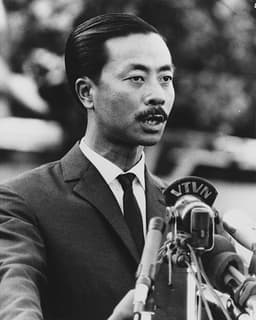
Nguyen Cao Ky
General · Modern
49.0Total
Basic Information
Born
1896
1930
Died
1974
—
Era
Modern
Modern
Nationality
Russia
Vietnam
Occupation
General
General
Civilization
Western
Eastern
Score Comparison
Military (10%)
80.0
45.0
Political (20%)
68.0
39.4
Influence (20%)
40.0
50.2
Legacy (20%)
90.0
40.0
Leadership (15%)
48.8
67.0
Strategy (15%)
80.1
60.0
TOTAL
66.0
49.0
Georgy Zhukov — Complete Timeline
1939 AD
Battle of Khalkhin GolWar
Zhukov commanded Soviet and Mongolian forces against the Japanese Kwantung Army at Khalkhin Gol. His use of combined arms tactics, including encirclement and artillery, resulted in a decisive Soviet victory that secured the Soviet eastern border.
Soviet-Japanese Border ConflictsCombined ArmsDecisive Victory
Impact: regional
1941 AD
Battle of MoscowWar
Zhukov took command of the defense of Moscow in October 1941. He organized a counteroffensive in December, pushing German forces back 100-250 miles from the capital. The victory was the first major defeat of the German army in World War II.
World War IIEastern FrontFirst German Defeat
Impact: global
1942 AD
Battle of StalingradWar
Zhukov planned and coordinated Operation Uranus, the Soviet counteroffensive that encircled the German 6th Army at Stalingrad. The operation led to the surrender of German forces in February 1943, a turning point in the war.
World War IIEastern FrontTurning Point
Impact: global
1943 AD
Battle of KurskWar◆ Major
Zhukov coordinated the Soviet defense at Kursk, the largest tank battle in history. The Soviet victory halted the German offensive and allowed the Red Army to launch a counteroffensive that pushed German forces back to the Dnieper River.
World War IIEastern FrontTank Battle
Impact: global
1945 AD
Battle of BerlinWar
Zhukov commanded the 1st Belorussian Front in the assault on Berlin. His forces captured the Reichstag and accepted the German surrender on May 8, 1945. The victory ended World War II in Europe and made Zhukov a national hero.
World War IIEastern FrontFall of Berlin
Impact: global
Nguyen Cao Ky — Complete Timeline
1963 AD
Commander of South Vietnamese Air ForcePolitical Action◆ Major
Nguyen Cao Ky was appointed commander of the Republic of Vietnam Air Force. He led the air force during the Buddhist crisis and participated in the coup that overthrew President Ngo Dinh Diem.
Air ForceCoupDiem
Impact: national
1965 AD
Appointed Prime MinisterPolitical Action◆ Major
Nguyen Cao Ky became Prime Minister of South Vietnam, leading a military junta. His government intensified the war against the Viet Cong and North Vietnam, with strong US support.
Prime MinisterMilitary juntaVietnam War
Impact: national
1967 AD
Conflict with President ThieuPolitical Action
Nguyen Cao Ky ran for president but lost to Nguyen Van Thieu, becoming vice president. The two leaders had a tense relationship, with Ky later accusing Thieu of corruption and mismanagement of the war.
ElectionThieuRivalry
Impact: nationaldestructive
1975 AD
Exile after fall of SaigonPolitical Action◆ Major
Nguyen Cao Ky fled South Vietnam as Saigon fell to North Vietnamese forces. He settled in the United States, where he became a critic of the communist government and later returned to Vietnam for visits.
ExileFall of SaigonVietnam War
Impact: nationaltragic
Expert Analysis
Origins
Georgy Zhukov was born in 1896 into a poor peasant family in Strelkovka, Russia. He received minimal formal education but apprenticed as a furrier. He was conscripted into the Imperial Russian Army in 1915, serving in a cavalry regiment during World War I. After the Bolshevik Revolution, he joined the Red Army in 1918, fighting in the Russian Civil War. He joined the Communist Party in 1919, and his rise through the ranks was aided by his tactical acumen and loyalty.
Nguyen Cao Ky was born in 1930 in Son Tay, French Indochina (now Vietnam), into a wealthy landowning family. He attended French colonial schools and later studied at the Dalat Military Academy. He joined the Vietnamese National Army under French command and trained as a pilot in France and the United States. His background was privileged compared to Zhukov's, but both were shaped by the wars of their times.
Rise to Power
Zhukov's rise began in the late 1930s after surviving Stalin's purges. His breakthrough came at the Battle of Khalkhin Gol in 1939, where he commanded Soviet and Mongolian forces against the Japanese. His use of combined arms tactics, including encirclement and artillery, resulted in a decisive victory. This earned him the title Hero of the Soviet Union and command of the Kiev Military District. In January 1941, he was appointed Chief of the General Staff, though he lost that position after disagreements with Stalin over the defense of Kiev. However, his reputation as a commander who could win was cemented.
Ky rose to power through the coup-prone politics of South Vietnam. As commander of the Republic of Vietnam Air Force from 1963, he participated in the coup that overthrew President Ngo Dinh Diem. In 1965, he became Prime Minister of South Vietnam, leading a military junta. His rise was less about battlefield victories and more about political maneuvering and control of the air force, scoring 67.0 in leadership but only 39.4 in political skills.
Leadership & Governance
Zhukov was a ruthless but effective military leader. He demanded strict discipline and was known for his meticulous planning and aggressive tactics. As a commander, he often visited front lines and personally directed operations. His leadership style was authoritarian, but he earned the respect of his troops. He scored 48.8 in leadership, reflecting his effectiveness in wartime but also his bluntness and lack of political finesse. In governance, he had little role except briefly as Defense Minister after Stalin's death, where he suppressed the Hungarian Revolution in 1956.
Ky governed South Vietnam as a military strongman. He pursued an aggressive war against the Viet Cong and North Vietnam, escalating U.S. involvement. He also attempted to stabilize the government through social reforms, but his regime was plagued by corruption and infighting. His political score of 39.4 indicates his limited success in governance. His leadership style was charismatic but volatile, often clashing with other generals, especially President Nguyen Van Thieu.
Triumph & Tragedy
Zhukov's greatest triumphs were his victories in World War II: the defense of Moscow (1941), the encirclement at Stalingrad (1942-43), the victory at Kursk (1943), and the capture of Berlin (1945). These operations involved massive forces and high casualties, but they were strategically decisive. His greatest tragedy was his post-war fall from favor. Stalin, fearing his popularity, demoted him to command of the Odessa Military District. After Stalin's death, he briefly served as Defense Minister but was forced into retirement by Nikita Khrushchev in 1957, effectively ending his career.
Ky's triumph was his role in stabilizing South Vietnam during a period of political chaos. He served as Prime Minister from 1965 to 1967, overseeing a period of military escalation. However, his tragedy was the ultimate failure of South Vietnam. After losing the 1967 presidential election to Thieu, he became a marginalized vice president. When Saigon fell in 1975, he fled to the United States, living in exile. He scored 40.0 in legacy, reflecting the collapse of his cause.
Character & Destiny
Zhukov was blunt, confident, and sometimes insubordinate. He was willing to stand up to Stalin, which at times put him at risk. His character was shaped by his peasant origins and his military success. He believed in decisive action and was not afraid to incur heavy losses to achieve victory. This determination saved the Soviet Union but also contributed to his post-war downfall, as Stalin viewed him as a potential rival.
Ky was flamboyant and ambitious. He was known for his distinctive black flight suit and his outspoken anti-communism. His character led him to take risks, such as leading coups and making bold military decisions. However, his lack of political tact and his rivalry with Thieu undermined his effectiveness. His destiny was tied to the U.S. commitment to South Vietnam; when that ended, so did his career.
Legacy
Zhukov's legacy is immense. He is remembered as the most decorated Soviet general and the one who led the Red Army to victory over Nazi Germany. His strategic innovations, such as the use of combined arms and deep operations, influenced military thinking. He scored 90.0 in legacy, the highest of any category. His reputation in Russia remains strong, with monuments and the Zhukov Order named after him.
Ky's legacy is more limited. He is remembered as a controversial figure in the Vietnam War, neither a great general nor a successful politician. His influence score of 50.2 reflects his role as a symbol of the South Vietnamese military regime. In Vietnam, he is largely forgotten; in the West, he is a footnote in the history of the war.
Conclusion
Georgy Zhukov had a far greater impact than Nguyen Cao Ky. Zhukov's military achievements were on a global scale, defeating Nazi Germany and shaping the post-war world order. His total score of 66.0 versus Ky's 49.0 reflects this disparity. While Ky played a role in the Vietnam War, his impact was regional and ultimately unsuccessful. Zhukov's legacy endures in military doctrine and Russian national identity, while Ky's is confined to a failed conflict. The data supports that Zhukov is the more significant historical figure.
Rankings
🥇
Georgy ZhukovLeader
Mil: 80.0Pol: 68.0Inf: 40.0
66.0
🥈
Nguyen Cao Ky
Mil: 45.0Pol: 39.4Inf: 50.2
49.0
+17.0 behind
How This Comparison Works
Algorithm
Each figure is scored on 6 dimensions (0—100 scale) based on structured historical data: Military (10%), Political (20%), Influence (20%), Legacy (20%), Leadership (15%), Strategy (15%). The weighted total produces the final ranking.
Data Sources
Scores are computed from structured sub-indicators in the database. Scale factors adjust for era (Ancient ×0.85, Modern ×1.0) and civilization size (Eastern ×1.05, Other ×0.80) to account for differences in population and military scale.
Maximum 3 Figures
Comparisons are limited to 2—3 figures to ensure readability and statistical meaningfulness.
Error Margins
±5 points per dimension — Sub-scores are derived from historical records with inherent uncertainty. Two figures within 5 points on a dimension should be considered roughly equivalent in that area.
Total Score Accuracy
±3 points overall — The weighted combination of 6 dimensions produces a total score with approximately ±3 points of uncertainty. Differences of less than 3 points are not statistically significant— the figures are effectively tied.
Known Limitations
- Historical records are incomplete and uneven across civilizations
- Figures from oral-tradition societies may be underrepresented
- Occupation labels can misclassify multi-role figures
- Scores measure capability and impact, not moral character
- Quantitative scoring is a comparison tool, not absolute truth
Capability Radar
Military (10%) — Battles & Warfare
Battles
95
30
Win Rate
90
35
Expansion
90
10
Political (20%) — Governance & Reform
Reform
40
20
Diplomacy
55
25
Economy
30
15
Influence (20%) — Cultural & Global Reach
Cultural
65
15
Global
80
15
Legacy (20%) — Historical Impact
Historical
85
20
Longevity
75
10
Leadership (15%) — Power & Stability
Tenure
60
40
Stability
45
10
Strategy (15%) — Tactics & Innovation
Strategy
95
30
Tactics
92
40
Reform
85
25
Similar Comparisons
Comments & Discussion
No comments yet. Be the first to share your thoughts!