Loading...
Gerald Ford vs Naoto Kan
Gerald Ford leads by 2.3 pts · 2 figures compared
…
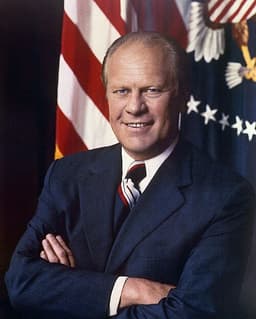
Gerald Ford
Politician · Modern
51.2Total

Naoto Kan
Politician · Modern
48.9Total
Basic Information
Born
1913
1946
Died
2006
—
Era
Modern
Modern
Nationality
United States
Japan
Occupation
Politician
Politician
Civilization
Western
Eastern
Score Comparison
Military (10%)
49.2
12.1
Political (20%)
48.0
54.7
Influence (20%)
54.1
55.7
Legacy (20%)
45.0
48.3
Leadership (15%)
68.0
65.7
Strategy (15%)
41.4
36.0
TOTAL
51.2
48.9
Gerald Ford — Complete Timeline
1973 AD
Appointed Vice PresidentPolitical Action◆ Major
Ford was appointed Vice President under the 25th Amendment after Spiro Agnew's resignation. He became the first person to hold the office without being elected to it.
Vice PresidencyConstitutional
Impact: national
1974 AD
Assumed Presidency after Nixon's ResignationPolitical Action
Ford became President after Richard Nixon resigned due to the Watergate scandal. He stated, 'Our long national nightmare is over,' aiming to restore trust in government.
PresidencyWatergate
Impact: national
Pardoned Richard NixonPolitical Action
Ford granted a full pardon to Richard Nixon for any crimes committed during his presidency. The pardon was highly controversial and is widely believed to have cost Ford the 1976 election.
PardonWatergate
Impact: national
1976 AD
Lost 1976 Presidential ElectionPolitical Action◆ Major
Ford lost the 1976 presidential election to Jimmy Carter. The narrow defeat was attributed to the Nixon pardon and economic issues, ending his brief presidency.
ElectionDefeat
Impact: nationaldestructive
Naoto Kan — Complete Timeline
2010 AD
Elected Prime Minister of JapanPolitical Action◆ Major
Kan was elected as Prime Minister of Japan after Yukio Hatoyama resigned. He succeeded Hatoyama as leader of the Democratic Party of Japan and formed a cabinet focused on fiscal reform and reducing the national debt.
JapanPrime MinisterDPJ
Impact: national
2011 AD
Announced phase-out of nuclear powerReform◆ Major
Kan announced a policy to phase out nuclear power in Japan by the 2030s. This decision followed the Fukushima disaster and marked a major shift in Japan's energy policy, though it was later reversed by subsequent governments.
JapanNuclear PowerEnergy Policy
Impact: nationalconstructive
Managed response to Fukushima Daiichi nuclear disasterPolitical Action◆ Major
Kan led Japan's response to the Fukushima nuclear disaster triggered by the T
JapanFukushimaNuclear Disaster
Impact: globaltragic
Resigned as Prime MinisterPolitical Action◆ Major
Kan resigned as Prime Minister after facing criticism over his handling of the Fukushima disaster and declining approval ratings. He was succeeded by Yoshihiko Noda.
JapanResignationFukushima
Impact: nationaltragic
Expert Analysis
Origins
Gerald Ford was born in 1913 in Omaha, Nebraska, and raised in Grand Rapids, Michigan. His early life was marked by his parents' divorce and his mother's remarriage. Ford attended the University of Michigan, where he played football, and later Yale Law School, graduating in 1941. He served in the US Navy during World War II, reaching the rank of lieutenant commander. Ford entered politics in 1949 as a US Representative from Michigan, serving for 25 years. Naoto Kan was born in 1946 in Ube, Yamaguchi, Japan. His father was a businessman, and Kan studied physics at the Tokyo Institute of Technology, graduating in 1970. He became a lawyer and entered politics in 1980 as a member of the House of Representatives. Kan co-founded the Democratic Party of Japan (DPJ) in 1998, advocating for reform and transparency.
Rise to Power
Ford became Vice President in 1973 under the 25th Amendment after Spiro Agnew's resignation. He assumed the presidency on August 9, 1974, following Richard Nixon's resignation due to the Watergate scandal. Ford's rise was unprecedented: he was the only person to hold both vice presidency and presidency without being elected. His key turning point was his appointment as Vice President, which placed him in line for the presidency. Kan rose to prominence as a reformist politician. He served as Minister of Health and Welfare in the 1990s, exposing a HIV-tainted blood scandal. He became Prime Minister of Japan on June 8, 2010, after Yukio Hatoyama resigned. Kan's rise was driven by his reputation as a crusader against corruption and his role in the DPJ's 2009 election victory.
Leadership & Governance
Ford's leadership focused on restoring trust after Watergate. He scored 68.0 in leadership, reflecting his calm demeanor. His signature act was pardoning Nixon on September 8, 1974, which he believed would allow the country to move forward. However, the pardon damaged his popularity and is widely seen as a political miscalculation. Ford also faced economic challenges, including inflation and recession, and his Whip Inflation Now (WIN) campaign had limited success. Kan's leadership was tested by the Fukushima disaster. He scored 65.7 in leadership. Kan took an active role in the crisis, often clashing with Tokyo Electric Power Company (TEPCO) and bureaucracy. He ordered evacuations and a nuclear phase-out, but his interventionist style was criticized for causing confusion. Kan's governance was marked by his push for renewable energy, but his approval ratings plummeted due to perceived mishandling of the crisis.
Triumph & Tragedy
Ford's greatest triumph was providing stability after Nixon's resignation. He helped restore public confidence in government, and his pardon of Nixon, though controversial, may have prevented a prolonged national trauma. His greatest failure was the pardon itself, which likely cost him the 1976 election. Ford also failed to address the economic stagflation effectively. Kan's triumph was his decisive response to Fukushima, including ordering evacuations that likely saved lives. He also implemented a phase-out of nuclear power, a major policy shift. His tragedy was the chaotic crisis management, criticized for lack of coordination. Kan's approval ratings fell from over 60% to under 20% by the time he resigned on September 2, 2011. Both leaders faced crises that defined their short tenures.
Character & Destiny
Ford was known for his honesty and integrity. He was a moderate Republican who prioritized healing the nation over his own political future. His character shaped his destiny: the pardon reflected his belief in forgiveness but sealed his electoral defeat. Ford scored 41.4 in strategy, indicating his reactive rather than proactive approach. Kan was a combative reformer, often described as stubborn. His character drove him to take charge during Fukushima, but his micromanagement created friction. Kan scored 36.0 in strategy, reflecting his difficulty in navigating complex systems. Both men were shaped by crises not of their making, and their responses reflected their core values.
Legacy
Ford's legacy is mixed. He is remembered for his pardon of Nixon, which remains debated. Historians rank him as an average president, with an overall score of 51.2. His political score is 48.0, influence 54.1, and legacy 45.0. Ford's greatest contribution was demonstrating constitutional continuity during a crisis. Kan's legacy is defined by Fukushima. He is credited with initiating Japan's shift away from nuclear power, but criticized for crisis management. Kan scores 48.9 overall, with political 54.7, influence 55.7, and legacy 48.3. Both leaders left lasting impacts on their nations' political landscapes.
Conclusion
Gerald Ford had a greater impact than Naoto Kan, as reflected in his higher total score (51.2 vs 48.9). Ford's actions during the Watergate crisis preserved constitutional order, while Kan's handling of Fukushima, though significant, was more reactive and less successful. Ford's leadership score (68.0) and military score (49.2) also exceed Kan's (65.7 and 12.1). While both faced unprecedented challenges, Ford's decision to pardon Nixon, however controversial, was a strategic choice to heal the nation, whereas Kan's crisis management was marked by confusion. Therefore, Ford's impact on American governance and trust in institutions outweighs Kan's influence on Japanese energy policy.
Rankings
🥇
Gerald FordLeader
Mil: 49.2Pol: 48.0Inf: 54.1
51.2
🥈
Naoto Kan
Mil: 12.1Pol: 54.7Inf: 55.7
48.9
+2.3 behind
How This Comparison Works
Algorithm
Each figure is scored on 6 dimensions (0—100 scale) based on structured historical data: Military (10%), Political (20%), Influence (20%), Legacy (20%), Leadership (15%), Strategy (15%). The weighted total produces the final ranking.
Data Sources
Scores are computed from structured sub-indicators in the database. Scale factors adjust for era (Ancient ×0.85, Modern ×1.0) and civilization size (Eastern ×1.05, Other ×0.80) to account for differences in population and military scale.
Maximum 3 Figures
Comparisons are limited to 2—3 figures to ensure readability and statistical meaningfulness.
Error Margins
±5 points per dimension — Sub-scores are derived from historical records with inherent uncertainty. Two figures within 5 points on a dimension should be considered roughly equivalent in that area.
Total Score Accuracy
±3 points overall — The weighted combination of 6 dimensions produces a total score with approximately ±3 points of uncertainty. Differences of less than 3 points are not statistically significant— the figures are effectively tied.
Known Limitations
- Historical records are incomplete and uneven across civilizations
- Figures from oral-tradition societies may be underrepresented
- Occupation labels can misclassify multi-role figures
- Scores measure capability and impact, not moral character
- Quantitative scoring is a comparison tool, not absolute truth
Capability Radar
Military (10%) — Battles & Warfare
Battles
27
14
Win Rate
35
19
Expansion
36
19
Political (20%) — Governance & Reform
Reform
40
45
Diplomacy
45
35
Economy
35
30
Influence (20%) — Cultural & Global Reach
Cultural
30
20
Global
35
45
Legacy (20%) — Historical Impact
Historical
40
50
Longevity
30
30
Leadership (15%) — Power & Stability
Tenure
55
40
Stability
50
25
Strategy (15%) — Tactics & Innovation
Strategy
36
22
Tactics
39
23
Reform
44
31
Similar Comparisons
Comments & Discussion
No comments yet. Be the first to share your thoughts!