Loading...
Gerald Ford vs Napoleon Bonaparte
Napoleon Bonaparte leads by 19.7 pts · 2 figures compared
…
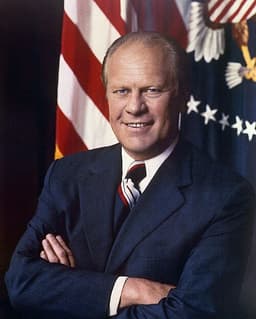
Gerald Ford
Politician · Modern
51.2Total

Napoleon Bonaparte
General · Modern
70.9Total
Basic Information
Born
1913
1769
Died
2006
1821
Era
Modern
Modern
Nationality
United States
France
Occupation
Politician
General
Civilization
Western
Western
Score Comparison
Military (10%)
49.2
94.0
Political (20%)
48.0
72.0
Influence (20%)
54.1
40.0
Legacy (20%)
45.0
80.0
Leadership (15%)
68.0
78.0
Strategy (15%)
41.4
90.0
TOTAL
51.2
70.9
Gerald Ford — Complete Timeline
1973 AD
Appointed Vice PresidentPolitical Action◆ Major
Ford was appointed Vice President under the 25th Amendment after Spiro Agnew's resignation. He became the first person to hold the office without being elected to it.
Vice PresidencyConstitutional
Impact: national
1974 AD
Assumed Presidency after Nixon's ResignationPolitical Action
Ford became President after Richard Nixon resigned due to the Watergate scandal. He stated, 'Our long national nightmare is over,' aiming to restore trust in government.
PresidencyWatergate
Impact: national
Pardoned Richard NixonPolitical Action
Ford granted a full pardon to Richard Nixon for any crimes committed during his presidency. The pardon was highly controversial and is widely believed to have cost Ford the 1976 election.
PardonWatergate
Impact: national
1976 AD
Lost 1976 Presidential ElectionPolitical Action◆ Major
Ford lost the 1976 presidential election to Jimmy Carter. The narrow defeat was attributed to the Nixon pardon and economic issues, ending his brief presidency.
ElectionDefeat
Impact: nationaldestructive
Napoleon Bonaparte — Complete Timeline
1799 AD
Coup of 18 BrumaireOther◆ Major
Napoleon Bonaparte, with support from his brother Lucien and key political figures, overthrew the Directory in a bloodless coup. He established the Consulate with himself as First Consul, effectively becoming the ruler of France. This event ended the French Revolution's most unstable period.
French RevolutionCoupRise to Power
Impact: regional
1804 AD
Promulgation of the Napoleonic CodeOther◆ Major
Napoleon enacted the Civil Code of the French, known as the Napoleonic Code, a comprehensive set of laws that replaced the fragmented feudal legal systems. The code established legal equality, protected property rights, and secularized law. It became the basis for legal systems in many European and world countries.
Legal ReformNapoleonic CodeCivil Law
Impact: globalconstructive
1805 AD
Battle of AusterlitzWar◆ Major
Napoleon's Grande Arm
Napoleonic WarsBattleDecisive Victory
Impact: global
1812 AD
Invasion of RussiaWar◆ Major
Napoleon led the Grande Arm
Napoleonic WarsInvasionDisaster
Impact: globaldestructive
1815 AD
Battle of WaterlooWar◆ Major
Napoleon's French army was defeated by the combined forces of the Duke of Wellington's Anglo-Allied army and Gebhard Leberecht von Bl
Napoleonic WarsBattleFinal Defeat
Impact: globaldestructive
Expert Analysis
gerald-ford-vs-napoleon-bonaparte
# The Emperor and the Healer: Two Men Who Shaped Their Eras in Opposite Ways
In the winter of 1814, Napoleon Bonaparte stood in the frozen courtyard of Fontainebleau, tearing the epaulets from his uniform as his generals wept. Twenty years earlier, he had been a penniless artillery officer from Corsica. Now, he was a fallen emperor, forced to abdicate and exiled to a Mediterranean island. Across the Atlantic and a century later, another man would assume power under circumstances no less extraordinary—but with a radically different approach. On August 9, 1974, Gerald Ford raised his right hand in the East Room of the White House and declared, “Our long national nightmare is over.” Where Napoleon had conquered to unify, Ford would pardon to heal. What drove these two Western leaders, both thrust into history’s crucible, to walk such divergent paths?
Origins
Napoleon was born in 1769 on Corsica, an island only recently annexed by France. His family were minor nobility, but they were not French—they spoke Italian, resented Paris, and dreamed of independence. This outsider status forged a restless ambition. At military school, he was mocked for his accent and small stature, but he devoured history and strategy, memorizing Alexander’s campaigns as other boys memorized prayers. The French Revolution, which erupted when he was twenty, shattered the old order and opened doors that birth alone could never have unlocked.
Gerald Ford, born in 1913 in Omaha, Nebraska, was the son of a wool merchant and a mother who fled an abusive first marriage. He grew up in Grand Rapids, Michigan, a Midwestern city where hard work and honesty were the highest virtues. Ford was a star football player at the University of Michigan—a team player, not a solo genius. He studied law at Yale, served in the Navy during World War II, and entered Congress in 1949. He was not brilliant, but he was steady. His colleagues called him “the most trusted man in Washington.” The Revolution that shaped Ford was not a storming of the Bastille but a quiet erosion of public trust in the 1970s.
Rise to Power
Napoleon’s ascent was a bolt of lightning. In 1793, at age twenty-four, he recaptured the port of Toulon from British forces with a bold artillery plan. By 1796, he commanded the French army in Italy, where he won six battles in twelve days. He was not merely a general—he was a political phenomenon. In 1799, he overthrew the corrupt Directory in a coup d’état and made himself First Consul. By 1804, he crowned himself Emperor of the French in Notre Dame Cathedral, taking the crown from the Pope’s hands and placing it on his own head. The message was unmistakable: his authority came from his own will, not from God or tradition.
Ford’s rise was the opposite—a slow, reluctant ascent through the only door left open. In 1973, Vice President Spiro Agnew resigned in disgrace, facing charges of bribery and tax evasion. President Richard Nixon, under the 25th Amendment, needed a replacement who could be confirmed by Congress. He chose Ford, the House Minority Leader, precisely because Ford had no enemies. Ford did not seek the vice presidency; it was thrust upon him. Eight months later, on August 8, 1974, Nixon himself resigned to avoid impeachment for the Watergate scandal. At noon the next day, Ford became the only person in American history to hold the presidency without ever being elected to it—neither as president nor as vice president.
Leadership & Governance
Napoleon governed with the same fury he brought to battle. He centralized the French state, created the Bank of France, and established lycées—state-run schools—to train a new elite. His greatest achievement was the Napoleonic Code of 1804, a civil law system that enshrined equality before the law, abolished feudal privileges, and protected property rights. It spread across Europe and still forms the basis of law in many countries today. But his military genius—scoring a 94 in strategy—was his defining trait. At Austerlitz in 1805, he lured the combined Russian and Austrian armies into a trap and destroyed them. He was a master of speed, deception, and concentration of force.
Yet Napoleon’s brilliance was also his flaw. He could not stop. He invaded Spain, then Russia, then Saxony. The Peninsular War bled his army dry. The Russian winter of 1812 killed 400,000 of his men. By 1814, the Sixth Coalition had cornered him. He abdicated, returned from exile in 1815 for the Hundred Days, and was finally crushed at Waterloo in June 1815.
Ford governed as a healer, not a conqueror. His political score of 67.5 reflects a man who prioritized stability over glory. He inherited a nation reeling from Watergate, inflation, and the humiliating end of the Vietnam War. His first act was to tell the nation, “I am acutely aware that you have not elected me as your president by your ballots.” Then, on September 8, 1974, he pardoned Richard Nixon for any crimes committed during the presidency. The decision was devastating to his popularity—his approval rating dropped from 71% to 49% overnight—but Ford believed it was necessary to “end the national nightmare.” He argued that a protracted trial would paralyze the government for years. History has largely vindicated him, though the pardon likely cost him the 1976 election.
Triumph & Tragedy
Napoleon’s greatest triumph was the Napoleonic Code—a legal framework that outlasted his empire. His greatest tragedy was his invasion of Russia in 1812. He marched 600,000 men into the vastness of Russia; fewer than 100,000 returned. The disaster shattered his aura of invincibility and emboldened his enemies.
Ford’s greatest triumph was the restoration of trust in the presidency. He governed with openness and humility, holding press conferences and meeting ordinary Americans. His greatest tragedy was the pardon itself—not because it was wrong, but because it was politically fatal. He lost the 1976 election to Jimmy Carter, a peanut farmer from Georgia, by a narrow margin. The pardon haunted him for the rest of his life.
Character & Destiny
Napoleon was a man of boundless ambition and ruthless pragmatism. He once said, “Impossible is a word to be found only in the dictionary of fools.” He believed he could bend history to his will. And for a time, he did. But his hubris—his conviction that no force could stop him—led him to overreach. He died in 1821 on Saint Helena, a remote island in the South Atlantic, at age fifty-one.
Ford was a man of decency and moderation. He once said, “I am a Ford, not a Lincoln.” He knew his limits. He did not try to be a great man; he tried to be a good one. He died in 2006 at age ninety-three, the longest-lived president in American history. His epitaph might be the eulogy given by Senator Edward Kennedy: “He helped restore faith in the presidency.”
Legacy
Napoleon’s legacy is written in the laws of Europe and the battlefields of history. He is studied as a military genius and a cautionary tale about the dangers of unchecked ambition. He scored an 82.4 overall—a towering figure whose flaws were as grand as his achievements.
Ford’s legacy is quieter but no less important. He scored 61.6 overall—modest by comparison. Yet he proved that leadership is not always about conquest. Sometimes it is about healing. In a time of crisis, he chose forgiveness over vengeance, stability over spectacle. And in doing so, he preserved the very institutions that Napoleon had sought to dominate.
Conclusion
Napoleon and Ford stand at opposite poles of Western leadership. One built an empire; the other mended a nation. One conquered Europe; the other conquered his own pride. Their lives remind us that history does not only belong to the brilliant and the bold. It also belongs to the steady and the humble. In the end, both men answered the call of their times—but in ways that could not have been more different.
Rankings
🥇
Napoleon BonaparteLeader
Mil: 94.0Pol: 72.0Inf: 40.0
70.9
🥈
Gerald Ford
Mil: 49.2Pol: 48.0Inf: 54.1
51.2
+19.7 behind
How This Comparison Works
Algorithm
Each figure is scored on 6 dimensions (0—100 scale) based on structured historical data: Military (10%), Political (20%), Influence (20%), Legacy (20%), Leadership (15%), Strategy (15%). The weighted total produces the final ranking.
Data Sources
Scores are computed from structured sub-indicators in the database. Scale factors adjust for era (Ancient ×0.85, Modern ×1.0) and civilization size (Eastern ×1.05, Other ×0.80) to account for differences in population and military scale.
Maximum 3 Figures
Comparisons are limited to 2—3 figures to ensure readability and statistical meaningfulness.
Error Margins
±5 points per dimension — Sub-scores are derived from historical records with inherent uncertainty. Two figures within 5 points on a dimension should be considered roughly equivalent in that area.
Total Score Accuracy
±3 points overall — The weighted combination of 6 dimensions produces a total score with approximately ±3 points of uncertainty. Differences of less than 3 points are not statistically significant— the figures are effectively tied.
Known Limitations
- Historical records are incomplete and uneven across civilizations
- Figures from oral-tradition societies may be underrepresented
- Occupation labels can misclassify multi-role figures
- Scores measure capability and impact, not moral character
- Quantitative scoring is a comparison tool, not absolute truth
Capability Radar
Military (10%) — Battles & Warfare
Battles
27
95
Win Rate
35
90
Expansion
36
95
Political (20%) — Governance & Reform
Reform
40
95
Diplomacy
45
80
Economy
35
85
Influence (20%) — Cultural & Global Reach
Cultural
30
85
Global
35
90
Legacy (20%) — Historical Impact
Historical
40
95
Longevity
30
90
Leadership (15%) — Power & Stability
Tenure
55
85
Stability
50
70
Strategy (15%) — Tactics & Innovation
Strategy
36
95
Tactics
39
98
Reform
44
92
Similar Comparisons
Comments & Discussion
No comments yet. Be the first to share your thoughts!