Loading...
This comparison has not been analyzed yet.
One-time AI generation (~1 minute). Scores and timeline are already available below.
Gerd von Rundstedt vs Raymond Spruance
Gerd von Rundstedt leads by 0.0 pts · 2 figures compared
…
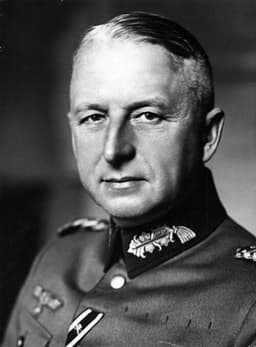
Gerd von Rundstedt
General · Modern
53.9Total

Raymond Spruance
General · Modern
53.9Total
Basic Information
Born
1875
1886
Died
1953
1969
Era
Modern
Modern
Nationality
Germany
United States
Occupation
General
General
Civilization
Western
Western
Score Comparison
Military (10%)
60.0
82.0
Political (20%)
36.5
30.8
Influence (20%)
62.0
59.0
Legacy (20%)
54.0
55.0
Leadership (15%)
50.7
40.4
Strategy (15%)
58.0
65.4
TOTAL
53.9
53.9
Gerd von Rundstedt — Complete Timeline
1940 AD
Command in the Battle of FranceWar◆ Major
Rundstedt commanded Army Group A during the invasion of France. His forces executed the Manstein Plan, advancing through the Ardennes and cutting off Allied forces in Belgium. The campaign resulted in the rapid defeat of France and the evacuation of British forces from Dunkirk.
World War IIBattle of FranceBlitzkrieg
Impact: global
1941 AD
Command of Army Group South in Operation BarbarossaWar◆ Major
Rundstedt commanded Army Group South during the invasion of the Soviet Union. His forces captured Kiev in September 1941, encircling and destroying a large Soviet force. However, he was relieved of command in December 1941 after ordering a retreat from Rostov against Hitler's orders.
World War IIEastern FrontInvasion
Impact: globaldestructive
1942 AD
Supreme Commander WestWar◆ Major
Rundstedt was appointed Commander-in-Chief West in March 1942, responsible for defending the Atlantic Wall against Allied invasion. He oversaw the construction of coastal defenses but clashed with Hitler over strategy, particularly regarding the placement of armored reserves.
World War IIWestern FrontDefense
Impact: regional
1944 AD
Dismissal and Recall during the Normandy CampaignWar◆ Major
Rundstedt was dismissed as Commander-in-Chief West in July 1944 after telling Hitler to make peace. He was recalled in September 1944 to command the Ardennes Offensive, but was again dismissed in March 1945 after the failure of the offensive.
World War IIWestern FrontCommand Change
Impact: regional
1945 AD
Capture and ImprisonmentPolitical Action
Rundstedt was captured by American forces in May 1945. He was held as a prisoner of war and later charged with war crimes, but was never tried due to his age and poor health. He was released in 1949.
World War IIPost-WarPrisoner
Impact: nationaltragic
Raymond Spruance — Complete Timeline
1942 AD
Battle of MidwayWar
Spruance commanded Task Force 16 at the Battle of Midway. His carriers launched airstrikes that sank four Japanese carriers. The victory was a turning point in the Pacific War. Spruance's cautious decision-making was credited with the success.
World War IIPacific TheaterNaval Battle
Impact: globalconstructive
1944 AD
Battle of the Philippine SeaWar◆ Major
Spruance commanded the Fifth Fleet in the Battle of the Philippine Sea. His forces destroyed over 600 Japanese aircraft and sank three carriers. The battle eliminated Japanese naval air power. Spruance's decision to not pursue the enemy fleet was debated.
World War IIPacific TheaterNaval Battle
Impact: regional
1945 AD
Battle of Iwo JimaWar◆ Major
Spruance oversaw the naval support for the invasion of Iwo Jima. His fleet provided bombardment and logistical support. The battle was one of the bloodiest in the Pacific. Spruance's planning was instrumental in the eventual capture of the island.
World War IIPacific TheaterAmphibious Assault
Impact: regional
Battle of OkinawaWar◆ Major
Spruance commanded the Fifth Fleet during the Battle of Okinawa. His forces faced intense kamikaze attacks. The fleet provided naval gunfire support and protected the invasion force. The battle resulted in heavy casualties on both sides.
World War IIPacific TheaterAmphibious Assault
Impact: regionaltragic
1946 AD
Appointed President of the Naval War CollegePolitical Action
Spruance served as President of the Naval War College from 1946 to 1948. He modernized the curriculum and emphasized the importance of naval aviation and joint operations. His tenure shaped post-war naval strategy.
Post-WarNaval EducationStrategy
Impact: nationalconstructive
This comparison has not been analyzed yet.
One-time AI generation (~1 minute). Scores and timeline are already available below.
Rankings
🥇
Gerd von RundstedtLeader
Mil: 60.0Pol: 36.5Inf: 62.0
53.9
🥈
Raymond Spruance
Mil: 82.0Pol: 30.8Inf: 59.0
53.9
How This Comparison Works
Algorithm
Each figure is scored on 6 dimensions (0—100 scale) based on structured historical data: Military (10%), Political (20%), Influence (20%), Legacy (20%), Leadership (15%), Strategy (15%). The weighted total produces the final ranking.
Data Sources
Scores are computed from structured sub-indicators in the database. Scale factors adjust for era (Ancient ×0.85, Modern ×1.0) and civilization size (Eastern ×1.05, Other ×0.80) to account for differences in population and military scale.
Maximum 3 Figures
Comparisons are limited to 2—3 figures to ensure readability and statistical meaningfulness.
Error Margins
±5 points per dimension — Sub-scores are derived from historical records with inherent uncertainty. Two figures within 5 points on a dimension should be considered roughly equivalent in that area.
Total Score Accuracy
±3 points overall — The weighted combination of 6 dimensions produces a total score with approximately ±3 points of uncertainty. Differences of less than 3 points are not statistically significant— the figures are effectively tied.
Known Limitations
- Historical records are incomplete and uneven across civilizations
- Figures from oral-tradition societies may be underrepresented
- Occupation labels can misclassify multi-role figures
- Scores measure capability and impact, not moral character
- Quantitative scoring is a comparison tool, not absolute truth
Capability Radar
Military (10%) — Battles & Warfare
Battles
75
85
Win Rate
65
90
Expansion
60
40
Political (20%) — Governance & Reform
Reform
20
10
Diplomacy
30
25
Economy
15
10
Influence (20%) — Cultural & Global Reach
Cultural
30
30
Global
50
55
Legacy (20%) — Historical Impact
Historical
55
70
Longevity
40
60
Leadership (15%) — Power & Stability
Tenure
30
20
Stability
20
15
Strategy (15%) — Tactics & Innovation
Strategy
75
92
Tactics
80
88
Reform
40
30
Similar Comparisons
Comments & Discussion
No comments yet. Be the first to share your thoughts!