Loading...
Francisco Franco vs Raymond Spruance
Francisco Franco leads by 8.0 pts · 2 figures compared
…
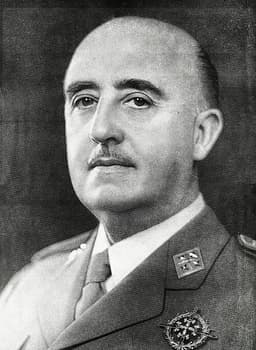
Francisco Franco
General · Modern
61.9Total

Raymond Spruance
General · Modern
53.9Total
Basic Information
Born
1892
1886
Died
1975
1969
Era
Modern
Modern
Nationality
Spain
United States
Occupation
General
General
Civilization
Western
Western
Score Comparison
Military (10%)
52.5
82.0
Political (20%)
68.0
30.8
Influence (20%)
56.7
59.0
Legacy (20%)
58.0
55.0
Leadership (15%)
78.0
40.4
Strategy (15%)
60.7
65.4
TOTAL
61.9
53.9
Francisco Franco — Complete Timeline
1936 AD
Appointed Generalissimo and Head of StatePolitical Action◆ Major
On October 1, 1936, the Nationalist faction appointed Francisco Franco as Generalissimo and Head of State of the Spanish State. This consolidated his leadership over the Nationalist forces during the Spanish Civil War, giving him supreme military and political authority.
Spanish Civil WarNationalist FactionLeadership
Impact: national
1939 AD
Declared Victory in the Spanish Civil WarOther◆ Major
On April 1, 1939, Franco announced the end of the Spanish Civil War after the Nationalist forces captured Madrid and the last Republican strongholds. This victory established Franco as the undisputed dictator of Spain, leading to a regime that lasted until his death.
Spanish Civil WarDictatorshipVictory
Impact: nationaldestructive
1947 AD
Signed the Law of SuccessionReform◆ Major
Franco enacted the Law of Succession in 1947, which declared Spain a monarchy but left Franco as regent for life with the power to choose his successor. This law institutionalized his personal rule and ensured the continuity of his regime after his death.
SuccessionMonarchyRegime Consolidation
Impact: national
1959 AD
Opened Spain to Foreign InvestmentOther◆ Major
In 1959, Franco approved the Stabilization Plan, which liberalized the Spanish economy, ended autarky, and opened Spain to foreign investment and tourism. This led to the 'Spanish Miracle' of rapid economic growth in the 1960s, transforming Spain from a poor agrarian country to a modern industrial economy.
Economic ReformStabilization PlanGrowth
Impact: nationalconstructive
1969 AD
Appointed Juan Carlos as SuccessorPolitical Action◆ Major
In 1969, Franco formally designated Prince Juan Carlos de Borb
SuccessionMonarchyTransition
Impact: national
Raymond Spruance — Complete Timeline
1942 AD
Battle of MidwayWar
Spruance commanded Task Force 16 at the Battle of Midway. His carriers launched airstrikes that sank four Japanese carriers. The victory was a turning point in the Pacific War. Spruance's cautious decision-making was credited with the success.
World War IIPacific TheaterNaval Battle
Impact: globalconstructive
1944 AD
Battle of the Philippine SeaWar◆ Major
Spruance commanded the Fifth Fleet in the Battle of the Philippine Sea. His forces destroyed over 600 Japanese aircraft and sank three carriers. The battle eliminated Japanese naval air power. Spruance's decision to not pursue the enemy fleet was debated.
World War IIPacific TheaterNaval Battle
Impact: regional
1945 AD
Battle of Iwo JimaWar◆ Major
Spruance oversaw the naval support for the invasion of Iwo Jima. His fleet provided bombardment and logistical support. The battle was one of the bloodiest in the Pacific. Spruance's planning was instrumental in the eventual capture of the island.
World War IIPacific TheaterAmphibious Assault
Impact: regional
Battle of OkinawaWar◆ Major
Spruance commanded the Fifth Fleet during the Battle of Okinawa. His forces faced intense kamikaze attacks. The fleet provided naval gunfire support and protected the invasion force. The battle resulted in heavy casualties on both sides.
World War IIPacific TheaterAmphibious Assault
Impact: regionaltragic
1946 AD
Appointed President of the Naval War CollegePolitical Action
Spruance served as President of the Naval War College from 1946 to 1948. He modernized the curriculum and emphasized the importance of naval aviation and joint operations. His tenure shaped post-war naval strategy.
Post-WarNaval EducationStrategy
Impact: nationalconstructive
Expert Analysis
Origins
Francisco Franco was born on December 4, 1892, in Ferrol, Galicia, Spain, into a naval family. His father was a naval officer, but Franco chose the army, entering the Infantry Academy at Toledo in 1907. He graduated in 1910 and served in Spanish Morocco, where he gained a reputation for effectiveness and ruthlessness. Raymond Spruance was born on July 3, 1886, in Baltimore, Maryland, USA. He attended the U.S. Naval Academy, graduating in 1906. His early career included service on battleships and destroyers, and he specialized in engineering and command. Unlike Franco, Spruance's background was purely professional military, without political ambitions.
Rise to Power
Franco rose rapidly through the ranks due to his service in Morocco, becoming the youngest general in Europe by 1926. He was appointed director of the General Military Academy in Zaragoza. When the Spanish Civil War began in July 1936, Franco was initially in the Canary Islands but quickly flew to Morocco to take command of the Army of Africa. On October 1, 1936, the Nationalist faction appointed him Generalissimo and Head of State. Franco consolidated power by defeating Republican forces with German and Italian support, declaring victory on April 1, 1939. Spruance's rise was less dramatic. He commanded a cruiser division in early 1942, but his big break came when he was assigned to lead Task Force 16 at the Battle of Midway in June 1942, replacing Admiral Halsey due to illness. Spruance's calm and strategic decisions during Midway led to the destruction of four Japanese carriers, a pivotal victory. He later commanded the Fifth Fleet, winning the Battle of the Philippine Sea in June 1944, where his forces destroyed over 600 Japanese aircraft and sank three carriers.
Leadership & Governance
Franco's leadership was autocratic and centralized. He ruled Spain as a dictator for 36 years, suppressing dissent through censorship, secret police, and execution of opponents. He enacted the Law of Succession in 1947, declaring Spain a monarchy but keeping himself as regent for life. Economically, Franco initially pursued autarky, leading to stagnation, but in 1959 he approved the Stabilization Plan, opening Spain to foreign investment and tourism, which spurred growth. Spruance's leadership was quiet and cerebral. He delegated authority effectively and focused on strategic planning. At the Philippine Sea, he made the controversial decision to not pursue the Japanese fleet aggressively, prioritizing the protection of the invasion force. This decision was criticized by some but defended by others as prudent. Spruance scored 40.4 in political leadership, reflecting his lack of interest in politics, while Franco scored 68.0.
Triumph & Tragedy
Franco's greatest triumph was winning the Spanish Civil War and establishing a stable authoritarian regime that lasted until his death. He kept Spain out of World War II, avoiding the devastation that befell other European nations. His economic reforms in the 1960s brought prosperity. However, his legacy is marred by the brutal repression during and after the civil war, with an estimated 100,000 to 200,000 executions. His regime suppressed regional languages and cultures. Spruance's greatest triumph was the victory at Midway, where his tactical decisions turned the tide in the Pacific. He also won the Philippine Sea, effectively destroying Japanese naval aviation. His tragedies were few; some criticized his caution at the Philippine Sea for not annihilating the remaining Japanese fleet, and the bloody battles of Iwo Jima and Okinawa under his command saw high casualties. Spruance's military score of 82.0 reflects his effectiveness, while his leadership score of 40.4 indicates a lack of political acumen.
Character & Destiny
Franco was calculating, patient, and ruthless. He avoided direct involvement in World War II to ensure his regime's survival, skillfully navigating pressure from Hitler. His decision to appoint Juan Carlos as successor ensured a peaceful transition to democracy after his death. Spruance was reserved, humble, and analytical. He avoided the spotlight and was known for his calm under pressure. His character led to consistent success in battle, but his lack of political ambition meant he never sought higher office. Spruance's destiny was to be a key figure in naval history, while Franco's was to shape Spain's 20th century.
Legacy
Franco's legacy is deeply divisive. His regime left Spain isolated and economically backward until the 1960s, but the subsequent transition to democracy and economic growth are partly due to his institutional choices. His scores: Influence 56.7, Legacy 58.0. Spruance's legacy is as one of America's greatest naval commanders. He is remembered for his role at Midway and the Philippine Sea. The Naval War College he led still influences naval strategy. Spruance's influence score of 59.0 and legacy score of 55.0 reflect his specialized impact.
Conclusion
While Franco's total score of 61.9 is higher than Spruance's 53.9, impact must be measured contextually. Franco's 36-year dictatorship directly affected millions, but his repressive regime and economic mismanagement largely hindered Spain's development. Spruance's victories at Midway and the Philippine Sea were decisive in World War II, a conflict that shaped global history. Spruance's strategic decisions had a more profound and positive impact on world events than Franco's authoritarian rule. Therefore, Raymond Spruance had greater historical impact.
Rankings
🥇
Francisco FrancoLeader
Mil: 52.5Pol: 68.0Inf: 56.7
61.9
🥈
Raymond Spruance
Mil: 82.0Pol: 30.8Inf: 59.0
53.9
+8.0 behind
How This Comparison Works
Algorithm
Each figure is scored on 6 dimensions (0—100 scale) based on structured historical data: Military (10%), Political (20%), Influence (20%), Legacy (20%), Leadership (15%), Strategy (15%). The weighted total produces the final ranking.
Data Sources
Scores are computed from structured sub-indicators in the database. Scale factors adjust for era (Ancient ×0.85, Modern ×1.0) and civilization size (Eastern ×1.05, Other ×0.80) to account for differences in population and military scale.
Maximum 3 Figures
Comparisons are limited to 2—3 figures to ensure readability and statistical meaningfulness.
Error Margins
±5 points per dimension — Sub-scores are derived from historical records with inherent uncertainty. Two figures within 5 points on a dimension should be considered roughly equivalent in that area.
Total Score Accuracy
±3 points overall — The weighted combination of 6 dimensions produces a total score with approximately ±3 points of uncertainty. Differences of less than 3 points are not statistically significant— the figures are effectively tied.
Known Limitations
- Historical records are incomplete and uneven across civilizations
- Figures from oral-tradition societies may be underrepresented
- Occupation labels can misclassify multi-role figures
- Scores measure capability and impact, not moral character
- Quantitative scoring is a comparison tool, not absolute truth
Capability Radar
Military (10%) — Battles & Warfare
Battles
65
85
Win Rate
70
90
Expansion
20
40
Political (20%) — Governance & Reform
Reform
40
10
Diplomacy
50
25
Economy
45
10
Influence (20%) — Cultural & Global Reach
Cultural
40
30
Global
55
55
Legacy (20%) — Historical Impact
Historical
60
70
Longevity
55
60
Leadership (15%) — Power & Stability
Tenure
90
20
Stability
55
15
Strategy (15%) — Tactics & Innovation
Strategy
65
92
Tactics
60
88
Reform
55
30
Similar Comparisons
Comments & Discussion
No comments yet. Be the first to share your thoughts!