Loading...
Golbery do Couto e Silva vs William Henry Harrison
Golbery do Couto e Silva leads by 6.8 pts · 2 figures compared
…
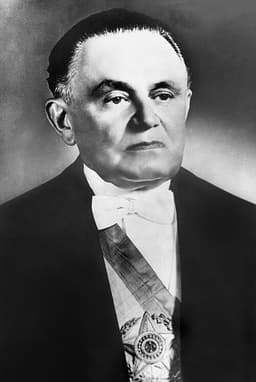
Golbery do Couto e Silva
General · Modern
48.8Total
William Henry Harrison
General · Modern
42.0Total
Basic Information
Born
1911
1773
Died
1987
1841
Era
Modern
Modern
Nationality
Brazil
United States
Occupation
General
General
Civilization
Western
Western
Score Comparison
Military (10%)
10.2
50.0
Political (20%)
68.0
30.8
Influence (20%)
51.8
49.4
Legacy (20%)
46.7
42.5
Leadership (15%)
57.6
33.6
Strategy (15%)
43.3
43.3
TOTAL
48.8
42.0
Golbery do Couto e Silva — Complete Timeline
1950 AD
Developed the 'Geopolitics of Brazil' DoctrineCultural◆ Major
Golbery published 'Geopolitics of Brazil', a book that outlined his strategic vision for Brazil's national security and development. This work influenced the military's thinking on national security and justified the regime's policies.
GeopoliticsNational SecurityMilitary Doctrine
Impact: national
1964 AD
Founded the National Intelligence Service (SNI)Political Action◆ Major
Golbery do Couto e Silva was the main architect and first head of the National Intelligence Service (SNI) after the 1964 military coup. The SNI became the central intelligence and coordination agency of the military regime, monitoring political opponents.
IntelligenceMilitary RegimeRepression
Impact: nationaldestructive
1974 AD
Chief of Staff of the Presidency under GeiselPolitical Action◆ Major
Golbery served as Chief of Staff of the Presidency under President Ernesto Geisel. He was a key strategist of the 'distens
Political StrategyLiberalizationGeisel
Impact: national
1979 AD
Resigned as Chief of StaffPolitical Action◆ Major
Golbery resigned as Chief of Staff under President Jo
ResignationPolitical ConflictAbertura
Impact: national
William Henry Harrison — Complete Timeline
1811 AD
Battle of TippecanoeWar◆ Major
Harrison led U.S. forces against a Native American confederation led by Tenskwatawa at Prophetstown, Indiana Territory. The battle ended in a U.S. victory, destroying the confederation's base and earning Harrison national fame.
War of 1812 EraNative American ConflictMilitary
Impact: regional
1813 AD
Battle of the ThamesWar◆ Major
Harrison commanded American forces that defeated a combined British and Native American army near present-day Chatham, Ontario. The battle killed Tecumseh, ending the Native American alliance and securing the Northwest Territory.
War of 1812TecumsehMilitary Victory
Impact: regional
1840 AD
Elected President of the United StatesPolitical Action◆ Major
Harrison won the 1840 presidential election as the Whig candidate, defeating incumbent Martin Van Buren. His campaign used the 'Tippecanoe and Tyler Too' slogan, emphasizing his military record.
PresidencyElectionWhig Party
Impact: national
1841 AD
Delivered Longest Inaugural AddressPolitical Action
Harrison delivered a 8,445-word inaugural address on a cold, wet day without a coat or hat. The speech outlined Whig policies but lasted nearly two hours, contributing to his subsequent illness.
InaugurationSpeech
Impact: national
Died in OfficeOther◆ Major
Harrison died of pneumonia on April 4, 1841, just 31 days after his inauguration. He served the shortest presidency in U.S. history, triggering the first presidential succession crisis.
DeathPresidential Succession
Impact: nationaltragic
Expert Analysis
Origins
Golbery do Couto e Silva was born on August 21, 1911, in Rio Grande do Sul, Brazil, into a military family. He entered the Brazilian Army and studied at the Escola Militar do Realengo, later specializing in geopolitics and intelligence. His early career included service in the Brazilian Expeditionary Force in Italy during World War II, which exposed him to modern warfare and intelligence methods.
William Henry Harrison was born on February 9, 1773, in Charles City County, Virginia, into a prominent political family; his father was a signer of the Declaration of Independence. He studied at Hampden-Sydney College and later studied medicine in Philadelphia, but abandoned it for a military career. He joined the U.S. Army in 1791 and served in the Northwest Indian War.
Rise to Power
Golbery's rise came after the 1964 Brazilian military coup. He was a key planner of the coup and subsequently founded the National Intelligence Service (SNI) in 1964, becoming its first director. The SNI became the central intelligence agency, giving Golbery immense influence over political surveillance and policy. He later served as Chief of Staff under President Ernesto Geisel from 1974 to 1979, where he orchestrated the 'distensão' (decompression) policy, a gradual political liberalization.
Harrison's rise to prominence came through military victories. He was appointed governor of the Indiana Territory in 1800. His victory at the Battle of Tippecanoe in 1811 against Tenskwatawa's confederation made him a national hero. During the War of 1812, he commanded the Army of the Northwest and won the Battle of the Thames in 1813, killing Tecumseh. After the war, he served in the U.S. House and Senate, and as ambassador to Colombia. In 1840, he won the presidency as a Whig, using the 'Tippecanoe and Tyler Too' slogan.
Leadership & Governance
Golbery's leadership style was strategic and behind-the-scenes. He wielded power through intelligence networks and policy advice rather than public office. As SNI chief, he centralized intelligence and used it to monitor opposition, but also advocated for gradual democratization. His 'Geopolitics of Brazil' doctrine emphasized national security and development, influencing military regimes. In governance, he supported economic growth but maintained authoritarian control, scoring 68.0 in political effectiveness.
Harrison's leadership was more direct but short-lived. As a military commander, he was cautious and methodical, focusing on logistics and alliances with Native American tribes. As president, he intended to implement Whig policies like a national bank and tariffs, but his tenure lasted only 31 days. He delivered a lengthy inaugural address in cold weather, which contributed to his death from pneumonia. His political score of 30.8 reflects his limited time in office.
Triumph & Tragedy
Golbery's greatest success was founding the SNI, which shaped Brazilian intelligence for decades and facilitated the controlled liberalization under Geisel. His strategy of 'distensão' allowed a gradual transition to democracy, avoiding civil war. However, his tragedy was the SNI's role in human rights abuses, including surveillance and repression of dissidents. He resigned in 1981 over disagreements with hardliners, failing to complete the political opening. His military score is low (10.2) because he was not a combat commander.
Harrison's triumph was his military career: the Battle of Tippecanoe and the Battle of the Thames secured his reputation. He also served as a congressman and senator, advocating for veterans' benefits. His tragedy was his presidency: his death after 31 days made him the shortest-serving president, and his policies never materialized. His long inaugural address is often cited as a cause of his death, though he may have been ill already. His military score is 50.0, reflecting his battlefield successes.
Character & Destiny
Golbery was intellectual, calculating, and pragmatic. He believed in a strong state guided by a technocratic elite. His character shaped Brazil's destiny by creating a powerful intelligence apparatus that outlasted the military regime. He scored 57.6 in leadership, reflecting his ability to influence policy without being president.
Harrison was ambitious and energetic, but his decision to give a long speech in bad weather proved fatal. His character as a war hero led to his election, but his lack of understanding of presidential health risks sealed his fate. His leadership score of 33.6 is negatively impacted by his short tenure.
Legacy
Golbery's legacy is the SNI, which influenced Brazilian politics until its dissolution in 1999. His geopolitical ideas shaped Brazil's foreign policy and national security doctrine. He is remembered as the 'gray eminence' of the military regime, both for his role in repression and in the eventual democratization. His influence score is 51.8.
Harrison's legacy is his military victories, which helped secure the American frontier, and his presidency as a cautionary tale. He is remembered for the shortest presidency and the 'Tippecanoe and Tyler Too' campaign. His influence score is 49.4, but his legacy score is 42.5 due to limited impact.
Conclusion
Golbery do Couto e Silva had a greater impact than William Henry Harrison. His total score of 48.8 versus Harrison's 42.0 reflects this. While Harrison's military achievements were significant, his political influence was minimal due to his brief presidency. Golbery's creation of the SNI and his role in Brazil's political transition had lasting effects on a nation of over 200 million people. Harrison's legacy is primarily symbolic, whereas Golbery's policies shaped Brazil's modern history. Therefore, Golbery do Couto e Silva is the more consequential figure.
Rankings
🥇
Golbery do Couto e SilvaLeader
Mil: 10.2Pol: 68.0Inf: 51.8
48.8
🥈
William Henry Harrison
Mil: 50.0Pol: 30.8Inf: 49.4
42.0
+6.8 behind
How This Comparison Works
Algorithm
Each figure is scored on 6 dimensions (0—100 scale) based on structured historical data: Military (10%), Political (20%), Influence (20%), Legacy (20%), Leadership (15%), Strategy (15%). The weighted total produces the final ranking.
Data Sources
Scores are computed from structured sub-indicators in the database. Scale factors adjust for era (Ancient ×0.85, Modern ×1.0) and civilization size (Eastern ×1.05, Other ×0.80) to account for differences in population and military scale.
Maximum 3 Figures
Comparisons are limited to 2—3 figures to ensure readability and statistical meaningfulness.
Error Margins
±5 points per dimension — Sub-scores are derived from historical records with inherent uncertainty. Two figures within 5 points on a dimension should be considered roughly equivalent in that area.
Total Score Accuracy
±3 points overall — The weighted combination of 6 dimensions produces a total score with approximately ±3 points of uncertainty. Differences of less than 3 points are not statistically significant— the figures are effectively tied.
Known Limitations
- Historical records are incomplete and uneven across civilizations
- Figures from oral-tradition societies may be underrepresented
- Occupation labels can misclassify multi-role figures
- Scores measure capability and impact, not moral character
- Quantitative scoring is a comparison tool, not absolute truth
Capability Radar
Military (10%) — Battles & Warfare
Battles
5
45
Win Rate
5
50
Expansion
5
35
Political (20%) — Governance & Reform
Reform
60
5
Diplomacy
55
30
Economy
30
10
Influence (20%) — Cultural & Global Reach
Cultural
20
10
Global
20
15
Legacy (20%) — Historical Impact
Historical
40
25
Longevity
30
20
Leadership (15%) — Power & Stability
Tenure
40
5
Stability
20
5
Strategy (15%) — Tactics & Innovation
Strategy
40
45
Tactics
10
40
Reform
30
20
Similar Comparisons
Comments & Discussion
No comments yet. Be the first to share your thoughts!