Loading...
Golda Meir vs Ichiro Hatoyama
Golda Meir leads by 3.7 pts · 2 figures compared
…
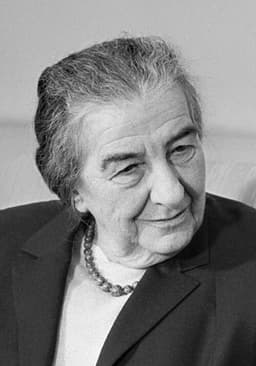
Golda Meir
Politician · Modern
55.8Total

Ichiro Hatoyama
Politician · Modern
52.1Total
Basic Information
Born
1898
1883
Died
1978
1959
Era
Modern
Modern
Nationality
Israel
Japan
Occupation
Politician
Politician
Civilization
Middle Eastern
Eastern
Score Comparison
Military (10%)
45.0
48.7
Political (20%)
72.0
45.0
Influence (20%)
55.0
55.7
Legacy (20%)
54.0
47.5
Leadership (15%)
72.0
68.0
Strategy (15%)
25.0
45.0
TOTAL
55.8
52.1
Golda Meir — Complete Timeline
1969 AD
Appointment as Prime Minister of IsraelPolitical Action◆ Major
Golda Meir became Prime Minister of Israel after the death of Levi Eshkol. She was the first and only woman to hold the office, leading the country during a period of significant tension and conflict in the Middle East.
Prime MinisterFirst womanLeadership
Impact: national
1973 AD
Yom Kippur WarWar
Meir led Israel during the Yom Kippur War, when Egypt and Syria launched a surprise attack on the holiest day of the Jewish calendar. Israel initially suffered heavy losses but eventually repelled the attacks, though the war exposed intelligence failures.
WarSurprise attackIntelligence failure
Impact: regionaltragic
1974 AD
Resignation after the Agranat CommissionPolitical Action◆ Major
Following the Yom Kippur War, the Agranat Commission criticized the government's handling of the conflict. Meir resigned as Prime Minister in 1974, taking responsibility for the failures, though she remained a respected figure in Israeli politics.
ResignationAccountabilityWar aftermath
Impact: nationaltragic
Ichiro Hatoyama — Complete Timeline
1954 AD
Appointed Prime Minister of JapanPolitical Action◆ Major
Ichiro Hatoyama became Prime Minister of Japan on December 10, 1954, succeeding Shigeru Yoshida. His appointment followed the merger of conservative parties to form the Liberal Democratic Party (LDP) in 1955. Hatoyama's government focused on constitutional revision and normalization of relations with the Soviet Union.
Prime MinisterLDPJapan
Impact: national
1955 AD
Founded the Liberal Democratic PartyPolitical Action
Hatoyama played a key role in merging the Liberal Party and the Japan Democratic Party to form the Liberal Democratic Party (LDP) on November 15, 1955. The LDP dominated Japanese politics for decades. Hatoyama became the first LDP prime minister, consolidating conservative power.
LDP FormationPolitical PartyJapan
Impact: nationalconstructive
1956 AD
Normalized Relations with the Soviet UnionPolitical Action◆ Major
Hatoyama signed the Soviet-Japanese Joint Declaration on October 19, 1956, ending the state of war between Japan and the Soviet Union. The declaration restored diplomatic relations and paved the way for Japan's entry into the United Nations. However, it did not resolve the territorial dispute over the Kuril Islands.
Soviet UnionDiplomacyNormalization
Impact: regionalconstructive
Expert Analysis
Origins
Golda Meir was born on May 3, 1898, in Kyiv, Russian Empire, into a Jewish family. Her family emigrated to the United States in 1906, settling in Milwaukee, Wisconsin. She attended the Milwaukee State Normal School and became active in Zionist youth movements. In 1921, she moved to Palestine, then under British mandate, joining a kibbutz.
Ichiro Hatoyama was born on January 1, 1883, in Tokyo, Japan, into a prominent political family. His father was a politician and his mother was a writer. He studied at Tokyo Imperial University and earned a law degree. He entered politics early, serving in the Tokyo City Assembly and later the House of Representatives.
Rise to Power
Meir's rise began in the labor movement in Palestine. She signed the Israeli Declaration of Independence in 1948 and served as Israel's ambassador to the Soviet Union. She held ministerial roles, including Minister of Labor and Foreign Minister. In 1969, she became Prime Minister after Levi Eshkol's death, leading the Labor Party.
Hatoyama rose through conservative politics in pre-war Japan. He served as Minister of Education in the 1930s but was purged after World War II. He returned to politics in the 1950s, opposing Shigeru Yoshida. In 1954, he became Prime Minister, and in 1955, he merged two conservative parties to form the Liberal Democratic Party (LDP).
Leadership & Governance
Meir's leadership style was pragmatic and decisive. She focused on national security and social welfare. During the Yom Kippur War (1973), she authorized preemptive mobilization despite initial intelligence failures. She also oversaw expansion of social programs. However, her government was criticized for unpreparedness at the war's outset, leading to high casualties.
Hatoyama's governance emphasized post-war reconstruction and conservative consolidation. He pursued a policy of 'independent diplomacy,' reducing US influence. He normalized relations with the Soviet Union in 1956, ending the state of war. Domestically, he focused on economic growth and education reform. His leadership score of 68.0 reflects his role in stabilizing Japanese politics via the LDP merger.
Triumph & Tragedy
Meir's greatest triumph was leading Israel through the Yom Kippur War, ultimately repelling the attack. She also established diplomatic ties with several African nations. Her tragedy was the intelligence failure before the war; the Agranat Commission blamed her government, leading to her resignation in 1974. This failure reduced her political score to 72.0.
Hatoyama's triumph was founding the LDP, which dominated Japanese politics for decades. His normalization of Soviet relations opened diplomatic channels. His tragedy was his inability to revise the constitution or fully restore Japan's military independence, as he desired. Also, his purge during the US occupation tarnished his image. His legacy score is 47.5.
Character & Destiny
Meir was known for her stubbornness and directness. She was called the 'Iron Lady' of Israel. Her character drove her to make tough decisions during war, but also led to her downfall due to reluctance to admit mistakes. Historians note her leadership score of 72.0 reflects her resilience, but her strategy score of 25.0 indicates her reactive approach.
Hatoyama was a pragmatic conservative, adept at political maneuvering. He was persistent in pursuing his goals despite setbacks. His character enabled him to unify factions, but his authoritarian tendencies alienated some. His strategy score of 45.0 reflects his competent but not exceptional planning.
Legacy
Meir's legacy is complex. She is remembered as a pioneering female leader and a symbol of Israeli resilience. However, the Yom Kippur War's failures remain associated with her tenure. Her influence score of 55.0 shows moderate global impact. The 1973 war reshaped Israeli defense policy.
Hatoyama's legacy is the LDP, which governed Japan for most of the post-war period. His normalization of Soviet relations set a precedent for detente. His legacy score of 47.5 indicates a moderate but lasting impact on Japanese politics. He is credited with ending the Yoshida era's subservience to the US.
Conclusion
Golda Meir had a greater impact than Ichiro Hatoyama, as reflected in her higher total score of 55.8 vs. 52.1. Meir led a nation under existential threat during a major war, while Hatoyama's achievements were more about political consolidation. Meir's leadership score of 72.0 surpasses Hatoyama's 68.0, and her political score of 72.0 is significantly higher than his 45.0. Despite her strategic weaknesses, her role in a global conflict amplifies her historical significance. Hatoyama's legacy is important but more regionally confined. Thus, Meir's impact outweighs Hatoyama's.
Rankings
🥇
Golda MeirLeader
Mil: 45.0Pol: 72.0Inf: 55.0
55.8
🥈
Ichiro Hatoyama
Mil: 48.7Pol: 45.0Inf: 55.7
52.1
+3.7 behind
How This Comparison Works
Algorithm
Each figure is scored on 6 dimensions (0—100 scale) based on structured historical data: Military (10%), Political (20%), Influence (20%), Legacy (20%), Leadership (15%), Strategy (15%). The weighted total produces the final ranking.
Data Sources
Scores are computed from structured sub-indicators in the database. Scale factors adjust for era (Ancient ×0.85, Modern ×1.0) and civilization size (Eastern ×1.05, Other ×0.80) to account for differences in population and military scale.
Maximum 3 Figures
Comparisons are limited to 2—3 figures to ensure readability and statistical meaningfulness.
Error Margins
±5 points per dimension — Sub-scores are derived from historical records with inherent uncertainty. Two figures within 5 points on a dimension should be considered roughly equivalent in that area.
Total Score Accuracy
±3 points overall — The weighted combination of 6 dimensions produces a total score with approximately ±3 points of uncertainty. Differences of less than 3 points are not statistically significant— the figures are effectively tied.
Known Limitations
- Historical records are incomplete and uneven across civilizations
- Figures from oral-tradition societies may be underrepresented
- Occupation labels can misclassify multi-role figures
- Scores measure capability and impact, not moral character
- Quantitative scoring is a comparison tool, not absolute truth
Capability Radar
Military (10%) — Battles & Warfare
Battles
0
34
Win Rate
0
36
Expansion
15
37
Political (20%) — Governance & Reform
Reform
55
60
Diplomacy
70
65
Economy
60
55
Influence (20%) — Cultural & Global Reach
Cultural
55
30
Global
60
35
Legacy (20%) — Historical Impact
Historical
65
45
Longevity
50
40
Leadership (15%) — Power & Stability
Tenure
60
55
Stability
50
50
Strategy (15%) — Tactics & Innovation
Strategy
10
41
Tactics
0
46
Reform
20
45
Similar Comparisons
Comments & Discussion
No comments yet. Be the first to share your thoughts!