Loading...
Goodluck Jonathan vs Julius Caesar
Julius Caesar leads by 28.7 pts · 2 figures compared
…
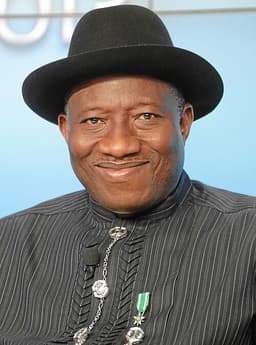
Goodluck Jonathan
Politician · Modern
54.1Total

Julius Caesar
General · Ancient
82.8Total
Basic Information
Born
1957
-100
Died
—
-44
Era
Modern
Ancient
Nationality
Nigeria
Roman Republic
Occupation
Politician
General
Civilization
Other
Western
Score Comparison
Military (10%)
26.9
88.0
Political (20%)
68.0
78.0
Influence (20%)
56.4
85.0
Legacy (20%)
49.2
82.0
Leadership (15%)
72.0
80.0
Strategy (15%)
40.5
85.0
TOTAL
54.1
82.8
Goodluck Jonathan — Complete Timeline
2010 AD
Election as President of NigeriaPolitical Action◆ Major
Goodluck Jonathan became president following the death of President Umaru Yar'Adua. He was later elected in his own right in the 2011 presidential election, winning a majority of votes.
ElectionSuccessionPresidency
Impact: national
2012 AD
Subsidy removal protestsPolitical Action◆ Major
Jonathan's government attempted to remove fuel subsidies, leading to nationwide protests known as the 'Occupy Nigeria' movement. The protests forced the government to partially reverse the policy, highlighting public discontent.
ProtestsSubsidyEconomic Policy
Impact: nationaldestructive
2015 AD
2015 presidential election defeatPolitical Action
Jonathan lost the 2015 presidential election to Muhammadu Buhari. In a historic move, he conceded defeat before the official results were announced, preventing post-election violence and setting a precedent for peaceful democratic transitions in Nigeria.
ElectionConcessionDemocracy
Impact: nationalconstructive
Julius Caesar — Complete Timeline
58 BC
Gallic WarsWar◆ Major
Caesar, as proconsul of Gaul, launched a series of campaigns that conquered all of Gaul (modern France, Belgium, and parts of Switzerland). He fought numerous battles, including against the Helvetii, the Belgae, and the Gallic chieftain Vercingetorix. The wars brought immense wealth and a loyal army to Caesar.
Gallic WarsConquestRoman Expansion
Impact: regional
49 BC
Crossing the RubiconPolitical Action◆ Major
Caesar led Legio XIII across the Rubicon River into Italy, defying the Roman Senate's order to disband his army. This act triggered a civil war against Pompey and the Optimates, ultimately leading to Caesar's dictatorship and the end of the Roman Republic.
Roman Civil WarEnd of RepublicPower Struggle
Impact: global
48 BC
Battle of PharsalusWar◆ Major
Caesar's outnumbered army defeated the larger forces of Pompey the Great at Pharsalus in Greece. Caesar's tactical use of a reserve line to counter Pompey's cavalry charge proved decisive. Pompey fled to Egypt, where he was assassinated, leaving Caesar as the undisputed master of the Roman world.
Roman Civil WarBattleDecisive Victory
Impact: regional
44 BC
Appointment as Dictator for LifePolitical Action◆ Major
The Roman Senate appointed Caesar dictator perpetuo (dictator for life), granting him unprecedented personal power. This move concentrated military, legislative, and judicial authority in one person, effectively ending the Roman Republic's traditional system of checks and balances and alarming many senators.
DictatorshipEnd of RepublicPower Consolidation
Impact: regionaldestructive
Assassination on the Ides of MarchPolitical Action◆ Major
A group of Roman senators, led by Marcus Junius Brutus and Gaius Cassius Longinus, stabbed Caesar to death at a meeting of the Senate in the Theatre of Pompey. The assassination was intended to restore the Republic, but instead triggered another civil war that led to the rise of the Roman Empire.
AssassinationRoman PoliticsEnd of Republic
Impact: globaldestructive
Expert Analysis
goodluck-jonathan-vs-julius-caesar
# The Dictator and the Democrat: Two Paths from the Rubicon to the Ballot Box
On March 15, 44 BCE, Julius Caesar fell beneath twenty-three dagger blows in the Roman Senate, his blood pooling on the marble floor where he had once stood as master of the known world. Two thousand and fifty-nine years later, in March 2015, Goodluck Jonathan picked up a telephone in Nigeria’s presidential villa and called his opponent to concede an election he had lost—before any official result had been announced. One man clung to power until death; the other let it slip through his fingers willingly. What separates these two figures, separated by millennia and continents, is not merely time or geography, but the entire architecture of how human beings have imagined power, legitimacy, and the cost of ambition.
Origins
Julius Caesar was born into a patrician family in 100 BCE, during the twilight of the Roman Republic. His Rome was a city of marble and blood, where political rivals routinely murdered one another and where military glory was the surest path to immortality. His uncle Marius had been a populist general; his father-in-law Cinna had been a consul. From childhood, Caesar breathed the air of civil war and understood that the Republic was a game played with swords as often as with votes.
Goodluck Jonathan, born in 1957 in the Niger Delta, came from a world of mud and fish. His father was a canoe carver, his mother a trader. He grew up in a village without electricity, attended a primary school with thatched roofs, and seemed destined for obscurity. His Nigeria was a newly independent nation struggling to find its footing after British colonial rule, a country where power had changed hands through coups more often than elections. Where Caesar inherited a name and a network, Jonathan inherited nothing but the need to climb from the bottom.
Rise to Power
Caesar’s rise was a masterclass in strategic patience. He served as a military tribune in Asia Minor, then as a quaestor in Spain, then as aedile in Rome, spending vast sums on public games to win the people’s love. In 60 BCE, he formed the First Triumvirate with Pompey and Crassus, an alliance that gave him the consulship and then the governorship of Gaul. His conquest of Gaul between 58 and 50 BCE was not merely a military campaign but a political machine—the wealth, the veterans, the glory all fed his ambition. When the Senate ordered him to disband his army, he crossed the Rubicon River in 49 BCE, uttering the famous words “*Alea iacta est*”—the die is cast—and plunged the Republic into civil war.
Jonathan’s rise was no less improbable, but it followed a different logic. He became governor of Bayelsa State in 2005, then vice president in 2007 under President Umaru Yar’Adua, who was gravely ill. When Yar’Adua died in 2010, Jonathan succeeded him. He was elected in his own right in 2011, a victory that surprised many. His path was not conquest but constitutional succession, not military brilliance but political survival in a system where ethnic and religious tensions could explode at any moment.
Leadership & Governance
Caesar governed as a revolutionary. As dictator, he reformed the calendar, granted citizenship to provincials, launched public works projects, and centralized power in his own hands. His military genius was undeniable—the siege of Alesia in 52 BCE, where he defeated a Gallic coalition under Vercingetorix, remains a textbook example of tactical brilliance. But his political wisdom was more fragile. He pardoned his enemies, only to be killed by them. He believed that generosity would buy loyalty, but in a Republic built on competition, mercy looked like weakness.
Jonathan governed as a democrat, but a struggling one. In 2012, his government attempted to remove fuel subsidies, sparking the “Occupy Nigeria” protests that paralyzed the country. He faced Boko Haram’s insurgency, corruption scandals, and a fractured economy. His strategy score of 39.8 reflects a leader who often reacted rather than planned. Yet his leadership score of 74.3 hints at something else: the ability to hold a fragile nation together through compromise and patience, even when the pressure was immense.
Triumph & Tragedy
Caesar’s greatest triumph was his conquest of Gaul, which brought him wealth, fame, and an army loyal to him alone. His tragedy was that he could not find a way to institutionalize his power without destroying the Republic. He became dictator for life in 44 BCE, a title that broke the last taboo. The Ides of March was not just his death—it was the death of the Republic he had tried to save by destroying it.
Jonathan’s greatest triumph was not a military victory but a moral one. In 2015, when he lost the presidential election to Muhammadu Buhari, he conceded defeat before the official results were announced. In a continent where incumbents often rig elections or refuse to leave, Jonathan’s phone call was revolutionary. His tragedy is that his presidency is remembered more for what he failed to do—stop corruption, defeat Boko Haram, manage the economy—than for what he achieved.
Character & Destiny
Caesar was driven by an insatiable hunger for glory. He wrote his own commentaries, controlled his own narrative, and believed that history belonged to those who acted boldly. His character was his destiny: he could not imagine stepping aside, could not conceive of a world where he was not first. That pride made him great; it also made him dead at fifty-five.
Jonathan was driven by something rarer in the annals of power: humility. He was a zoologist by training, a man who had spent years studying snails before entering politics. He seemed uncomfortable with the trappings of power, and that discomfort may have been his greatest gift. His character allowed him to do what Caesar could not: walk away.
Legacy
Caesar’s legacy is the Roman Empire itself. His name became a title—*Kaiser*, *Tsar*—and his reforms shaped Western civilization for two millennia. He is remembered as a genius, a tyrant, and a martyr, depending on who tells the story. His military score of 88.0 and influence score of 85.0 reflect a man who changed the world, for better or worse.
Jonathan’s legacy is more modest but no less significant. His legacy score of 64.6 reflects a mixed record, but his peaceful concession may prove more important than any policy he enacted. In a world where strongmen cling to power and democracies erode, Jonathan showed that losing can be a form of winning. He may not have conquered Gaul, but he did something Caesar never could: he proved that power can be surrendered peacefully.
Conclusion
Standing on the banks of the Rubicon, Caesar weighed his choices and decided that the only way forward was forward, across the river, into war. Standing in the villa at Aso Rock, Jonathan weighed his choices and decided that the only way forward was backward, into retirement, into peace. Both men faced the same fundamental question: What is power worth? Caesar answered with his life. Jonathan answered with his legacy. Two thousand years of human history separate them, but the question remains the same. The answer, perhaps, is what separates civilization from collapse.
Rankings
🥇
Julius CaesarLeader
Mil: 88.0Pol: 78.0Inf: 85.0
82.8
🥈
Goodluck Jonathan
Mil: 26.9Pol: 68.0Inf: 56.4
54.1
+28.7 behind
How This Comparison Works
Algorithm
Each figure is scored on 6 dimensions (0—100 scale) based on structured historical data: Military (10%), Political (20%), Influence (20%), Legacy (20%), Leadership (15%), Strategy (15%). The weighted total produces the final ranking.
Data Sources
Scores are computed from structured sub-indicators in the database. Scale factors adjust for era (Ancient ×0.85, Modern ×1.0) and civilization size (Eastern ×1.05, Other ×0.80) to account for differences in population and military scale.
Maximum 3 Figures
Comparisons are limited to 2—3 figures to ensure readability and statistical meaningfulness.
Error Margins
±5 points per dimension — Sub-scores are derived from historical records with inherent uncertainty. Two figures within 5 points on a dimension should be considered roughly equivalent in that area.
Total Score Accuracy
±3 points overall — The weighted combination of 6 dimensions produces a total score with approximately ±3 points of uncertainty. Differences of less than 3 points are not statistically significant— the figures are effectively tied.
Known Limitations
- Historical records are incomplete and uneven across civilizations
- Figures from oral-tradition societies may be underrepresented
- Occupation labels can misclassify multi-role figures
- Scores measure capability and impact, not moral character
- Quantitative scoring is a comparison tool, not absolute truth
Capability Radar
Military (10%) — Battles & Warfare
Battles
19
95
Win Rate
24
92
Expansion
27
97
Political (20%) — Governance & Reform
Reform
40
90
Diplomacy
65
85
Economy
45
82
Influence (20%) — Cultural & Global Reach
Cultural
30
88
Global
50
94
Legacy (20%) — Historical Impact
Historical
55
95
Longevity
40
96
Leadership (15%) — Power & Stability
Tenure
60
75
Stability
50
60
Strategy (15%) — Tactics & Innovation
Strategy
31
94
Tactics
35
96
Reform
36
88
Similar Comparisons
Comments & Discussion
No comments yet. Be the first to share your thoughts!