Loading...
Goodluck Jonathan vs Patricio Aylwin
Patricio Aylwin leads by 4.7 pts · 2 figures compared
…
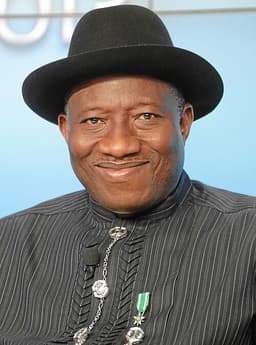
Goodluck Jonathan
Politician · Modern
54.1Total

Patricio Aylwin
Politician · Modern
58.8Total
Basic Information
Born
1957
1918
Died
—
2016
Era
Modern
Modern
Nationality
Nigeria
Chile
Occupation
Politician
Politician
Civilization
Other
Western
Score Comparison
Military (10%)
26.9
49.0
Political (20%)
68.0
70.3
Influence (20%)
56.4
59.0
Legacy (20%)
49.2
54.0
Leadership (15%)
72.0
72.0
Strategy (15%)
40.5
42.8
TOTAL
54.1
58.8
Goodluck Jonathan — Complete Timeline
2010 AD
Election as President of NigeriaPolitical Action◆ Major
Goodluck Jonathan became president following the death of President Umaru Yar'Adua. He was later elected in his own right in the 2011 presidential election, winning a majority of votes.
ElectionSuccessionPresidency
Impact: national
2012 AD
Subsidy removal protestsPolitical Action◆ Major
Jonathan's government attempted to remove fuel subsidies, leading to nationwide protests known as the 'Occupy Nigeria' movement. The protests forced the government to partially reverse the policy, highlighting public discontent.
ProtestsSubsidyEconomic Policy
Impact: nationaldestructive
2015 AD
2015 presidential election defeatPolitical Action
Jonathan lost the 2015 presidential election to Muhammadu Buhari. In a historic move, he conceded defeat before the official results were announced, preventing post-election violence and setting a precedent for peaceful democratic transitions in Nigeria.
ElectionConcessionDemocracy
Impact: nationalconstructive
Patricio Aylwin — Complete Timeline
1990 AD
Aylwin becomes first democratic president after PinochetPolitical Action
Patricio Aylwin was elected President of Chile as the candidate of the Concertaci
DemocracyTransition1990
Impact: nationalprogressive
Aylwin's Truth and Reconciliation CommissionPolitical Action◆ Major
Aylwin established the National Commission for Truth and Reconciliation (Rettig Commission) to investigate human rights abuses during the Pinochet regime. The commission's report documented over 2,000 deaths and disappearances, but faced criticism for limited justice.
Human RightsTruth CommissionTransitional Justice
Impact: nationalconstructive
1991 AD
Aylwin's economic continuity and growthReform◆ Major
Aylwin's government maintained the free-market economic model inherited from Pinochet, while increasing social spending. This policy led to sustained economic growth and poverty reduction, but also perpetuated inequality.
Economic PolicyContinuityGrowth
Impact: nationalconstructive
Aylwin's constitutional reformsReform◆ Major
Aylwin's government negotiated a series of constitutional reforms with the right-wing opposition, including changes to the electoral system and the removal of some authoritarian enclaves. These reforms strengthened democratic institutions but left the 1980 constitution largely intact.
Constitutional ReformDemocracyNegotiation
Impact: nationalconstructive
Expert Analysis
Origins
Goodluck Jonathan was born on November 20, 1957, in Otuoke, Bayelsa State, Nigeria, into a family of canoe makers. His father, Lawrence Jonathan, was a canoe carver, and his mother, Eunice, was a trader. Jonathan attended local primary and secondary schools before earning a B.Sc. in Zoology, an M.Sc. in Hydrobiology, and a Ph.D. in Zoology from the University of Port Harcourt. He worked as a lecturer and later as an assistant director at the university.
Patricio Aylwin Azócar was born on November 26, 1918, in Viña del Mar, Chile, into a politically active family. His father, Miguel Aylwin, was a judge, and his mother, Laura Azócar, was a homemaker. Aylwin studied law at the University of Chile, graduating in 1943. He practiced law and taught at the university, and became involved in the Christian Democratic Party, serving as its president from 1973 to 1976.
Rise to Power
Goodluck Jonathan's political career began when he became Deputy Governor of Bayelsa State in 1999, and later Governor in 2005. He was selected as running mate to Umaru Yar'Adua in the 2007 presidential election, winning as vice president. Upon Yar'Adua's death in May 2010, Jonathan became president. He won the 2011 presidential election with 58.9% of the vote, defeating Muhammadu Buhari.
Patricio Aylwin rose through the Christian Democratic Party, serving as a senator from 1965 to 1973. After the 1973 coup, he opposed the Pinochet regime, becoming a leading figure in the opposition. In 1989, he led the Concertación coalition to victory in the 1989 presidential election, winning 55.2% of the vote and becoming the first democratic president after 17 years of military rule.
Leadership & Governance
Jonathan's leadership was marked by attempts to reform Nigeria's economy and infrastructure, but his tenure was plagued by corruption and security challenges. He faced the Boko Haram insurgency, which escalated under his watch, and the 2012 Occupy Nigeria protests against fuel subsidy removal. His political score of 68.0 reflects his ability to navigate a complex political landscape, but his strategy score of 40.5 indicates poor crisis management.
Aylwin's governance focused on democratic consolidation and human rights. He established the Truth and Reconciliation Commission (Rettig Commission) in 1990 to investigate human rights abuses, which documented 2,279 deaths. He maintained the free-market economic model, achieving 7.7% GDP growth in 1992 and reducing poverty from 44% to 33% during his term. His political score of 70.3 and leadership score of 72.0 underscore his effective transition management.
Triumph & Tragedy
Jonathan's greatest triumph was his peaceful concession in the 2015 election, which averted potential violence and set a precedent for democratic transitions in Africa. His tragedy was the failure to curb Boko Haram, which by 2015 controlled territory equivalent to Belgium. The 2014 Chibok schoolgirl kidnapping highlighted security lapses. His legacy score of 49.2 reflects mixed perceptions.
Aylwin's triumph was the successful transition to democracy and the Rettig Commission, which provided a model for transitional justice. His tragedy was the inability to fully address economic inequality; the Gini coefficient remained around 0.56. The 1990 assassination of Senator Jaime Guzmán by leftist extremists also marred his term. His legacy score of 54.0 indicates a more positive assessment.
Character & Destiny
Jonathan was perceived as a mild-mannered and conciliatory figure, often indecisive. His decision to concede defeat peacefully was a defining moment, showing humility and commitment to democracy. However, his reluctance to confront corruption and security issues weakened his administration. His leadership score of 72.0 reflects his ability to unite, but his strategy score of 40.5 reveals a lack of decisive action.
Aylwin was known for his pragmatism and consensus-building skills. He navigated the delicate balance between prosecuting past abuses and maintaining stability. His decision to prioritize reconciliation over retribution was criticized by human rights groups but helped stabilize democracy. His leadership score of 72.0 and strategy score of 42.8 reflect a careful, methodical approach.
Legacy
Jonathan's legacy is defined by the 2015 concession, which strengthened Nigeria's democracy and inspired similar actions in Africa. However, his tenure is also remembered for increased corruption and insecurity. The Chibok girls remain a symbol of state failure. His influence score of 56.4 indicates moderate impact.
Aylwin's legacy is that of a founding father of Chilean democracy. The Rettig Commission and constitutional reforms laid the groundwork for future governments. His economic policies led to sustained growth, with Chile's GDP per capita rising from $2,500 in 1990 to $4,000 by 1994. His influence score of 59.0 and legacy score of 54.0 reflect a more enduring impact.
Conclusion
Patricio Aylwin had a greater impact than Goodluck Jonathan, as reflected in his higher total score of 58.8 versus Jonathan's 54.1. Aylwin successfully transitioned Chile from dictatorship to democracy, established truth and reconciliation, and maintained economic growth. Jonathan's peaceful concession was historic, but his inability to address corruption and security challenges limited his overall effectiveness. Aylwin's structural reforms and human rights initiatives created a lasting foundation for Chile's democracy, whereas Jonathan's legacy is more contingent on the symbolic act of concession. Thus, Aylwin emerges as the more consequential leader.
Rankings
🥇
Patricio AylwinLeader
Mil: 49.0Pol: 70.3Inf: 59.0
58.8
🥈
Goodluck Jonathan
Mil: 26.9Pol: 68.0Inf: 56.4
54.1
+4.7 behind
How This Comparison Works
Algorithm
Each figure is scored on 6 dimensions (0—100 scale) based on structured historical data: Military (10%), Political (20%), Influence (20%), Legacy (20%), Leadership (15%), Strategy (15%). The weighted total produces the final ranking.
Data Sources
Scores are computed from structured sub-indicators in the database. Scale factors adjust for era (Ancient ×0.85, Modern ×1.0) and civilization size (Eastern ×1.05, Other ×0.80) to account for differences in population and military scale.
Maximum 3 Figures
Comparisons are limited to 2—3 figures to ensure readability and statistical meaningfulness.
Error Margins
±5 points per dimension — Sub-scores are derived from historical records with inherent uncertainty. Two figures within 5 points on a dimension should be considered roughly equivalent in that area.
Total Score Accuracy
±3 points overall — The weighted combination of 6 dimensions produces a total score with approximately ±3 points of uncertainty. Differences of less than 3 points are not statistically significant— the figures are effectively tied.
Known Limitations
- Historical records are incomplete and uneven across civilizations
- Figures from oral-tradition societies may be underrepresented
- Occupation labels can misclassify multi-role figures
- Scores measure capability and impact, not moral character
- Quantitative scoring is a comparison tool, not absolute truth
Capability Radar
Military (10%) — Battles & Warfare
Battles
19
30
Win Rate
24
33
Expansion
27
34
Political (20%) — Governance & Reform
Reform
40
75
Diplomacy
65
70
Economy
45
65
Influence (20%) — Cultural & Global Reach
Cultural
30
40
Global
50
55
Legacy (20%) — Historical Impact
Historical
55
65
Longevity
40
50
Leadership (15%) — Power & Stability
Tenure
60
60
Stability
50
70
Strategy (15%) — Tactics & Innovation
Strategy
31
40
Tactics
35
39
Reform
36
45
Similar Comparisons
Comments & Discussion
No comments yet. Be the first to share your thoughts!