Loading...
Govinda III vs Mangalesha
Govinda III leads by 15.7 pts · 2 figures compared
…
Govinda III
Emperor · Medieval
63.5Total
Mangalesha
Emperor · Medieval
47.8Total
Basic Information
Born
778
597
Died
814
609
Era
Medieval
Medieval
Nationality
India
India
Occupation
Emperor
Emperor
Civilization
Indian
Indian
Score Comparison
Military (10%)
78.0
46.7
Political (20%)
72.0
36.5
Influence (20%)
60.0
53.3
Legacy (20%)
52.0
44.2
Leadership (15%)
72.0
58.8
Strategy (15%)
61.2
45.0
TOTAL
63.5
47.8
Govinda III — Complete Timeline
800 AD
Expedition to the VindhyasWar
Govinda III launched a military expedition into the Vindhya region, subduing the Kalachuri king Shankaragana. He annexed parts of the Kalachuri kingdom, extending Rashtrakuta control into central India. This campaign secured the northern frontier.
Central IndiaKalachuri WarTerritorial Expansion
Impact: regionaldestructive
803 AD
Conquest of KanchipuramWar◆ Major
Govinda III led a campaign against the Pallava king Dantivarman and captured Kanchipuram. He then marched south, receiving tribute from the Chola, Pandya, and Chera kings. This established Rashtrakuta hegemony over the entire Tamil country.
Southern CampaignPallava WarTamil Nadu
Impact: regionaldestructive
805 AD
Defeat of the Gurjara-PratiharasWar◆ Major
Govinda III defeated the Gurjara-Pratihara king Nagabhata II in a battle near the Ganges. He captured the Pratihara capital of Kannauj and forced Nagabhata to flee. This victory made the Rashtrakutas the dominant power in northern India.
North Indian CampaignPratihara WarKannauj
Impact: regionaldestructive
Mangalesha — Complete Timeline
597 AD
Regency and usurpationPolitical Action◆ Major
Mangalesha became regent for his young nephew Pulakeshin II after the death of Kirtivarman I. He later attempted to usurp the throne for himself, leading to a civil war with Pulakeshin II, who eventually defeated and killed him.
UsurpationCivil WarChalukya
Impact: regionaldestructive
600 AD
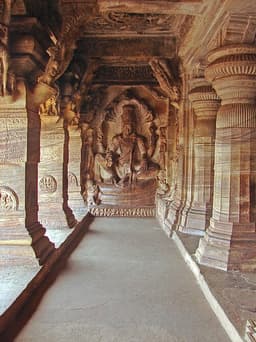
Construction of Cave 3 at BadamiCultural◆ Major
Mangalesha commissioned the excavation of Cave 3 at Badami, a Hindu rock-cut temple dedicated to Vishnu. This cave contains some of the earliest and finest examples of Chalukya architecture and sculpture.
Badami CavesArchitectureChalukya
Impact: regionalconstructive
Expert Analysis
Origins
**Govinda III** (c. 793–814 CE) was born into the Rashtrakuta dynasty, which had established its dominance in the Deccan under his father, Dhruva Dharavarsha. Little is known of his early life, but as a prince, he likely received military training and administrative experience. The Rashtrakutas were a feudatory family that had overthrown the Chalukyas of Badami, setting the stage for a lasting rivalry.
**Mangalesha** (c. 597–609 CE) was a Chalukya prince of the Badami branch. He was the son of Pulakeshin I, the founder of the Chalukya dynasty. After his elder brother Kirtivarman I died, Mangalesha became regent for his infant nephew Pulakeshin II. His early years were spent consolidating the kingdom and commissioning architectural projects.
Rise to Power
Govinda III ascended the throne after his father's death in 793 CE. He quickly faced challenges from neighboring powers, including the Pallavas and the Gangas. In 794 CE, he led his first major campaign against the Pallava king Dantivarman, capturing Kanchipuram. This victory established his reputation and forced the Chola, Pandya, and Kerala rulers to pay tribute. His most significant triumph came in 800 CE when he defeated the Gurjara-Pratihara king Nagabhata II near the Ganges, capturing Kannauj and forcing Nagabhata to flee. Govinda III's military scores of 78.0 reflect his success in expanding the Rashtrakuta empire.
Mangalesha's rise was more contested. After Kirtivarman I's death (c. 597 CE), Mangalesha became regent for Pulakeshin II, who was still a child. He successfully defended the kingdom against the Kadambas and the Kalachuris, but his ambition grew. In 609 CE, he attempted to usurp the throne, leading to a civil war with his nephew. His political score of 36.5 indicates his failure to secure a stable succession.
Leadership & Governance
Govinda III ruled as an expansionist monarch, relying on military might and diplomatic tribute. He maintained control over the Deccan through a network of feudatories, but his governance was primarily focused on conquest. He issued land grants to Brahmins and supported Jainism, but his administrative reforms were limited.
Mangalesha, by contrast, is remembered for his patronage of the arts and architecture. He commissioned the excavation of Cave 3 at Badami, a Hindu rock-cut temple dedicated to Vishnu, which contains some of the earliest and finest examples of Chalukya art. His leadership score of 58.8 reflects his cultural contributions, though his political maneuvering was flawed.
Triumph & Tragedy
Govinda III's greatest triumph was his conquest of Kannauj, which made the Rashtrakutas a pan-Indian power. He also successfully subdued the Kalachuris and the Vindhya region. However, his empire was built on personal charisma and military success; after his death, his son Amoghavarsha faced rebellions, indicating the fragility of his achievements.
Mangalesha's triumph was the construction of Cave 3, a UNESCO World Heritage site that stands as a testament to Chalukya art. His tragedy was his failed usurpation: Pulakeshin II defeated him in battle, and Mangalesha was killed, losing his legacy to his nephew's greater fame.
Character & Destiny
Govinda III was a decisive and ambitious ruler, driven by the desire to surpass his father's achievements. His strategy score of 61.2 shows his military acumen, but his reliance on conquest over stable institutions limited his long-term impact.
Mangalesha was a capable administrator and patron but lacked political foresight. His attempt to seize the throne from his nephew alienated supporters and led to his downfall. His character—artistic but ambitious—shaped his destiny as a footnote in Chalukya history.
Legacy
Govinda III's legacy is mixed. He expanded the Rashtrakuta empire to its greatest extent, but his conquests did not endure. His influence score of 60.0 reflects his role in shaping Deccan politics. He is remembered primarily in inscriptions and as a predecessor to Amoghavarsha.
Mangalesha's legacy is more tangible: Cave 3 at Badami remains a major historical site. His legacy score of 44.2 is lower because his political failure overshadowed his artistic contributions. However, his cave temple is a lasting monument to Chalukya culture.
Conclusion
Govinda III had a greater impact on the Deccan and Indian politics. His military campaigns (score 78.0) and political reach (score 72.0) dwarf Mangalesha's achievements. While Mangalesha's Cave 3 is culturally significant, Govinda III's conquests influenced the balance of power in India for decades. The total score gap of 15.7 points supports this conclusion. Govinda III emerges as the more consequential figure.
Rankings
🥇
Govinda IIILeader
Mil: 78.0Pol: 72.0Inf: 60.0
63.5
🥈
Mangalesha
Mil: 46.7Pol: 36.5Inf: 53.3
47.8
+15.7 behind
How This Comparison Works
Algorithm
Each figure is scored on 6 dimensions (0—100 scale) based on structured historical data: Military (10%), Political (20%), Influence (20%), Legacy (20%), Leadership (15%), Strategy (15%). The weighted total produces the final ranking.
Data Sources
Scores are computed from structured sub-indicators in the database. Scale factors adjust for era (Ancient ×0.85, Modern ×1.0) and civilization size (Eastern ×1.05, Other ×0.80) to account for differences in population and military scale.
Maximum 3 Figures
Comparisons are limited to 2—3 figures to ensure readability and statistical meaningfulness.
Error Margins
±5 points per dimension — Sub-scores are derived from historical records with inherent uncertainty. Two figures within 5 points on a dimension should be considered roughly equivalent in that area.
Total Score Accuracy
±3 points overall — The weighted combination of 6 dimensions produces a total score with approximately ±3 points of uncertainty. Differences of less than 3 points are not statistically significant— the figures are effectively tied.
Known Limitations
- Historical records are incomplete and uneven across civilizations
- Figures from oral-tradition societies may be underrepresented
- Occupation labels can misclassify multi-role figures
- Scores measure capability and impact, not moral character
- Quantitative scoring is a comparison tool, not absolute truth
Capability Radar
Military (10%) — Battles & Warfare
Battles
75
30
Win Rate
80
30
Expansion
80
35
Political (20%) — Governance & Reform
Reform
65
30
Diplomacy
70
35
Economy
70
30
Influence (20%) — Cultural & Global Reach
Cultural
55
40
Global
45
20
Legacy (20%) — Historical Impact
Historical
60
35
Longevity
50
30
Leadership (15%) — Power & Stability
Tenure
75
40
Stability
70
35
Strategy (15%) — Tactics & Innovation
Strategy
75
30
Tactics
70
35
Reform
60
20
Similar Comparisons
Comments & Discussion
No comments yet. Be the first to share your thoughts!