Loading...
This comparison has not been analyzed yet.
One-time AI generation (~1 minute). Scores and timeline are already available below.
Guan Yu vs Zhuge Dan
Guan Yu leads by 19.1 pts · 2 figures compared
…
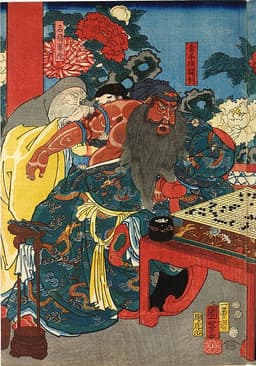
Guan Yu
General · Ancient
57.6Total

Zhuge Dan
General · Ancient
38.5Total
Basic Information
Born
160
206
Died
220
258
Era
Ancient
Ancient
Nationality
China
China
Occupation
General
General
Civilization
Eastern
Eastern
Score Comparison
Military (10%)
61.7
10.0
Political (20%)
35.0
35.0
Influence (20%)
72.0
46.3
Legacy (20%)
68.0
37.5
Leadership (15%)
40.9
46.3
Strategy (15%)
50.0
43.3
TOTAL
57.6
38.5
Guan Yu — Complete Timeline
200 AD
Battle of BomaWar
Guan Yu, serving under Cao Cao, killed the enemy general Yan Liang in battle at Boma. This act demonstrated his martial prowess and loyalty to Cao Cao at the time. The victory helped Cao Cao's forces in the campaign against Yuan Shao.
Three KingdomsBattleMartial Skill
Impact: regional
Departure from Cao Cao to Rejoin Liu BeiPolitical Action◆ Major
After learning of Liu Bei's whereabouts, Guan Yu left Cao Cao's service, crossing five passes and killing six generals to rejoin his sworn brother. This act of loyalty became legendary, symbolizing unwavering commitment to one's oath.
LoyaltyOathThree Kingdoms
Impact: regional
219 AD
Battle of FanchengWar◆ Major
Guan Yu led a campaign against Cao Cao's forces at Fancheng. He achieved initial success, flooding the city, but was ultimately defeated by reinforcements led by Xu Huang. This battle marked the turning point in his military career.
Three KingdomsSiegeTurning Point
Impact: regional
220 AD
Capture and Execution by Sun Quan's ForcesWar◆ Major
After the defeat at Fancheng, Guan Yu retreated but was ambushed and captured by Sun Quan's general L
ExecutionThree KingdomsRevenge
Impact: regionaltragic
Zhuge Dan — Complete Timeline
252 AD
Battle of DongxingWar◆ Major
Zhuge Dan commanded Wei forces at Dongxing against Wu. He led a premature assault on Wu fortifications, falling into an ambush. Wei forces were routed, suffering heavy losses. This defeat damaged his reputation and contributed to his later rebellion.
Three KingdomsWei-Wu WarDefeat
Impact: regionaltragic
255 AD
Appointed Inspector of Yang ProvincePolitical Action
Zhuge Dan was appointed Inspector of Yang Province, giving him control over Wei's southeastern territories. This position provided him with military resources and autonomy. He used this power to prepare for his eventual rebellion against the Sima clan.
Three KingdomsWei PoliticsAppointment
Impact: regional
257 AD
Zhuge Dan RebellionWar
Zhuge Dan rebelled against Sima Zhao's regency, declaring loyalty to Wei. He allied with Wu forces and fortified Shouchun. Sima Zhao besieged the city for months. The rebellion failed when Wu reinforcements were defeated and Shouchun fell, leading to Zhuge Dan's execution.
Three KingdomsWei Civil WarRebellion
Impact: nationaldestructive
This comparison has not been analyzed yet.
One-time AI generation (~1 minute). Scores and timeline are already available below.
Rankings
🥇
Guan YuLeader
Mil: 61.7Pol: 35.0Inf: 72.0
57.6
🥈
Zhuge Dan
Mil: 10.0Pol: 35.0Inf: 46.3
38.5
+19.1 behind
How This Comparison Works
Algorithm
Each figure is scored on 6 dimensions (0—100 scale) based on structured historical data: Military (10%), Political (20%), Influence (20%), Legacy (20%), Leadership (15%), Strategy (15%). The weighted total produces the final ranking.
Data Sources
Scores are computed from structured sub-indicators in the database. Scale factors adjust for era (Ancient ×0.85, Modern ×1.0) and civilization size (Eastern ×1.05, Other ×0.80) to account for differences in population and military scale.
Maximum 3 Figures
Comparisons are limited to 2—3 figures to ensure readability and statistical meaningfulness.
Error Margins
±5 points per dimension — Sub-scores are derived from historical records with inherent uncertainty. Two figures within 5 points on a dimension should be considered roughly equivalent in that area.
Total Score Accuracy
±3 points overall — The weighted combination of 6 dimensions produces a total score with approximately ±3 points of uncertainty. Differences of less than 3 points are not statistically significant— the figures are effectively tied.
Known Limitations
- Historical records are incomplete and uneven across civilizations
- Figures from oral-tradition societies may be underrepresented
- Occupation labels can misclassify multi-role figures
- Scores measure capability and impact, not moral character
- Quantitative scoring is a comparison tool, not absolute truth
Capability Radar
Military (10%) — Battles & Warfare
Battles
65
40
Win Rate
55
30
Expansion
45
10
Political (20%) — Governance & Reform
Reform
10
10
Diplomacy
25
25
Economy
15
10
Influence (20%) — Cultural & Global Reach
Cultural
85
15
Global
70
10
Legacy (20%) — Historical Impact
Historical
80
20
Longevity
90
15
Leadership (15%) — Power & Stability
Tenure
30
30
Stability
20
15
Strategy (15%) — Tactics & Innovation
Strategy
50
30
Tactics
70
35
Reform
10
10
Similar Comparisons
Comments & Discussion
No comments yet. Be the first to share your thoughts!