Loading...
Guillermo Lasso vs Julius Caesar
Julius Caesar leads by 29.9 pts · 2 figures compared
…
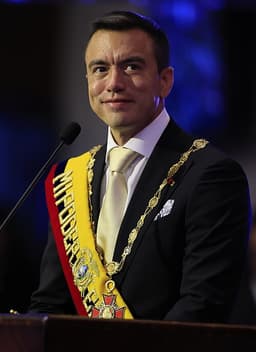
Guillermo Lasso
Politician · Modern
52.9Total

Julius Caesar
General · Ancient
82.8Total
Basic Information
Born
1955
-100
Died
—
-44
Era
Modern
Ancient
Nationality
Ecuador
Roman Republic
Occupation
Politician
General
Civilization
Western
Western
Score Comparison
Military (10%)
48.4
88.0
Political (20%)
68.0
78.0
Influence (20%)
51.0
85.0
Legacy (20%)
39.2
82.0
Leadership (15%)
74.0
80.0
Strategy (15%)
41.7
85.0
TOTAL
52.9
82.8
Guillermo Lasso — Complete Timeline
2021 AD
Elected President of EcuadorPolitical Action◆ Major
Guillermo Lasso won the 2021 presidential election runoff against Andr
ElectionConservativeEconomic Reform
Impact: national
2022 AD
Faced massive indigenous protests over fuel pricesPolitical Action◆ Major
In June 2022, Ecuador experienced 18 days of nationwide protests led by indigenous groups against rising fuel prices and living costs. The protests resulted in at least six deaths and forced Lasso to declare a state of emergency in several provinces, eventually leading to negotiations.
ProtestsIndigenousEconomic Crisis
Impact: nationaldestructive
2023 AD
Dissolved Congress and triggered early electionsPolitical Action◆ Major
Facing an impeachment trial for alleged embezzlement, Lasso invoked the 'muerte cruzada' constitutional mechanism on May 17, 2023, dissolving the National Assembly and calling for early elections. This was the first time a president used this power, ending his term early.
Constitutional CrisisImpeachmentEarly Elections
Impact: nationaldestructive
Julius Caesar — Complete Timeline
58 BC
Gallic WarsWar◆ Major
Caesar, as proconsul of Gaul, launched a series of campaigns that conquered all of Gaul (modern France, Belgium, and parts of Switzerland). He fought numerous battles, including against the Helvetii, the Belgae, and the Gallic chieftain Vercingetorix. The wars brought immense wealth and a loyal army to Caesar.
Gallic WarsConquestRoman Expansion
Impact: regional
49 BC
Crossing the RubiconPolitical Action◆ Major
Caesar led Legio XIII across the Rubicon River into Italy, defying the Roman Senate's order to disband his army. This act triggered a civil war against Pompey and the Optimates, ultimately leading to Caesar's dictatorship and the end of the Roman Republic.
Roman Civil WarEnd of RepublicPower Struggle
Impact: global
48 BC
Battle of PharsalusWar◆ Major
Caesar's outnumbered army defeated the larger forces of Pompey the Great at Pharsalus in Greece. Caesar's tactical use of a reserve line to counter Pompey's cavalry charge proved decisive. Pompey fled to Egypt, where he was assassinated, leaving Caesar as the undisputed master of the Roman world.
Roman Civil WarBattleDecisive Victory
Impact: regional
44 BC
Appointment as Dictator for LifePolitical Action◆ Major
The Roman Senate appointed Caesar dictator perpetuo (dictator for life), granting him unprecedented personal power. This move concentrated military, legislative, and judicial authority in one person, effectively ending the Roman Republic's traditional system of checks and balances and alarming many senators.
DictatorshipEnd of RepublicPower Consolidation
Impact: regionaldestructive
Assassination on the Ides of MarchPolitical Action◆ Major
A group of Roman senators, led by Marcus Junius Brutus and Gaius Cassius Longinus, stabbed Caesar to death at a meeting of the Senate in the Theatre of Pompey. The assassination was intended to restore the Republic, but instead triggered another civil war that led to the rise of the Roman Empire.
AssassinationRoman PoliticsEnd of Republic
Impact: globaldestructive
Expert Analysis
guillermo-lasso-vs-julius-caesar
# The Crossroads of Power: Caesar and Lasso
On the Ides of March, 44 BCE, the Roman Senate erupted into chaos as sixty conspirators surrounded Gaius Julius Caesar, their daggers flashing in the morning light. The dictator fell, his blood pooling on the marble floor beneath Pompey’s statue, his final words perhaps a whispered “Et tu, Brute?” Two millennia later, on a May morning in 2023, Guillermo Lasso sat in Ecuador’s presidential palace, signing a decree that would dissolve his own National Assembly. One man died for seizing too much power. The other surrendered his to save what remained. How could two leaders, both Western, both navigating the treacherous currents of political crisis, arrive at such opposite fates?
Origins
Julius Caesar was born into the patrician Julian clan, a family claiming descent from the goddess Venus, but their political influence had waned. Rome in the first century BCE was a republic in convulsion—slave revolts, civil wars, and the constant rivalry between populists and aristocrats. Caesar’s father died when he was sixteen, leaving him to navigate a world where survival meant aligning with the right patrons. He learned early that in Rome, reputation was currency, and debt could be a tool. His aunt married Gaius Marius, the great populist general, and Caesar himself refused to divorce his wife at the dictator Sulla’s command, fleeing Rome in disguise rather than submit.
Guillermo Lasso was born in 1955 in Guayaquil, Ecuador, a port city where commerce, not conquest, defined success. His family was middle-class, but tragedy struck early: his father died when Lasso was a child, forcing him to drop out of school at fifteen to support his family. He started as a messenger boy at a local bank, working his way up through sheer tenacity. Ecuador in the mid-twentieth century was a nation of fragile democracies, military coups, and oil booms that enriched few while leaving many in poverty. Lasso’s formative years were shaped not by senatorial intrigue but by balance sheets and loan approvals.
Rise to Power
Caesar’s ascent was a masterpiece of calculated audacity. He served as a military tribune, then quaestor in Hispania, where he reportedly wept before a statue of Alexander the Great, lamenting that at thirty-three, he had achieved nothing while Alexander had conquered the world. He climbed the political ladder—aedile, pontifex maximus, praetor—spending fortunes on games and bribes, plunging into debt to buy popularity. In 59 BCE, he formed the First Triumvirate with Pompey and Crassus, a private alliance that effectively ruled Rome. Then came Gaul: eight years of brutal warfare that made him the richest man in the Republic and commander of a loyal army. When the Senate ordered him to disband his forces, he crossed the Rubicon River in 49 BCE, uttering “the die is cast,” and ignited a civil war.
Lasso’s path was slower, more patient. He entered politics in the 1990s as a technocrat, serving as governor of Guayas Province and later as minister of economy under President Jamil Mahuad. But Ecuador’s political landscape was volatile: presidents fell to indigenous uprisings, financial collapses, and the rise of Rafael Correa, a leftist populist who dominated the 2010s. Lasso ran for president three times—in 2013, 2017, and finally 2021, when he defeated Andrés Arauz, a Correa ally, in a runoff. At sixty-five, he took office on May 24, 2021, promising fiscal discipline and free markets in a nation exhausted by oil dependence and social unrest.
Leadership & Governance
Caesar governed as a revolutionary reformer. As dictator, he overhauled the calendar, introduced the Julian system still used today. He granted citizenship to Gauls and Spaniards, expanded the Senate to include provincials, and initiated massive public works. His military genius was unquestioned: at Alesia in 52 BCE, he besieged a Gallic stronghold while simultaneously fighting off a relief army, a feat of tactical brilliance that ended Gallic resistance. But his governance was also autocratic. He centralized power, accepted the title “dictator for life,” and minted coins with his own image—acts that terrified the senatorial elite who saw him as a king in all but name.
Lasso governed as a crisis manager in a system designed to frustrate action. His conservative economic policies—lowering taxes, promoting foreign investment—won praise from international lenders but sparked fury at home. In June 2022, indigenous groups led eighteen days of nationwide protests against rising fuel prices, blockading roads and shutting down Quito. Lasso’s response was negotiation, not repression; he conceded to some demands, a move that stabilized the immediate crisis but weakened his authority. Unlike Caesar, who commanded legions, Lasso commanded only the police—and even they were divided.
Triumph & Tragedy
Caesar’s greatest triumph was Gaul: the conquest of a territory that stretched from the Rhine to the Atlantic, bringing immense wealth and glory. His Commentaries on the Gallic Wars remain a masterpiece of military literature and propaganda. His tragedy was his own success. By concentrating power, he made himself a target. The Ides of March was not a random assassination but a political execution, carried out by senators who believed they were saving the Republic.
Lasso’s triumph was simply surviving a tumultuous term in a country where few presidents finish their mandates. His tragedy came in May 2023, when the National Assembly opened an impeachment trial for alleged embezzlement. Rather than fight, Lasso invoked “muerte cruzada”—a constitutional mechanism that dissolves Congress and triggers early elections. It was a gambit born of weakness, not strength. He avoided impeachment but ceded his remaining power, becoming a caretaker president presiding over a snap election that would likely end his political career.
Character & Destiny
Caesar was driven by an insatiable ambition. He once said, “It is better to create than to learn! Creating is the essence of life.” He believed in his own destiny, in the greatness that awaited him. This confidence, bordering on arrogance, made him bold in battle and reckless in politics. He pardoned his enemies, hoping to win them over—a generosity that cost him his life when Brutus, whom he had spared, plunged a dagger into his chest.
Lasso is a man of caution, not charisma. A banker by trade, he values stability over glory. Where Caesar crossed the Rubicon, Lasso invoked the constitution. Where Caesar silenced his critics by force or favor, Lasso tried to negotiate. His character reflects his era: a modern democracy where power is checked by courts, protests, and media. He could not, like Caesar, rewrite the rules; he could only play within them, and when the game turned against him, he folded.
Legacy
Caesar’s legacy is colossal. His name became synonymous with imperial rule: “Caesar” evolved into “Kaiser” and “Tsar.” His reforms laid the foundation for the Roman Empire, and his assassination triggered another civil war that ended the Republic forever. He is remembered as a military genius, a political visionary, and a cautionary tale about ambition.
Lasso’s legacy is far more modest. He will be remembered, if at all, as a technocrat who tried to steer a fragile democracy through economic turmoil and social unrest. His “muerte cruzada” may be studied as a constitutional escape hatch, but it is unlikely to inspire poetry or plays. He did not conquer Gaul or cross a Rubicon; he merely crossed a bureaucratic threshold.
Conclusion
What separates Caesar from Lasso is not just time or technology—it is the nature of power itself. Caesar lived in a world where one man could bend history through force of will, where the Senate was a stage for ambition and assassination was the price of greatness. Lasso lives in a world where power is diffused, where presidents negotiate with protesters, and where the ultimate check is not a dagger but a ballot box. Caesar’s story is a tragedy of hubris; Lasso’s is a drama of endurance. Both men stood at crossroads, but their paths were determined by the roads their civilizations had built. One chose to cross, and died. The other chose to dissolve, and survived. History, it seems, has room for both kinds of courage.
Rankings
🥇
Julius CaesarLeader
Mil: 88.0Pol: 78.0Inf: 85.0
82.8
🥈
Guillermo Lasso
Mil: 48.4Pol: 68.0Inf: 51.0
52.9
+29.9 behind
How This Comparison Works
Algorithm
Each figure is scored on 6 dimensions (0—100 scale) based on structured historical data: Military (10%), Political (20%), Influence (20%), Legacy (20%), Leadership (15%), Strategy (15%). The weighted total produces the final ranking.
Data Sources
Scores are computed from structured sub-indicators in the database. Scale factors adjust for era (Ancient ×0.85, Modern ×1.0) and civilization size (Eastern ×1.05, Other ×0.80) to account for differences in population and military scale.
Maximum 3 Figures
Comparisons are limited to 2—3 figures to ensure readability and statistical meaningfulness.
Error Margins
±5 points per dimension — Sub-scores are derived from historical records with inherent uncertainty. Two figures within 5 points on a dimension should be considered roughly equivalent in that area.
Total Score Accuracy
±3 points overall — The weighted combination of 6 dimensions produces a total score with approximately ±3 points of uncertainty. Differences of less than 3 points are not statistically significant— the figures are effectively tied.
Known Limitations
- Historical records are incomplete and uneven across civilizations
- Figures from oral-tradition societies may be underrepresented
- Occupation labels can misclassify multi-role figures
- Scores measure capability and impact, not moral character
- Quantitative scoring is a comparison tool, not absolute truth
Capability Radar
Military (10%) — Battles & Warfare
Battles
31
95
Win Rate
30
92
Expansion
37
97
Political (20%) — Governance & Reform
Reform
40
90
Diplomacy
50
85
Economy
45
82
Influence (20%) — Cultural & Global Reach
Cultural
20
88
Global
25
94
Legacy (20%) — Historical Impact
Historical
20
95
Longevity
15
96
Leadership (15%) — Power & Stability
Tenure
55
75
Stability
35
60
Strategy (15%) — Tactics & Innovation
Strategy
35
94
Tactics
39
96
Reform
47
88
Similar Comparisons
Comments & Discussion
Historian7246/17/2026
Caesar’s fatal flaw wasn’t ambition—it was ignoring military loyalty. He disbanded his veteran legions before entering the Senate that day, thinking his charisma alone could shield him. Big mistake. A dictator without a sword is just a target. Lasso, by contrast, knew exactly when to retreat and save his political skin. Caesar should have brought a few centurions in toga pockets. Power without force is just theater. History’s lesson: keep your Praetorians close, your enemies closer, and never tr