Loading...
Hafez al-Assad vs Yamashita Tomoyuki
Hafez al-Assad leads by 5.4 pts · 2 figures compared
…
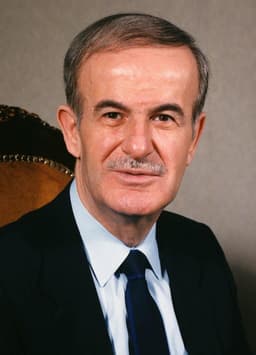
Hafez al-Assad
General · Modern
54.4Total

Yamashita Tomoyuki
General · Modern
49.0Total
Basic Information
Born
1930
1885
Died
—
1946
Era
Modern
Modern
Nationality
Syria
Japan
Occupation
General
General
Civilization
Middle Eastern
Eastern
Score Comparison
Military (10%)
20.0
74.7
Political (20%)
45.0
29.3
Influence (20%)
61.0
59.0
Legacy (20%)
54.0
47.5
Leadership (15%)
72.0
33.5
Strategy (15%)
60.7
55.0
TOTAL
54.4
49.0
Hafez al-Assad — Complete Timeline
1970 AD
Seized power in the Corrective MovementPolitical Action
Hafez al-Assad, then Minister of Defense, launched a bloodless intra-party coup known as the Corrective Movement on November 13, 1970. He ousted the civilian leadership of the Ba'ath Party, assumed the presidency, and established an authoritarian regime dominated by the Alawite minority.
Coup d'étatBa'ath PartyAlawite Rule
Impact: nationaldestructive
1973 AD
Launched the Yom Kippur WarWar◆ Major
Assad coordinated with Egypt's Anwar Sadat to launch a surprise attack on Israel on October 6, 1973. Syrian forces advanced into the Golan Heights but were repelled by Israeli counterattacks. The war ended with a ceasefire, and Syria failed to regain the Golan Heights.
Arab-Israeli WarGolan HeightsMilitary Campaign
Impact: regional
1976 AD
Intervened in the Lebanese Civil WarWar◆ Major
Assad sent Syrian troops into Lebanon to intervene in the civil war, initially against Palestinian and leftist forces. The Syrian military remained in Lebanon for 29 years, exerting political and military control. The intervention solidified Syria's dominance over Lebanese affairs.
LebanonMilitary InterventionHegemony
Impact: regionaldestructive
1982 AD
Crushed the Muslim Brotherhood uprising in HamaWar◆ Major
Assad ordered the Syrian army to besiege and bombard the city of Hama to suppress an Islamist uprising led by the Muslim Brotherhood. Over several weeks, between 10,000 and 40,000 civilians were killed, and large parts of the city were destroyed. The massacre ended armed opposition for decades.
MassacreRepressionMuslim Brotherhood
Impact: nationaldestructive
Yamashita Tomoyuki — Complete Timeline
1942 AD
Captured SingaporeWar
Yamashita Tomoyuki led the Japanese 25th Army in a swift campaign through Malaya, culminating in the capture of Singapore in February 1942. He forced the surrender of over 80,000 British, Indian, and Australian troops, the largest surrender in British military history.
World War IIMalaya CampaignSingapore
Impact: regional
1944 AD
Commanded Defense of the PhilippinesWar◆ Major
Yamashita was appointed commander of Japanese forces in the Philippines in October 1944. He organized a defensive campaign against the Allied invasion, but was unable to prevent the loss of the islands after fierce fighting, including the Battle of Leyte Gulf.
World War IIPhilippines CampaignMilitary Defense
Impact: regional
1946 AD
Executed for War CrimesPolitical Action◆ Major
Yamashita Tomoyuki was tried by a U.S. military commission in Manila and found guilty of war crimes for failing to prevent atrocities committed by his troops. He was sentenced to death and executed by hanging on February 23, 1946, a controversial verdict known as the 'Yamashita standard'.
War Crimes TrialExecutionCommand Responsibility
Impact: globaldestructive
Expert Analysis
Origins
**Hafez al-Assad** was born on October 6, 1930, into a poor Alawite family in the village of Qardaha, Syria. His father, Ali Sulayman al-Assad, was a respected local figure. Hafez joined the Ba'ath Party as a teenager and later enrolled in the Syrian Military Academy, graduating as a pilot. His early military career was shaped by the 1963 Ba'athist coup, which brought his sect to prominence.
**Yamashita Tomoyuki** was born on November 8, 1885, in the village of Osugi, Japan, to a rural doctor. He attended the Imperial Japanese Army Academy and later the Army War College. Yamashita rose through the ranks as a specialist in military strategy, serving as a military attaché in Europe. His formative experiences included observing Nazi Germany's blitzkrieg tactics.
Rise to Power
Assad's rise began as Minister of Defense in 1966. On November 13, 1970, he launched the "Corrective Movement," a bloodless intra-party coup that ousted the radical wing of the Ba'ath Party. He consolidated power by aligning with the military and the Alawite minority, appointing loyalists to key posts. By 1971, he was elected President with 99.2% of the vote in a referendum.
Yamashita's rise came through military conquest. In December 1941, he led the 25th Army in the Malayan campaign. Using bicycle infantry and swift flanking maneuvers, he advanced 600 miles in 55 days. His crowning achievement was the capture of Singapore on February 15, 1942, where he forced the surrender of 80,000 British troops—the largest British capitulation in history. This earned him the nickname "Tiger of Malaya."
Leadership & Governance
Assad's leadership style was authoritarian and centralized. He controlled Syria through a network of Alawite-dominated security services, including the Mukhabarat. His governance focused on stability and strategic alliances: he forged a pact with the Soviet Union, intervened in Lebanon (1976), and supported Iran in the Iran-Iraq War. His political score of 45.0 reflects his ability to maintain power despite a fragmented society. He implemented economic liberalization in the 1980s but crushed dissent ruthlessly, as in the 1982 Hama massacre, where the army killed between 10,000 and 40,000 civilians.
Yamashita's leadership was tactical rather than political. He commanded the Philippines defense in 1944-45, where he faced overwhelming Allied forces. His strategy was to delay the U.S. advance through guerrilla warfare, but he lacked control over subordinate units, leading to atrocities like the Manila Massacre. His leadership score of 33.5 is low due to his inability to prevent war crimes. In contrast, his military score of 74.7 highlights his operational brilliance in Malaya.
Triumph & Tragedy
Assad's greatest triumph was transforming Syria into a regional power. He maintained Ba'athist rule for 30 years, built a formidable military, and established the Assad dynasty. His greatest tragedy was the Hama massacre, which cemented his reputation as a brutal dictator. The death toll remains disputed, but it effectively ended the Muslim Brotherhood insurgency.
Yamashita's triumph was the capture of Singapore, a textbook example of rapid invasion. His tragedy was his execution in 1946. He was held responsible under the "command responsibility" doctrine for atrocities committed by his troops in the Philippines, even though he had limited control. His legacy remains controversial: a brilliant tactician but a symbol of Japanese wartime brutality.
Character & Destiny
Assad was cold, calculating, and patient. He played a long game, balancing rival factions within Syria and the Arab world. His character shaped his destiny: he died in office in 2000, having secured the succession for his son Bashar. His political survival skills were unmatched.
Yamashita was a professional soldier who despised politics. He was known for his directness and tactical genius but lacked the ruthlessness to control his subordinates. His destiny was sealed by the Manila Massacre, for which he was scapegoated. His trial set a legal precedent for command responsibility, influencing international law.
Legacy
Assad's legacy is mixed. He is revered by Alawites and some Arab nationalists as a strong leader who stood up to Israel and the West, but condemned by human rights groups. His total score of 54.4 reflects his enduring influence on Syrian politics and the Middle East. The Assad regime continues under his son.
Yamashita's legacy is primarily military. His tactics are studied in war colleges, but his execution overshadows his achievements. His total score of 49.0 is dragged down by low leadership and political scores. He is remembered as a symbol of Japanese imperialism and the legal concept of command responsibility.
Conclusion
Hafez al-Assad had greater historical impact than Yamashita Tomoyuki. Assad's political score of 45.0, combined with his 72.0 leadership, allowed him to shape Syria and the region for decades. Yamashita's military brilliance (74.7) was confined to a brief wartime period and tainted by his failure to control his forces. Assad's legacy continues to influence global politics, while Yamashita's is a historical footnote. The score gap of 5.4 points reflects Assad's broader and more enduring impact.
Rankings
🥇
Hafez al-AssadLeader
Mil: 20.0Pol: 45.0Inf: 61.0
54.4
🥈
Yamashita Tomoyuki
Mil: 74.7Pol: 29.3Inf: 59.0
49.0
+5.4 behind
How This Comparison Works
Algorithm
Each figure is scored on 6 dimensions (0—100 scale) based on structured historical data: Military (10%), Political (20%), Influence (20%), Legacy (20%), Leadership (15%), Strategy (15%). The weighted total produces the final ranking.
Data Sources
Scores are computed from structured sub-indicators in the database. Scale factors adjust for era (Ancient ×0.85, Modern ×1.0) and civilization size (Eastern ×1.05, Other ×0.80) to account for differences in population and military scale.
Maximum 3 Figures
Comparisons are limited to 2—3 figures to ensure readability and statistical meaningfulness.
Error Margins
±5 points per dimension — Sub-scores are derived from historical records with inherent uncertainty. Two figures within 5 points on a dimension should be considered roughly equivalent in that area.
Total Score Accuracy
±3 points overall — The weighted combination of 6 dimensions produces a total score with approximately ±3 points of uncertainty. Differences of less than 3 points are not statistically significant— the figures are effectively tied.
Known Limitations
- Historical records are incomplete and uneven across civilizations
- Figures from oral-tradition societies may be underrepresented
- Occupation labels can misclassify multi-role figures
- Scores measure capability and impact, not moral character
- Quantitative scoring is a comparison tool, not absolute truth
Capability Radar
Military (10%) — Battles & Warfare
Battles
45
75
Win Rate
40
70
Expansion
30
65
Political (20%) — Governance & Reform
Reform
50
10
Diplomacy
70
20
Economy
45
10
Influence (20%) — Cultural & Global Reach
Cultural
40
40
Global
55
45
Legacy (20%) — Historical Impact
Historical
60
55
Longevity
55
30
Leadership (15%) — Power & Stability
Tenure
85
15
Stability
40
10
Strategy (15%) — Tactics & Innovation
Strategy
60
80
Tactics
55
85
Reform
65
20
Similar Comparisons
Comments & Discussion
No comments yet. Be the first to share your thoughts!