Loading...
Chester W. Nimitz vs Hafez al-Assad
Chester W. Nimitz leads by 17.5 pts · 2 figures compared
…

Chester W. Nimitz
General · Modern
71.9Total
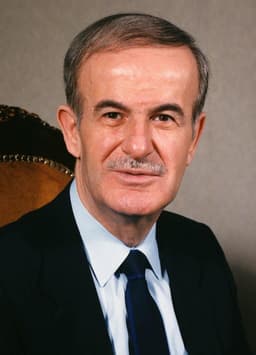
Hafez al-Assad
General · Modern
54.4Total
Basic Information
Born
1885
1930
Died
1966
—
Era
Modern
Modern
Nationality
United States
Syria
Occupation
General
General
Civilization
Western
Middle Eastern
Score Comparison
Military (10%)
82.0
20.0
Political (20%)
78.0
45.0
Influence (20%)
65.0
61.0
Legacy (20%)
65.0
54.0
Leadership (15%)
78.0
72.0
Strategy (15%)
78.4
60.7
TOTAL
71.9
54.4
Chester W. Nimitz — Complete Timeline
1941 AD
Appointed Commander-in-Chief of the Pacific FleetOther◆ Major
Following the attack on Pearl Harbor, Nimitz was appointed Commander-in-Chief of the U.S. Pacific Fleet on December 31, 1941. He assumed command during a period of severe losses and low morale, tasked with rebuilding the fleet and turning the tide against Japan.
World War IIPacific TheaterNaval Command
Impact: global
1942 AD
Battle of MidwayWar◆ Major
Nimitz directed the U.S. Navy to intercept the Japanese fleet at Midway Atoll from June 4-7, 1942. His forces sank four Japanese aircraft carriers against the loss of one U.S. carrier, marking a decisive turning point in the Pacific War and ending Japanese offensive capability.
World War IIPacific TheaterNaval Victory
Impact: globalconstructive
Guadalcanal CampaignWar◆ Major
Nimitz oversaw the amphibious assault on Guadalcanal beginning August 7, 1942, the first major Allied offensive in the Pacific. The campaign lasted six months, involving naval battles and ground combat, resulting in the first Japanese land defeat and securing Allied supply lines to Australia.
World War IIPacific TheaterAmphibious Assault
Impact: regionalconstructive
1943 AD
Island Hopping CampaignOther◆ Major
Nimitz implemented the island-hopping strategy, bypassing heavily fortified Japanese positions to capture strategically important islands. This campaign included the Gilbert and Marshall Islands operations in 1943-1944, progressively cutting Japanese supply lines and establishing bases for the final assault on Japan.
World War IIPacific TheaterMilitary Strategy
Impact: global
1944 AD
Battle of Leyte GulfWar◆ Major
Nimitz commanded U.S. naval forces during the Battle of Leyte Gulf from October 23-26, 1944, the largest naval battle in history. The victory destroyed the remaining Japanese fleet and secured the Allied invasion of the Philippines, effectively ending Japanese naval power.
World War IIPacific TheaterNaval Victory
Impact: globalconstructive
1945 AD
Signed the Japanese SurrenderOther◆ Major
As Commander of the Pacific Fleet, Nimitz signed the Japanese Instrument of Surrender on behalf of the United States aboard the USS Missouri on September 2, 1945. This act formally ended World War II and marked the conclusion of the Pacific War.
World War IIPacific TheaterDiplomacy
Impact: globalconstructive
Appointed Chief of Naval OperationsOther◆ Major
Nimitz was appointed Chief of Naval Operations in December 1945, the highest-ranking officer in the U.S. Navy. He served until 1947, overseeing the post-war demobilization and reorganization of the Navy, including the transition to a peacetime force.
Post-WarNaval AdministrationLeadership
Impact: national
Hafez al-Assad — Complete Timeline
1970 AD
Seized power in the Corrective MovementPolitical Action
Hafez al-Assad, then Minister of Defense, launched a bloodless intra-party coup known as the Corrective Movement on November 13, 1970. He ousted the civilian leadership of the Ba'ath Party, assumed the presidency, and established an authoritarian regime dominated by the Alawite minority.
Coup d'étatBa'ath PartyAlawite Rule
Impact: nationaldestructive
1973 AD
Launched the Yom Kippur WarWar◆ Major
Assad coordinated with Egypt's Anwar Sadat to launch a surprise attack on Israel on October 6, 1973. Syrian forces advanced into the Golan Heights but were repelled by Israeli counterattacks. The war ended with a ceasefire, and Syria failed to regain the Golan Heights.
Arab-Israeli WarGolan HeightsMilitary Campaign
Impact: regional
1976 AD
Intervened in the Lebanese Civil WarWar◆ Major
Assad sent Syrian troops into Lebanon to intervene in the civil war, initially against Palestinian and leftist forces. The Syrian military remained in Lebanon for 29 years, exerting political and military control. The intervention solidified Syria's dominance over Lebanese affairs.
LebanonMilitary InterventionHegemony
Impact: regionaldestructive
1982 AD
Crushed the Muslim Brotherhood uprising in HamaWar◆ Major
Assad ordered the Syrian army to besiege and bombard the city of Hama to suppress an Islamist uprising led by the Muslim Brotherhood. Over several weeks, between 10,000 and 40,000 civilians were killed, and large parts of the city were destroyed. The massacre ended armed opposition for decades.
MassacreRepressionMuslim Brotherhood
Impact: nationaldestructive
Expert Analysis
Origins
Chester W. Nimitz was born on February 24, 1885, in Fredericksburg, Texas, to a family with a strong naval tradition. His father died before he was born, and he was raised by his mother and grandfather. Nimitz attended the U.S. Naval Academy, graduating in 1905, seventh in his class. His early career included service on submarines and surface vessels, where he developed expertise in diesel engines.
Hafez al-Assad was born on October 6, 1930, in Qardaha, Syria, to a poor Alawite family. He was the ninth of eleven children. Assad joined the Ba'ath Party at age 16 and later attended the Homs Military Academy, graduating as a pilot in 1955. His early military career included training in the Soviet Union and rising through the ranks of the Syrian Air Force.
Rise to Power
Nimitz's rise was steady and merit-based. He served as Chief of the Bureau of Navigation from 1939 to 1941, overseeing personnel matters. After the Japanese attack on Pearl Harbor on December 7, 1941, Admiral Husband Kimmel was relieved, and Nimitz was appointed Commander-in-Chief of the U.S. Pacific Fleet on December 31, 1941, with the rank of admiral. He quickly restored morale and organized the defense of the Pacific.
Assad seized power through a bloodless intra-party coup known as the Corrective Movement on November 13, 1970. As Minister of Defense, he ousted the civilian leadership of the Ba'ath Party, led by Salah Jadid. Assad consolidated power by positioning himself as a strongman, securing support from the military and the Alawite minority. He became President in 1971 after a referendum.
Leadership & Governance
Nimitz led with a calm, methodical style, emphasizing delegation and trust in subordinates. He oversaw the largest naval campaign in history, implementing the island-hopping strategy that bypassed heavily fortified Japanese positions. He scored 78.0 in political and 78.4 in strategy, reflecting his ability to coordinate with Army and Allied forces. His governance was purely military, focused on defeating Japan.
Assad ruled Syria with an iron fist, establishing a totalitarian regime. He scored 45.0 in political and 20.0 in military, but 72.0 in leadership, indicating his authoritarian control. He crushed dissent, notably the Muslim Brotherhood uprising in Hama in 1982, where his forces killed tens of thousands. He maintained power through a cult of personality and a security state, intervening in Lebanon's civil war in 1976 to assert Syrian influence.
Triumph & Tragedy
Nimitz's greatest triumph was the Battle of Midway on June 4-7, 1942, where his forces sank four Japanese aircraft carriers, turning the tide of the Pacific War. He also oversaw the Guadalcanal Campaign and the Battle of Leyte Gulf, the largest naval battle in history. His tragedy was the loss of many sailors and ships, but he achieved victory with minimal strategic errors. He scored 82.0 in military, the highest among his metrics.
Assad's triumph was launching the Yom Kippur War on October 6, 1973, coordinating with Egypt to attack Israel. Syrian forces initially advanced into the Golan Heights but were repelled. His tragedy was the brutal suppression in Hama, which solidified his power but at a horrific human cost. He also failed to achieve lasting strategic gains against Israel. His military score of 20.0 reflects his limited success in combat.
Character & Destiny
Nimitz was known for his integrity, humility, and strategic foresight. He remained calm under pressure, earning the respect of his peers. His character shaped his fate as a victorious commander who helped defeat Japan. He was appointed Fleet Admiral in 1944 and served as Chief of Naval Operations after the war. His legacy is one of effective leadership.
Assad was cunning, ruthless, and pragmatic. He manipulated rival factions and maintained power through fear. His character led to a stable but oppressive regime that lasted 30 years. He died in office on June 10, 2000, passing power to his son Bashar. His destiny was to be a dictator who shaped modern Syria's authoritarian trajectory.
Legacy
Nimitz's legacy is enshrined in the U.S. Navy: the USS Nimitz, a nuclear-powered aircraft carrier, bears his name. His island-hopping strategy and naval tactics are studied in military academies. He scored 65.0 in influence and legacy, reflecting his enduring impact on naval warfare.
Assad's legacy is mixed: he transformed Syria into a regional power but left a brutal authoritarian system that contributed to the Syrian Civil War. His influence score of 61.0 and legacy of 54.0 reflect his lasting impact on Middle Eastern politics, though largely negative.
Conclusion
Chester W. Nimitz had a greater impact than Hafez al-Assad, as reflected in his higher total score of 71.9 versus 54.4. Nimitz's strategic victories in World War II directly shaped the global order and saved countless lives, while Assad's rule, though influential, was marked by repression and failed wars. Nimitz's leadership in naval history is a model of effective command, while Assad's authoritarianism left a destructive legacy. The data supports Nimitz as the more historically significant figure.
Rankings
🥇
Chester W. NimitzLeader
Mil: 82.0Pol: 78.0Inf: 65.0
71.9
🥈
Hafez al-Assad
Mil: 20.0Pol: 45.0Inf: 61.0
54.4
+17.5 behind
How This Comparison Works
Algorithm
Each figure is scored on 6 dimensions (0—100 scale) based on structured historical data: Military (10%), Political (20%), Influence (20%), Legacy (20%), Leadership (15%), Strategy (15%). The weighted total produces the final ranking.
Data Sources
Scores are computed from structured sub-indicators in the database. Scale factors adjust for era (Ancient ×0.85, Modern ×1.0) and civilization size (Eastern ×1.05, Other ×0.80) to account for differences in population and military scale.
Maximum 3 Figures
Comparisons are limited to 2—3 figures to ensure readability and statistical meaningfulness.
Error Margins
±5 points per dimension — Sub-scores are derived from historical records with inherent uncertainty. Two figures within 5 points on a dimension should be considered roughly equivalent in that area.
Total Score Accuracy
±3 points overall — The weighted combination of 6 dimensions produces a total score with approximately ±3 points of uncertainty. Differences of less than 3 points are not statistically significant— the figures are effectively tied.
Known Limitations
- Historical records are incomplete and uneven across civilizations
- Figures from oral-tradition societies may be underrepresented
- Occupation labels can misclassify multi-role figures
- Scores measure capability and impact, not moral character
- Quantitative scoring is a comparison tool, not absolute truth
Capability Radar
Military (10%) — Battles & Warfare
Battles
92
45
Win Rate
95
40
Expansion
90
30
Political (20%) — Governance & Reform
Reform
75
50
Diplomacy
80
70
Economy
60
45
Influence (20%) — Cultural & Global Reach
Cultural
65
40
Global
80
55
Legacy (20%) — Historical Impact
Historical
85
60
Longevity
70
55
Leadership (15%) — Power & Stability
Tenure
70
85
Stability
85
40
Strategy (15%) — Tactics & Innovation
Strategy
95
60
Tactics
88
55
Reform
85
65
Similar Comparisons
Comments & Discussion
No comments yet. Be the first to share your thoughts!