Loading...
Haile Selassie I vs John William of Cleves
Haile Selassie I leads by 15.0 pts · 2 figures compared
…

Haile Selassie I
Emperor · Modern
64.6Total
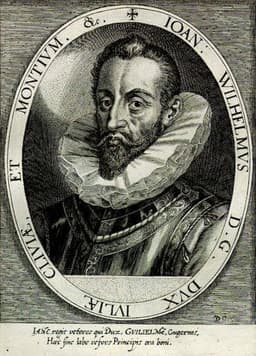
John William of Cleves
Emperor · Modern
49.6Total
Basic Information
Born
1892
1562
Died
1975
1609
Era
Modern
Modern
Nationality
Ethiopia
Cleves
Occupation
Emperor
Emperor
Civilization
Other
Western
Score Comparison
Military (10%)
25.0
11.2
Political (20%)
59.3
68.0
Influence (20%)
88.0
60.0
Legacy (20%)
55.0
34.2
Leadership (15%)
79.8
58.8
Strategy (15%)
55.0
59.2
TOTAL
64.6
49.6
Haile Selassie I — Complete Timeline
1930 AD
Became Emperor of EthiopiaPolitical Action◆ Major
Haile Selassie was crowned Emperor of Ethiopia after the death of Empress Zewditu. His coronation was a lavish ceremony attended by foreign dignitaries, symbolizing Ethiopia's independence and modernization efforts.
CoronationEthiopian EmpireModernization
Impact: national
Declared Divine Figure by Rastafari MovementCultural◆ Major
Following his coronation, the Rastafari movement in Jamaica began to venerate Haile Selassie as the messiah and a divine figure. This belief, based on interpretations of biblical prophecy, made him a central religious icon for millions worldwide.
RastafariReligionMessianism
Impact: global
1936 AD
Addressed the League of Nations on Italian InvasionPolitical Action◆ Major
After Italy invaded Ethiopia, Haile Selassie delivered a powerful speech to the League of Nations in Geneva, warning that 'today it is us, tomorrow it will be you.' The League failed to act, and Ethiopia was occupied by Italy.
League of NationsItalian InvasionAppeal
Impact: globaltragic
1941 AD
Returned to Ethiopia After LiberationPolitical Action◆ Major
With British military assistance, Haile Selassie returned to Ethiopia after five years of Italian occupation. He was restored to the throne and began the process of rebuilding the country and modernizing its institutions.
LiberationRestorationWorld War II
Impact: nationalconstructive
1963 AD
Founded the Organization of African UnityPolitical Action
Haile Selassie hosted the conference that established the Organization of African Unity (OAU) in Addis Ababa. He played a key role in promoting pan-Africanism and decolonization, making Ethiopia a hub for African diplomacy.
OAUPan-AfricanismDecolonization
Impact: globalconstructive
1974 AD
Ousted by the Derg Military CoupPolitical Action
After months of protests and a military mutiny, Haile Selassie was deposed by the Derg, a Marxist military junta. He was placed under house arrest and died the following year under mysterious circumstances, ending the Solomonic dynasty's rule.
Coup d'étatDergEnd of Monarchy
Impact: nationaltragic
John William of Cleves — Complete Timeline
1592 AD
Inherited the Duchies of Jülich-Cleves-BergPolitical Action◆ Major
John William inherited the united Duchies of J
SuccessionMental IllnessRegency
Impact: regionaltragic
1609 AD
Death of John WilliamPolitical Action
John William died without a direct heir, ending the male line of the House of La Marck. His death triggered the War of the J
DeathSuccession CrisisWar of the Jülich Succession
Impact: regionaltragic
Expert Analysis
Origins
Haile Selassie I was born Tafari Makonnen on July 23, 1892, in Ejersa Goro, Ethiopia. He was the son of Ras Makonnen, a governor and cousin of Emperor Menelik II. Tafari received a traditional Ethiopian education, including Coptic Christian teachings, and was groomed for leadership from a young age. His background as a member of the Solomonic dynasty gave him a strong claim to the throne.
John William of Cleves was born on May 28, 1562, in Cleves, as the eldest son of Duke William the Rich and Maria of Habsburg. His family ruled the United Duchies of Jülich-Cleves-Berg, a significant territory in the Holy Roman Empire. John William's education was typical of a noble prince, but his mental health deteriorated early in life, leading to severe psychological issues that defined his reign.
Rise to Power
Haile Selassie rose through political maneuvering. Appointed governor of Sidamo in 1908, he later became regent in 1916 after a coup against Emperor Iyasu V. He effectively ruled as regent until Empress Zewditu's death in 1930, when he was crowned Emperor of Ethiopia. His coronation on November 2, 1930, was a lavish ceremony attended by foreign dignitaries, signaling his international ambitions.
John William inherited the duchy upon his father's death in 1592, but his mental illness rendered him incapable of ruling. His regency was managed by his mother and later by his brother-in-law. His reign was largely symbolic, with real power held by nobles and relatives. His death on March 25, 1609, without an heir, triggered the War of the Jülich Succession, as multiple claimants vied for the territories.
Leadership & Governance
Haile Selassie was a modernizing autocrat. He centralized the government, introduced a constitution in 1931, and attempted to abolish slavery. He invested in infrastructure, education, and diplomacy. However, his rule was authoritarian, suppressing dissent and maintaining a feudal system. He scored 79.8 in leadership, reflecting his ability to command respect and navigate international politics, but his governance faced criticism for failing to address inequality.
John William had no effective leadership due to his mental illness. His score of 58.8 in leadership reflects the nominal role he played. Governance during his reign was carried out by regents who struggled to maintain stability. His inability to produce an heir led to a succession crisis, demonstrating how his condition shaped the region's politics.
Triumph & Tragedy
Haile Selassie's greatest triumph was his address to the League of Nations on June 30, 1936, after Italy's invasion of Ethiopia. His speech warned against appeasement and made him a global symbol of anti-colonial resistance. Another triumph was founding the Organization of African Unity in 1963, promoting pan-Africanism. His tragedy came in 1974 when the Derg military coup ousted him. He was placed under house arrest and died on August 27, 1975, under mysterious circumstances. His failure to address domestic poverty and inequality contributed to his downfall.
John William's life was marked by tragedy. His mental illness prevented him from ruling or fathering children. His death without an heir caused the War of the Jülich Succession (1609-1614), a destructive conflict involving multiple European powers. He had no significant triumphs; his legacy is the war triggered by his death. His political score of 68.0 reflects the influence of his inheritance, but his personal leadership score was low.
Character & Destiny
Haile Selassie was a shrewd diplomat and determined modernizer. He believed in Ethiopia's sovereignty and his divine right to rule, which led to clashes with progressive forces. His character combined charisma with aloofness, and his trust in international institutions proved misplaced when the League failed to protect Ethiopia. His destiny was tied to the decline of monarchy in Africa; he could not adapt to the changing political landscape, leading to his overthrow.
John William suffered from severe mental illness, likely schizophrenia or bipolar disorder, which rendered him incapable of governance. His character was defined by his illness, and his destiny was to be a pawn in dynastic politics. His death triggered a war that reshaped the region, but he himself had little agency.
Legacy
Haile Selassie's legacy is complex. He is revered by Rastafarians as a messianic figure and remembered as a founding father of the OAU (now African Union). His modernization efforts had mixed results; Ethiopia remained poor and authoritarian. His influence score is 88.0, reflecting his global symbolic importance. However, his legacy score of 55.0 indicates that his long-term impact was limited by the overthrow of his regime and Ethiopia's subsequent struggles.
John William's legacy is primarily the War of the Jülich Succession, which weakened the Holy Roman Empire and contributed to the Thirty Years' War. His territories were eventually divided, and his dynasty ended. His influence score of 60.0 reflects the significance of his death, but his legacy score of 34.2 shows he is little remembered beyond historical events.
Conclusion
Haile Selassie I had a greater impact than John William of Cleves, as evidenced by his total score of 64.6 versus 49.6. Selassie's role in founding the OAU and his symbolic resistance to colonialism shaped 20th-century Africa, while John William's significance is confined to a regional succession war. Selassie's leadership and influence scores far exceed John William's, despite his failures. Thus, Haile Selassie emerges as the more consequential figure in historical terms.
Rankings
🥇
Haile Selassie ILeader
Mil: 25.0Pol: 59.3Inf: 88.0
64.6
🥈
John William of Cleves
Mil: 11.2Pol: 68.0Inf: 60.0
49.6
+15.0 behind
How This Comparison Works
Algorithm
Each figure is scored on 6 dimensions (0—100 scale) based on structured historical data: Military (10%), Political (20%), Influence (20%), Legacy (20%), Leadership (15%), Strategy (15%). The weighted total produces the final ranking.
Data Sources
Scores are computed from structured sub-indicators in the database. Scale factors adjust for era (Ancient ×0.85, Modern ×1.0) and civilization size (Eastern ×1.05, Other ×0.80) to account for differences in population and military scale.
Maximum 3 Figures
Comparisons are limited to 2—3 figures to ensure readability and statistical meaningfulness.
Error Margins
±5 points per dimension — Sub-scores are derived from historical records with inherent uncertainty. Two figures within 5 points on a dimension should be considered roughly equivalent in that area.
Total Score Accuracy
±3 points overall — The weighted combination of 6 dimensions produces a total score with approximately ±3 points of uncertainty. Differences of less than 3 points are not statistically significant— the figures are effectively tied.
Known Limitations
- Historical records are incomplete and uneven across civilizations
- Figures from oral-tradition societies may be underrepresented
- Occupation labels can misclassify multi-role figures
- Scores measure capability and impact, not moral character
- Quantitative scoring is a comparison tool, not absolute truth
Capability Radar
Military (10%) — Battles & Warfare
Battles
45
34
Win Rate
40
42
Expansion
30
45
Political (20%) — Governance & Reform
Reform
70
0
Diplomacy
75
0
Economy
50
0
Influence (20%) — Cultural & Global Reach
Cultural
80
0
Global
75
0
Legacy (20%) — Historical Impact
Historical
75
10
Longevity
70
5
Leadership (15%) — Power & Stability
Tenure
85
5
Stability
45
0
Strategy (15%) — Tactics & Innovation
Strategy
55
45
Tactics
50
48
Reform
60
49
Similar Comparisons
Comments & Discussion
No comments yet. Be the first to share your thoughts!