Loading...
John William of Cleves vs Napoleon Bonaparte
Napoleon Bonaparte leads by 21.3 pts · 2 figures compared
…
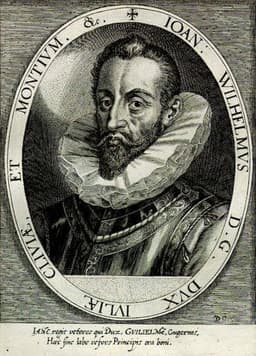
John William of Cleves
Emperor · Modern
49.6Total

Napoleon Bonaparte
General · Modern
70.9Total
Basic Information
Born
1562
1769
Died
1609
1821
Era
Modern
Modern
Nationality
Cleves
France
Occupation
Emperor
General
Civilization
Western
Western
Score Comparison
Military (10%)
11.2
94.0
Political (20%)
68.0
72.0
Influence (20%)
60.0
40.0
Legacy (20%)
34.2
80.0
Leadership (15%)
58.8
78.0
Strategy (15%)
59.2
90.0
TOTAL
49.6
70.9
John William of Cleves — Complete Timeline
1592 AD
Inherited the Duchies of Jülich-Cleves-BergPolitical Action◆ Major
John William inherited the united Duchies of J
SuccessionMental IllnessRegency
Impact: regionaltragic
1609 AD
Death of John WilliamPolitical Action
John William died without a direct heir, ending the male line of the House of La Marck. His death triggered the War of the J
DeathSuccession CrisisWar of the Jülich Succession
Impact: regionaltragic
Napoleon Bonaparte — Complete Timeline
1799 AD
Coup of 18 BrumaireOther◆ Major
Napoleon Bonaparte, with support from his brother Lucien and key political figures, overthrew the Directory in a bloodless coup. He established the Consulate with himself as First Consul, effectively becoming the ruler of France. This event ended the French Revolution's most unstable period.
French RevolutionCoupRise to Power
Impact: regional
1804 AD
Promulgation of the Napoleonic CodeOther◆ Major
Napoleon enacted the Civil Code of the French, known as the Napoleonic Code, a comprehensive set of laws that replaced the fragmented feudal legal systems. The code established legal equality, protected property rights, and secularized law. It became the basis for legal systems in many European and world countries.
Legal ReformNapoleonic CodeCivil Law
Impact: globalconstructive
1805 AD
Battle of AusterlitzWar◆ Major
Napoleon's Grande Arm
Napoleonic WarsBattleDecisive Victory
Impact: global
1812 AD
Invasion of RussiaWar◆ Major
Napoleon led the Grande Arm
Napoleonic WarsInvasionDisaster
Impact: globaldestructive
1815 AD
Battle of WaterlooWar◆ Major
Napoleon's French army was defeated by the combined forces of the Duke of Wellington's Anglo-Allied army and Gebhard Leberecht von Bl
Napoleonic WarsBattleFinal Defeat
Impact: globaldestructive
Expert Analysis
john-william-of-cleves-vs-napoleon-bonaparte
# The Conqueror and the Cipher
On a battlefield in Belgium, in June 1815, the greatest military mind of his age watched his empire crumble. Napoleon Bonaparte, who had crowned himself Emperor of the French and redrawn the map of Europe, saw his Grand Army shattered at Waterloo. Less than two centuries earlier, in a quiet ducal palace on the Rhine, another ruler—John William of Cleves—breathed his last in 1609, leaving behind not a legacy of conquest but a succession crisis that would plunge Europe into war. What separates a figure who reshapes history from one who merely triggers it? The answer lies not in the accidents of birth but in the chasm between genius and incapacity, between will and its absence.
Origins
Napoleon Bonaparte was born in 1769 on the island of Corsica, a recent French acquisition, to a minor noble family of Italian ancestry. His world was one of volcanic ambition and revolutionary upheaval. The French Revolution, which erupted when he was twenty, shattered the old order and created opportunities unknown under the Bourbon monarchy. A young artillery officer from the periphery could rise on merit alone. Napoleon devoured military history, studied the campaigns of Alexander and Caesar, and absorbed the Enlightenment's faith in reason and order. His era demanded action, and he was built for it.
John William of Cleves, born in 1562, inherited a different world. The Duchy of Jülich-Cleves-Berg was a prosperous but precarious territory on the Rhine, caught between Catholic Spain and Protestant Dutch rebels. His father, William the Rich, had united these lands through careful marriage politics. But John William was born into a family cursed by mental illness. From his youth, he displayed signs of severe psychological disturbance—episodes of violence, delusion, and incapacity. His era, the late Renaissance, was one of religious conflict and dynastic maneuvering, but it required rulers who could navigate these treacherous waters. John William could barely steer his own mind.
Rise to Power
Napoleon's ascent was meteoric. In 1793, at age twenty-four, he drove the British from Toulon with brilliant artillery tactics. By 1796, he commanded the Army of Italy and stunned Europe with a campaign of lightning speed—defeating larger Austrian armies through rapid marches and decisive strikes. His 1798 Egyptian expedition, though ultimately a strategic failure, burnished his legend. In 1799, he seized power in a coup d'état, becoming First Consul of France. By 1804, he crowned himself Emperor. Every step was a calculated gamble, each victory a ladder rung.
John William's rise was an accident of biology. He inherited the duchies from his father in 1592, but he never truly ruled. His mental state deteriorated rapidly after 1590, leaving him incapable of governance. His lands were administered by regents—his mother, then his wife, then a council of nobles. The historical record of his reign is a chronicle of decline: the duke who could not sign documents, who wandered the palace in confusion, who had to be locked in his chambers during violent fits. He did not rise to power; he was overtaken by it.
Leadership & Governance
Napoleon governed with the same energy he brought to war. He centralized the French state, created the Bank of France, and established the Napoleonic Code—a legal framework that enshrined equality before the law, property rights, and secular administration. His military genius (scored at 94.0 for military ability, 93.0 for strategy) was matched by political acumen (75.0). He appointed officials based on merit, reformed education, and negotiated the Concordat of 1801 with the Catholic Church, ending a decade of religious strife. Yet his governance was also authoritarian—press censorship, secret police, and a cult of personality that demanded absolute loyalty.
John William governed not at all. His leadership score of 77.0 reflects the competence of his regents, not the duke himself. The Duchy of Jülich-Cleves-Berg was well-administered in his name—trade flourished, religious toleration was maintained, and the territory remained neutral in the Dutch Revolt. But this was governance by default, not design. John William was a vessel through which others ruled. His political score of 74.4 is a phantom number, measuring the structure he inherited rather than any action he took.
Triumph & Tragedy
Napoleon's greatest moment was Austerlitz in December 1805, where he destroyed a combined Russian and Austrian army, forcing the Holy Roman Empire's dissolution. His Napoleonic Code spread across Europe, influencing legal systems from Italy to Latin America. But his tragedy was hubris—the 1812 invasion of Russia, where he lost half a million men to winter and guerrilla warfare. Exiled to Elba, he returned in 1815 for the Hundred Days, only to meet final defeat at Waterloo. His total score of 82.4 reflects a life of extraordinary achievement and catastrophic failure.
John William's triumph was simply surviving until 1609. His tragedy was his existence—a man born to rule who could not rule himself. His death without a direct heir triggered the War of the Jülich Succession (1609–1614), a conflict that drew in Spain, France, the Dutch Republic, and the Holy Roman Empire. The crisis destabilized the Rhineland and contributed to the broader tensions that erupted into the Thirty Years' War. John William's legacy is one of absence—a vacuum that others filled with blood.
Character & Destiny
Napoleon's character was forged from Corsican pride, revolutionary ambition, and a relentless will to dominate. He once said, "Impossible is a word to be found only in the dictionary of fools." His decisions—from the coup of 1799 to the Russian campaign—were driven by a conviction that he could shape destiny itself. This made him both liberator and tyrant, reformer and conqueror. His personality was his destiny: a man who could not stop until he was stopped.
John William's character was erased by illness. He was a cipher, a placeholder in history's ledger. His decisions were none of his own. His destiny was determined by biology—a genetic inheritance that rendered him incapable of agency. Where Napoleon shaped history through force of will, John William was shaped by forces beyond his control. The contrast is not between good and evil but between presence and absence, between a man who seized his era and a man who was seized by his demons.
Legacy
Napoleon's legacy is monumental. The Napoleonic Code remains the foundation of civil law in much of Europe and the world. His military innovations—the corps system, rapid mobilization, decisive battle—influenced warfare into the twentieth century. He is remembered as both a genius and a cautionary tale, a figure who expanded human possibility and then destroyed it. His legacy score of 78.0 understates his enduring presence in Western consciousness.
John William of Cleves is remembered, if at all, as a footnote—the mad duke whose death sparked a war. His legacy score of 46.5 reflects his obscurity. Yet his story carries its own lesson: that history is not only made by the great but also by the broken, that the absence of leadership can be as consequential as its presence. The War of the Jülich Succession reshaped the Rhineland, and the Thirty Years' War that followed devastated Germany for a generation. John William's tragedy was not his alone; it became Europe's.
Conclusion
Standing at Waterloo, Napoleon Bonaparte could see the end of his world. In a palace in Cleves, John William could not see anything at all. One man conquered Europe; the other could not conquer his own mind. Their stories, so different, reveal a single truth: that history is the product of human agency—and its absence. Napoleon reminds us that will can reshape the world. John William reminds us that when will fails, the world reshapes itself, often in blood. Both are necessary to understand the full range of human possibility, from the heights of genius to the depths of incapacity, and how both leave their mark on the centuries that follow.
Rankings
🥇
Napoleon BonaparteLeader
Mil: 94.0Pol: 72.0Inf: 40.0
70.9
🥈
John William of Cleves
Mil: 11.2Pol: 68.0Inf: 60.0
49.6
+21.3 behind
How This Comparison Works
Algorithm
Each figure is scored on 6 dimensions (0—100 scale) based on structured historical data: Military (10%), Political (20%), Influence (20%), Legacy (20%), Leadership (15%), Strategy (15%). The weighted total produces the final ranking.
Data Sources
Scores are computed from structured sub-indicators in the database. Scale factors adjust for era (Ancient ×0.85, Modern ×1.0) and civilization size (Eastern ×1.05, Other ×0.80) to account for differences in population and military scale.
Maximum 3 Figures
Comparisons are limited to 2—3 figures to ensure readability and statistical meaningfulness.
Error Margins
±5 points per dimension — Sub-scores are derived from historical records with inherent uncertainty. Two figures within 5 points on a dimension should be considered roughly equivalent in that area.
Total Score Accuracy
±3 points overall — The weighted combination of 6 dimensions produces a total score with approximately ±3 points of uncertainty. Differences of less than 3 points are not statistically significant— the figures are effectively tied.
Known Limitations
- Historical records are incomplete and uneven across civilizations
- Figures from oral-tradition societies may be underrepresented
- Occupation labels can misclassify multi-role figures
- Scores measure capability and impact, not moral character
- Quantitative scoring is a comparison tool, not absolute truth
Capability Radar
Military (10%) — Battles & Warfare
Battles
34
95
Win Rate
42
90
Expansion
45
95
Political (20%) — Governance & Reform
Reform
0
95
Diplomacy
0
80
Economy
0
85
Influence (20%) — Cultural & Global Reach
Cultural
0
85
Global
0
90
Legacy (20%) — Historical Impact
Historical
10
95
Longevity
5
90
Leadership (15%) — Power & Stability
Tenure
5
85
Stability
0
70
Strategy (15%) — Tactics & Innovation
Strategy
45
95
Tactics
48
98
Reform
49
92
Similar Comparisons
Comments & Discussion
1. **IronLegion6/17/2026
Calling this a comparison is like comparing a lion to a lamprey. Napoleon commanded armies that changed Europe's political DNA, from the Napoleonic Code to national conscription. John William of Cleves was so forgettable he died without an heir—like a historical footnote that couldn't even bark. Waterloo at least gave us drama; Cleves gave us a succession crisis that bored everyone into a war. If you want history with teeth, pick Bonaparte.**
2. **数字侦探6/17/2026
数据不会骗人:拿破仑打了超过60场战役,统治过7千万人,对欧洲的影响写在每本法典里。克利夫斯的约翰·威廉统治30年,领土小得连德国人都记不清,死时连个儿子都没留下。比个什么劲儿?一个是改变世界的引擎,一个只是路边的一个坑。只看数据,高下立判。**
3. **GaulicMargin6/17/2026
As a classics scholar, I see Napoleon as a failed Alexander—brilliant but hubristic, his empire crumbling faster than it rose. But John William? He’s more like a minor Hellenistic satrap: nobody remembers his name, yet his death triggered the Thirty Years’ War via the War of the Jülich Succession. Napoleon’s legacy is loud and short; Cleves’s silence echoes for centuries. Sometimes the weakest link in history does more damage than the strongest blow.**
4. **反骨编年史6/17/2026
你们都在夸拿破仑的“天才”,但克利夫斯的约翰·威廉才是欧洲混乱的隐形推手。他的死亡直接引爆了三十年战争的导火索——那块地现在还是德法争端的疤痕。拿破仑再牛,滑铁卢后就被流放,像个过气的独裁者。克利夫斯却用一个空王位,让全欧洲打了十年。历史不是只有赢家,还有埋雷的赢家。**
Historian9966/17/2026
From a military historian’s view, Napoleon mastered maneuver warfare—Austerlitz was a chess masterpiece. But John William of Cleves? He didn’t even command a battalion. His “legacy” is a power vacuum that Habsburgs and Hohenzollerns fought over like dogs over scraps. Napoleon shaped his era through will; Cleves shaped his through absence. One is a general, the other a ghost. Give me the man who at least swung a sword.**