Loading...
Harry S. Truman vs Julius Caesar
Julius Caesar leads by 19.1 pts · 2 figures compared
…
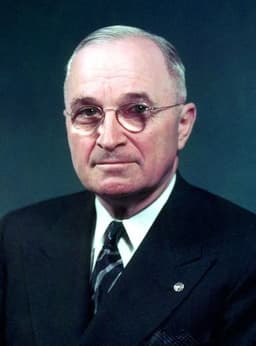
Harry S. Truman
Politician · Modern
63.7Total

Julius Caesar
General · Ancient
82.8Total
Basic Information
Born
1884
-100
Died
1972
-44
Era
Modern
Ancient
Nationality
United States
Roman Republic
Occupation
Politician
General
Civilization
Western
Western
Score Comparison
Military (10%)
30.0
88.0
Political (20%)
55.0
78.0
Influence (20%)
68.0
85.0
Legacy (20%)
72.0
82.0
Leadership (15%)
79.8
80.0
Strategy (15%)
55.0
85.0
TOTAL
63.7
82.8
Harry S. Truman — Complete Timeline
1945 AD
Ordered atomic bombings of Hiroshima and NagasakiWar
Truman authorized the use of atomic bombs against Japan. Hiroshima was bombed on August 6, Nagasaki on August 9. Japan surrendered on August 15, ending World War II. The bombings caused massive civilian casualties and initiated the nuclear age.
World War IINuclear WeaponsJapan
Impact: globaldestructive
1947 AD
Announced the Truman DoctrinePolitical Action◆ Major
Truman declared that the United States would provide political, military, and economic assistance to all democratic nations under threat from authoritarian forces. This policy was first applied to Greece and Turkey, marking the start of the Cold War containment strategy.
Cold WarContainmentForeign Policy
Impact: globalconstructive
1948 AD
Desegregated the U.S. armed forcesReform◆ Major
Truman issued Executive Order 9981, mandating equality of treatment and opportunity for all persons in the armed services regardless of race. This order began the process of racial integration in the U.S. military, a major step in the civil rights movement.
Civil RightsMilitaryDesegregation
Impact: nationalprogressive
Signed the Marshall Plan into lawPolitical Action◆ Major
Truman signed the Economic Cooperation Act, implementing the Marshall Plan. This program provided over $12 billion in economic aid to rebuild Western European economies after World War II, stabilizing the region and countering Soviet influence.
Cold WarEconomic AidEurope
Impact: globalconstructive
1950 AD
Ordered U.S. intervention in the Korean WarWar◆ Major
After North Korea invaded South Korea, Truman committed U.S. forces under a United Nations mandate. The war lasted until 1953, ended in an armistice, and solidified the division of Korea. It also led to the militarization of the Cold War.
Korean WarCold WarMilitary Intervention
Impact: global
Julius Caesar — Complete Timeline
58 BC
Gallic WarsWar◆ Major
Caesar, as proconsul of Gaul, launched a series of campaigns that conquered all of Gaul (modern France, Belgium, and parts of Switzerland). He fought numerous battles, including against the Helvetii, the Belgae, and the Gallic chieftain Vercingetorix. The wars brought immense wealth and a loyal army to Caesar.
Gallic WarsConquestRoman Expansion
Impact: regional
49 BC
Crossing the RubiconPolitical Action◆ Major
Caesar led Legio XIII across the Rubicon River into Italy, defying the Roman Senate's order to disband his army. This act triggered a civil war against Pompey and the Optimates, ultimately leading to Caesar's dictatorship and the end of the Roman Republic.
Roman Civil WarEnd of RepublicPower Struggle
Impact: global
48 BC
Battle of PharsalusWar◆ Major
Caesar's outnumbered army defeated the larger forces of Pompey the Great at Pharsalus in Greece. Caesar's tactical use of a reserve line to counter Pompey's cavalry charge proved decisive. Pompey fled to Egypt, where he was assassinated, leaving Caesar as the undisputed master of the Roman world.
Roman Civil WarBattleDecisive Victory
Impact: regional
44 BC
Appointment as Dictator for LifePolitical Action◆ Major
The Roman Senate appointed Caesar dictator perpetuo (dictator for life), granting him unprecedented personal power. This move concentrated military, legislative, and judicial authority in one person, effectively ending the Roman Republic's traditional system of checks and balances and alarming many senators.
DictatorshipEnd of RepublicPower Consolidation
Impact: regionaldestructive
Assassination on the Ides of MarchPolitical Action◆ Major
A group of Roman senators, led by Marcus Junius Brutus and Gaius Cassius Longinus, stabbed Caesar to death at a meeting of the Senate in the Theatre of Pompey. The assassination was intended to restore the Republic, but instead triggered another civil war that led to the rise of the Roman Empire.
AssassinationRoman PoliticsEnd of Republic
Impact: globaldestructive
Expert Analysis
Origins
Harry S. Truman was born on May 8, 1884, in Lamar, Missouri, into a farming family. He graduated from high school in 1901 but could not afford college. He worked various jobs, including as a bank clerk and farmer, before serving in World War I as an artillery officer. His political career began in 1922 when he was elected county judge, with support from the Pendergast machine. Truman's early life was marked by modest means and a lack of elite education, shaping his pragmatic, down-to-earth approach.
Julius Caesar was born on July 12, 100 BCE, into the patrician Julian family in Rome, though his family was not wealthy. He received a thorough education in rhetoric and philosophy. His early career included military service in Asia and capture by pirates, whom he later crucified. He gained prominence as a lawyer and politician, aligning with populares. Caesar's aristocratic but financially strained background drove his ambition for power and glory.
Rise to Power
Truman rose unexpectedly to national prominence. In 1934, he was elected to the U.S. Senate, where he gained recognition for his investigation of defense spending during World War II. In 1944, he was chosen as Franklin D. Roosevelt's running mate, becoming vice president. Upon Roosevelt's death on April 12, 1945, Truman became president, facing the end of World War II and the decision to use atomic bombs. His rise was largely accidental and unplanned.
Caesar's rise was deliberate and strategic. He formed the First Triumvirate with Pompey and Crassus in 60 BCE, securing the consulship in 59 BCE. As proconsul of Gaul from 58 to 50 BCE, he conquered Gaul through the Gallic Wars, building a loyal army and immense wealth. His crossing of the Rubicon in 49 BCE triggered a civil war, leading to his victory over Pompey at Pharsalus in 48 BCE. By 44 BCE, he was appointed dictator for life. Caesar's rise was marked by military conquest and political maneuvering.
Leadership & Governance
Truman's leadership style was decisive and blunt. He made the controversial decision to drop atomic bombs on Hiroshima and Nagasaki in August 1945, ending World War II but causing massive civilian casualties. Domestically, he desegregated the U.S. armed forces with Executive Order 9981 in 1948 and pushed for civil rights. His Truman Doctrine in 1947 and the Marshall Plan in 1948 established containment policy, shaping the Cold War. He also intervened in the Korean War in 1950 without congressional approval. His approval ratings fluctuated, but he left office with a legacy of firm anti-communist stance.
Caesar's governance was transformative. As dictator, he implemented reforms including the Julian calendar, land redistribution, and centralization of power. He extended Roman citizenship to provincials and initiated public works. However, his accumulation of power alienated the Senate, leading to his assassination on the Ides of March in 44 BCE. His administrative reforms laid the groundwork for the Roman Empire. Caesar's leadership was autocratic and innovative, but his disregard for republican norms proved fatal. In terms of political scores, Caesar scored 78.0, while Truman scored 55.0, reflecting Caesar's greater impact on governance structures.
Triumph & Tragedy
Truman's greatest triumph was successfully overseeing the end of World War II and the implementation of the Marshall Plan, which rebuilt Western Europe. He also established NATO in 1949, ensuring collective defense. However, his decision to use atomic bombs remains controversial, with estimates of 200,000 deaths. Additionally, the Korean War ended in a stalemate, and his administration faced accusations of corruption. Truman's legacy is mixed: he scored 72.0 in legacy, while Caesar scored 82.0.
Caesar's triumphs include the conquest of Gaul, extending Roman territory to the Rhine, and his victory in the civil war. He implemented lasting reforms like the Julian calendar. However, his assassination ended his reforms and plunged Rome into further civil wars. His dictatorship set a precedent for autocracy, but his murder failed to restore the Republic. Caesar's military score of 88.0 and strategy of 85.0 far exceed Truman's 30.0 and 55.0, highlighting his superior battlefield achievements.
Character & Destiny
Truman was known for his plain-spoken honesty and decisiveness. He famously kept a "The Buck Stops Here" sign on his desk. His character was shaped by his humble origins, leading to a pragmatic, no-nonsense approach. He often made tough decisions alone, as seen in the atomic bomb decision. His destiny was to lead the U.S. into the Cold War, a role he embraced with determination.
Caesar was ambitious, charismatic, and ruthless. He cultivated a personal image as a military genius and popular leader. His crossing of the Rubicon was a calculated risk that defined his fate. His character combined clemency toward defeated enemies with a drive for absolute power. His destiny was to transform the Roman Republic, but his arrogance and disregard for norms led to his assassination. Historians note his strategic brilliance but also his fatal overreach.
Legacy
Truman's legacy is enduring: he set the framework for U.S. Cold War policy, including containment and the Truman Doctrine. The Marshall Plan and NATO remain pillars of American foreign policy. His civil rights actions paved the way for later legislation. He scored 68.0 in influence and 72.0 in legacy, reflecting his long-term impact on global politics.
Caesar's legacy is monumental: his conquests and reforms directly led to the end of the Roman Republic and the rise of the Roman Empire. The term "Caesar" became synonymous with autocratic rulers. His military tactics are still studied. His influence score of 85.0 and legacy of 82.0 surpass Truman's. Caesar's transformation of Rome reverberates through Western history.
Conclusion
Julius Caesar had a greater impact on history than Harry S. Truman. Caesar's total score of 82.8 versus Truman's 63.7 reflects this disparity. While Truman made critical decisions that shaped the Cold War, Caesar fundamentally altered the course of Western civilization, ending the Roman Republic and establishing imperial rule. His military conquests, political reforms, and enduring influence on language and governance exceed Truman's achievements. Truman's influence was significant but confined to the 20th century, whereas Caesar's legacy spans millennia. Thus, Caesar emerges as the more transformative figure.
Rankings
🥇
Julius CaesarLeader
Mil: 88.0Pol: 78.0Inf: 85.0
82.8
🥈
Harry S. Truman
Mil: 30.0Pol: 55.0Inf: 68.0
63.7
+19.1 behind
How This Comparison Works
Algorithm
Each figure is scored on 6 dimensions (0—100 scale) based on structured historical data: Military (10%), Political (20%), Influence (20%), Legacy (20%), Leadership (15%), Strategy (15%). The weighted total produces the final ranking.
Data Sources
Scores are computed from structured sub-indicators in the database. Scale factors adjust for era (Ancient ×0.85, Modern ×1.0) and civilization size (Eastern ×1.05, Other ×0.80) to account for differences in population and military scale.
Maximum 3 Figures
Comparisons are limited to 2—3 figures to ensure readability and statistical meaningfulness.
Error Margins
±5 points per dimension — Sub-scores are derived from historical records with inherent uncertainty. Two figures within 5 points on a dimension should be considered roughly equivalent in that area.
Total Score Accuracy
±3 points overall — The weighted combination of 6 dimensions produces a total score with approximately ±3 points of uncertainty. Differences of less than 3 points are not statistically significant— the figures are effectively tied.
Known Limitations
- Historical records are incomplete and uneven across civilizations
- Figures from oral-tradition societies may be underrepresented
- Occupation labels can misclassify multi-role figures
- Scores measure capability and impact, not moral character
- Quantitative scoring is a comparison tool, not absolute truth
Capability Radar
Military (10%) — Battles & Warfare
Battles
0
95
Win Rate
0
92
Expansion
0
97
Political (20%) — Governance & Reform
Reform
65
90
Diplomacy
75
85
Economy
60
82
Influence (20%) — Cultural & Global Reach
Cultural
55
88
Global
80
94
Legacy (20%) — Historical Impact
Historical
80
95
Longevity
70
96
Leadership (15%) — Power & Stability
Tenure
70
75
Stability
60
60
Strategy (15%) — Tactics & Innovation
Strategy
70
94
Tactics
0
96
Reform
60
88
Similar Comparisons
Comments & Discussion
No comments yet. Be the first to share your thoughts!