Loading...
Hassan Ibrahim vs Julius Caesar
Julius Caesar leads by 38.4 pts · 2 figures compared
…
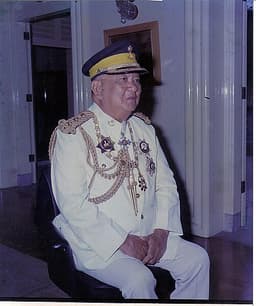
Hassan Ibrahim
General · Modern
44.4Total

Julius Caesar
General · Ancient
82.8Total
Basic Information
Born
1917
-100
Died
1996
-44
Era
Modern
Ancient
Nationality
Egypt
Roman Republic
Occupation
General
General
Civilization
Middle Eastern
Western
Score Comparison
Military (10%)
10.2
88.0
Political (20%)
40.8
78.0
Influence (20%)
51.8
85.0
Legacy (20%)
39.2
82.0
Leadership (15%)
67.0
80.0
Strategy (15%)
45.0
85.0
TOTAL
44.4
82.8
Hassan Ibrahim — Complete Timeline
1952 AD
Participated in the 1952 Egyptian RevolutionPolitical Action◆ Major
Hassan Ibrahim was a member of the Free Officers movement that overthrew King Farouk. He was part of the inner circle that planned the July 23 coup.
Egyptian RevolutionFree OfficersCoup
Impact: national
1961 AD
Served as Vice President of EgyptPolitical Action◆ Major
Ibrahim served as Vice President of Egypt under Nasser from 1961 to 1964. He was involved in the administration of the United Arab Republic and domestic policy.
Vice PresidentUnited Arab RepublicNasser Era
Impact: national
1964 AD
Resigned from GovernmentPolitical Action
Ibrahim resigned from his vice presidency due to disagreements with Nasser's policies. He later retired from public life, distancing himself from the regime.
ResignationPolitical DisagreementNasser Era
Impact: national
Julius Caesar — Complete Timeline
58 BC
Gallic WarsWar◆ Major
Caesar, as proconsul of Gaul, launched a series of campaigns that conquered all of Gaul (modern France, Belgium, and parts of Switzerland). He fought numerous battles, including against the Helvetii, the Belgae, and the Gallic chieftain Vercingetorix. The wars brought immense wealth and a loyal army to Caesar.
Gallic WarsConquestRoman Expansion
Impact: regional
49 BC
Crossing the RubiconPolitical Action◆ Major
Caesar led Legio XIII across the Rubicon River into Italy, defying the Roman Senate's order to disband his army. This act triggered a civil war against Pompey and the Optimates, ultimately leading to Caesar's dictatorship and the end of the Roman Republic.
Roman Civil WarEnd of RepublicPower Struggle
Impact: global
48 BC
Battle of PharsalusWar◆ Major
Caesar's outnumbered army defeated the larger forces of Pompey the Great at Pharsalus in Greece. Caesar's tactical use of a reserve line to counter Pompey's cavalry charge proved decisive. Pompey fled to Egypt, where he was assassinated, leaving Caesar as the undisputed master of the Roman world.
Roman Civil WarBattleDecisive Victory
Impact: regional
44 BC
Appointment as Dictator for LifePolitical Action◆ Major
The Roman Senate appointed Caesar dictator perpetuo (dictator for life), granting him unprecedented personal power. This move concentrated military, legislative, and judicial authority in one person, effectively ending the Roman Republic's traditional system of checks and balances and alarming many senators.
DictatorshipEnd of RepublicPower Consolidation
Impact: regionaldestructive
Assassination on the Ides of MarchPolitical Action◆ Major
A group of Roman senators, led by Marcus Junius Brutus and Gaius Cassius Longinus, stabbed Caesar to death at a meeting of the Senate in the Theatre of Pompey. The assassination was intended to restore the Republic, but instead triggered another civil war that led to the rise of the Roman Empire.
AssassinationRoman PoliticsEnd of Republic
Impact: globaldestructive
Expert Analysis
hassan-ibrahim-vs-julius-caesar
# The General Who Crossed the Rubicon and the Officer Who Stepped Aside
In March of 44 BCE, a mob of Roman senators closed in on a man in a purple toga, stabbing him twenty-three times. Julius Caesar fell at the base of Pompey’s statue, bleeding out on the marble floor of the Senate chamber. More than two thousand years later, in 1964, an Egyptian general named Hassan Ibrahim quietly resigned his post as Vice President, walked away from the corridors of power in Cairo, and retreated into a private life that would end in near-obscurity. Both men were generals. Both stood at the threshold of supreme authority. One seized history by the throat; the other let it slip through his fingers. What makes one man risk everything for glory and another choose silence?
Origins
Caesar was born into the patrician Julian clan, a family with a mythological lineage tracing back to the goddess Venus, but with little contemporary political clout. Rome in the first century BCE was a republic in convulsion—wealthy aristocrats and populist tribunes tearing at each other, while slaves and provincials simmered beneath. Young Caesar grew up amid civil wars and proscriptions, learning early that power was a game won by audacity, not birthright. His uncle Marius had been a populist general; his father-in-law Cinna, a radical reformer. Blood and marriage bound him to the revolutionary tradition.
Hassan Ibrahim, born in 1917, came of age in a very different world. Egypt was a British protectorate, a country ruled by a foreign power and a decadent king. The son of a middle-class family, he entered the military academy at a time when Egyptian officers were humiliated by their subordination to British commanders. Unlike Caesar, who inherited a name, Ibrahim inherited a grievance—nationalist, anti-colonial, simmering. The Free Officers movement that he joined in the late 1940s was not a family affair but a secret society of young men who met in apartments, plotting a coup.
Rise to Power
Caesar’s path was a masterclass in patience and risk. He served as a military tribune, then quaestor in Spain, then aedile in Rome, spending borrowed fortunes on games and public works to win popularity. He forged the First Triumvirate with Pompey and Crassus, an informal alliance that gave him command of Gaul. There, over eight years, he conquered a territory larger than Italy, wrote commentaries that made him a legend, and built an army loyal to him alone—not to the Senate, not to the Republic. When his enemies in Rome ordered him to disband his legions, he made his choice: he crossed the Rubicon River into Italy, an act of war. “The die is cast,” he said, and the Republic fell.
Hassan Ibrahim’s rise was quieter, but no less decisive. On July 23, 1952, he was among the Free Officers who seized control of Cairo, broadcasting the revolution’s first communiqué to a stunned nation. He was not the movement’s leader—that was Gamal Abdel Nasser—but he was trusted, a member of the inner circle. When Nasser became Prime Minister, Ibrahim served as Minister of National Guidance, then Vice President in 1961. His rise was not built on battlefield glory or personal ambition, but on loyalty and proximity to a stronger man.
Leadership & Governance
Caesar governed as he conquered: with speed, ruthlessness, and a genius for spectacle. As dictator, he reformed the calendar, granted citizenship to provincials, launched public works, and centralized tax collection. He also packed the Senate with his supporters, minted coins with his own image, and accepted the title “dictator for life.” His military strategy was a blend of tactical brilliance—the double circumvallation at Alesia, the daring pursuit of Pompey to Egypt—and psychological warfare. He pardoned his enemies, but only to disarm them. He knew that mercy, when unexpected, could be more devastating than slaughter.
Hassan Ibrahim governed in Nasser’s shadow. As Vice President, he was part of the administration of the United Arab Republic, the short-lived union between Egypt and Syria. He oversaw bureaucratic affairs, not armies. His military score, by any measure, is negligible—19.9 out of 100, reflecting a career spent in staff rooms rather than battlefields. His political score, 72.0, suggests competence, but not vision. He was a lieutenant, not a commander. Where Caesar redefined the art of war, Ibrahim administered a state already shaped by others.
Triumph & Tragedy
Caesar’s greatest triumph was Gaul—the conquest of a million men, the capture of eight hundred cities, the subjugation of three hundred tribes. He celebrated four triumphs in Rome, parading Gallic chieftains in chains and displaying the wealth of a continent. His tragedy was that he could not stop. He wanted more: the Parthian campaign, the title of king, the deification of his person. The Ides of March was not a failure of power but a failure of trust. He had pardoned Brutus and Cassius, and they killed him anyway.
Hassan Ibrahim’s triumph was the revolution itself—the overthrow of King Farouk, the end of British domination, the birth of a republic. It was a bloodless coup, executed with precision and discipline. His tragedy was that he had no further role. In 1964, he resigned, citing disagreements with Nasser’s policies. What those disagreements were, history does not record with clarity. Perhaps he saw the drift toward authoritarianism, the crushing of dissent, the war in Yemen. Perhaps he simply tired of being second. He retired, and Egypt moved on without him.
Character & Destiny
Caesar’s character was a furnace of ambition, intellect, and charm. He was a gambler who calculated odds with cold precision, a seducer who won men’s loyalty as easily as women’s hearts. He wrote his own story—the *Commentaries* are propaganda masquerading as history—and he believed, with the certainty of a man who had never been defeated, that he was destined to rule. That belief drove him to the Senate floor on the Ides of March, where he dismissed his wife’s dreams of blood and ignored the soothsayer’s warning. “Cowards die many times before their deaths,” he wrote. He died once, but that was enough.
Hassan Ibrahim’s character is harder to read. He was not a writer, not a self-mythologizer. His scores—Leadership 79.1, Influence 68.2—suggest a man of capability but not charisma. He chose loyalty over ambition, then chose silence over conflict. Where Caesar would have fought, Ibrahim resigned. Where Caesar would have rewritten the rules, Ibrahim accepted them. His destiny was not to be a Caesar, but to be a footnote—a name in the biographies of greater men.
Legacy
Caesar’s legacy is the Roman Empire. His adopted son Octavian became Augustus, the first emperor, and for five centuries the world would be ruled by men who called themselves Caesar. His reforms outlived him; his calendar is still used; his name became a title—Kaiser, Tsar. He is remembered as the man who ended the Republic, but also as the man who set the stage for the Pax Romana. His scores—Military 88.0, Influence 85.0, Legacy 82.0—reflect a figure who changed the course of civilization.
Hassan Ibrahim’s legacy is modest. He is remembered as one of the Free Officers, a participant in a revolution that reshaped the Middle East. But his name does not appear in the standard histories of Egypt, except as a brief mention. His Legacy score, 51.2, is the average of a life lived in the margins of power. He did not build an empire or write a book. He served, and then he stepped away.
Conclusion
The difference between Julius Caesar and Hassan Ibrahim is not merely one of scale—it is one of appetite. Caesar hungered for glory the way a fire hungers for air; Ibrahim seemed content with a seat at the table, not the head of it. One was a man who believed the world owed him greatness; the other was a man who accepted the world as it was. Both were generals. Both had power within their grasp. But history remembers those who take, not those who hold back. In the end, Caesar died because he wanted everything. Ibrahim lived because he wanted enough.
Rankings
🥇
Julius CaesarLeader
Mil: 88.0Pol: 78.0Inf: 85.0
82.8
🥈
Hassan Ibrahim
Mil: 10.2Pol: 40.8Inf: 51.8
44.4
+38.4 behind
How This Comparison Works
Algorithm
Each figure is scored on 6 dimensions (0—100 scale) based on structured historical data: Military (10%), Political (20%), Influence (20%), Legacy (20%), Leadership (15%), Strategy (15%). The weighted total produces the final ranking.
Data Sources
Scores are computed from structured sub-indicators in the database. Scale factors adjust for era (Ancient ×0.85, Modern ×1.0) and civilization size (Eastern ×1.05, Other ×0.80) to account for differences in population and military scale.
Maximum 3 Figures
Comparisons are limited to 2—3 figures to ensure readability and statistical meaningfulness.
Error Margins
±5 points per dimension — Sub-scores are derived from historical records with inherent uncertainty. Two figures within 5 points on a dimension should be considered roughly equivalent in that area.
Total Score Accuracy
±3 points overall — The weighted combination of 6 dimensions produces a total score with approximately ±3 points of uncertainty. Differences of less than 3 points are not statistically significant— the figures are effectively tied.
Known Limitations
- Historical records are incomplete and uneven across civilizations
- Figures from oral-tradition societies may be underrepresented
- Occupation labels can misclassify multi-role figures
- Scores measure capability and impact, not moral character
- Quantitative scoring is a comparison tool, not absolute truth
Capability Radar
Military (10%) — Battles & Warfare
Battles
5
95
Win Rate
5
92
Expansion
5
97
Political (20%) — Governance & Reform
Reform
30
90
Diplomacy
30
85
Economy
20
82
Influence (20%) — Cultural & Global Reach
Cultural
10
88
Global
10
94
Legacy (20%) — Historical Impact
Historical
15
95
Longevity
10
96
Leadership (15%) — Power & Stability
Tenure
40
75
Stability
30
60
Strategy (15%) — Tactics & Innovation
Strategy
5
94
Tactics
5
96
Reform
5
88
Similar Comparisons
Comments & Discussion
RUBICON_VET6/17/2026
Caesar didn't just cross a river—he committed treason with flair. Ibrahim would've been court-martialed for refusing to cross the Red Sea. The difference? Caesar knew power flows to those willing to burn bridges. Ibrahim had a perfect chance in 1964, but he chose a quiet retirement over a coup attempt. Nasser's regime was fracturing, and a decisive general could've reshaped Egypt. Instead, he left. History remembers men who grab it, not those who politely decline.
尼罗河之狐6/17/2026
拿易卜拉欣跟恺撒比,简直是对罗马的侮辱。恺撒在高卢杀了百万蛮族,让元老院发抖;易卜拉欣呢?1964年纳赛尔心脏病发时他干了啥?递辞呈!埃及需要军事强人稳住局势,他却选择当个退休公务员。军人就该像恺撒一样,要么赢天下,要么死得壮烈。易卜拉欣就是条不敢咬人的狗。
PRAETORIAN_GUARD_DEFECTOR6/17/2026
Ibrahim's resignation shows he understood something Caesar never grasped: that real power sometimes requires knowing when to step back. Caesar's assassination proved his ambition was ultimately self-destructive. Ibrahim lived another 46 years in peace, raised a family, and died naturally. Roman senators killed Caesar precisely because he crossed the Rubicon. Ibrahim avoided that fate entirely. Frankly, survival is an underrated strategic victory. Not every general needs a battlefield death to be
沙漠之鹰6/17/2026
恺撒跨卢比孔河前,在卢卡会议上跟庞培、克拉苏分赃——三头同盟的本质就是帮派交易。易卜拉欣继承的埃及是被英国殖民过的残破国家,自由军官组织内部比罗马元老院还乱。他选择退场,是因为知道强出头只会让埃及更分裂。1961年叙利亚脱离阿联已经证明,合久必分。恺撒不懂见好就收,结果被捅23刀;易卜拉欣懂,所以他善终。这不是懦弱,是智慧。