Loading...
Hassan Rouhani vs Julius Caesar
Julius Caesar leads by 32.7 pts · 2 figures compared
…
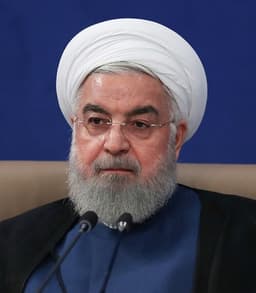
Hassan Rouhani
Politician · Modern
50.1Total

Julius Caesar
General · Ancient
82.8Total
Basic Information
Born
1948
-100
Died
—
-44
Era
Modern
Ancient
Nationality
Iran
Roman Republic
Occupation
Politician
General
Civilization
Middle Eastern
Western
Score Comparison
Military (10%)
34.1
88.0
Political (20%)
45.0
78.0
Influence (20%)
60.0
85.0
Legacy (20%)
50.0
82.0
Leadership (15%)
53.2
80.0
Strategy (15%)
44.4
85.0
TOTAL
50.1
82.8
Hassan Rouhani — Complete Timeline
2013 AD
Elected President of IranPolitical Action◆ Major
Rouhani won the presidential election with a landslide, promising to improve relations with the West and revive the economy. His victory was seen as a mandate for moderation and reform after the hardline presidency of Mahmoud Ahmadinejad.
ElectionReformIran
Impact: nationalconstructive
2015 AD
Joint Comprehensive Plan of Action (JCPOA)Political Action
Rouhani's government negotiated the JCPOA with the P5+1 (US, UK, France, Russia, China, Germany). The deal limited Iran's nuclear program in exchange for sanctions relief, marking a major diplomatic achievement.
Nuclear DealDiplomacySanctions
Impact: globalconstructive
2018 AD
US withdrawal from JCPOAPolitical Action◆ Major
President Trump withdrew the US from the JCPOA and reimposed sanctions. Rouhani's government struggled to maintain the deal with European partners, but the economic pressure led to protests and a currency crisis in Iran.
Nuclear DealSanctionsUS-Iran
Impact: globaldestructive
2019 AD
2019-2020 Iranian protestsPolitical Action◆ Major
Rouhani's government faced nationwide protests over fuel price hikes and economic mismanagement. The protests were violently suppressed, with hundreds killed according to human rights groups, damaging Rouhani's reformist image.
ProtestsSuppressionEconomy
Impact: nationaldestructive
Julius Caesar — Complete Timeline
58 BC
Gallic WarsWar◆ Major
Caesar, as proconsul of Gaul, launched a series of campaigns that conquered all of Gaul (modern France, Belgium, and parts of Switzerland). He fought numerous battles, including against the Helvetii, the Belgae, and the Gallic chieftain Vercingetorix. The wars brought immense wealth and a loyal army to Caesar.
Gallic WarsConquestRoman Expansion
Impact: regional
49 BC
Crossing the RubiconPolitical Action◆ Major
Caesar led Legio XIII across the Rubicon River into Italy, defying the Roman Senate's order to disband his army. This act triggered a civil war against Pompey and the Optimates, ultimately leading to Caesar's dictatorship and the end of the Roman Republic.
Roman Civil WarEnd of RepublicPower Struggle
Impact: global
48 BC
Battle of PharsalusWar◆ Major
Caesar's outnumbered army defeated the larger forces of Pompey the Great at Pharsalus in Greece. Caesar's tactical use of a reserve line to counter Pompey's cavalry charge proved decisive. Pompey fled to Egypt, where he was assassinated, leaving Caesar as the undisputed master of the Roman world.
Roman Civil WarBattleDecisive Victory
Impact: regional
44 BC
Appointment as Dictator for LifePolitical Action◆ Major
The Roman Senate appointed Caesar dictator perpetuo (dictator for life), granting him unprecedented personal power. This move concentrated military, legislative, and judicial authority in one person, effectively ending the Roman Republic's traditional system of checks and balances and alarming many senators.
DictatorshipEnd of RepublicPower Consolidation
Impact: regionaldestructive
Assassination on the Ides of MarchPolitical Action◆ Major
A group of Roman senators, led by Marcus Junius Brutus and Gaius Cassius Longinus, stabbed Caesar to death at a meeting of the Senate in the Theatre of Pompey. The assassination was intended to restore the Republic, but instead triggered another civil war that led to the rise of the Roman Empire.
AssassinationRoman PoliticsEnd of Republic
Impact: globaldestructive
Expert Analysis
hassan-rouhani-vs-julius-caesar
# The Ides of March and the Nuclear Dawn
On a spring morning in 44 BCE, Julius Caesar walked into the Senate chamber, dismissing a soothsayer’s warning. Within hours, he lay bleeding from twenty-three stab wounds, his blood pooling on the marble floor. Two thousand years later, in the summer of 2015, Hassan Rouhani stood before a bank of microphones in Vienna, announcing a deal that would reshape the Middle East. Both men sought to transform their worlds through sheer force of will. One died a martyr to his own ambition. The other survived to see his life’s work unravel.
Origins
Caesar was born into the patrician Julian clan, a family of ancient lineage but modest wealth in a Republic already cracking under the weight of its conquests. His uncle Marius had been a populist general; his father-in-law Cinna a radical reformer. From boyhood, Caesar breathed the air of a political system in its death throes—corrupt, violent, and hungry for a strong hand. He learned early that in Rome, glory was the only currency that mattered.
Rouhani entered the world in 1948 in Sorkheh, a small town in Semnan Province, into a religious family in a nation still reeling from foreign intervention. He was six years old when the CIA-backed coup toppled Iran’s democratically elected prime minister. He came of age under the shah’s secret police, then witnessed the 1979 Islamic Revolution from the inside. Unlike Caesar, who inherited a world of swords and legions, Rouhani inherited a world of clerics and centrifuges.
Rise to Power
Caesar’s path was a masterpiece of calculated risk. He borrowed fortunes to fund games and bribes, won command in Spain through political maneuvering, then formed the First Triumvirate with Pompey and Crassus. But his true springboard was Gaul. Between 58 and 50 BCE, he conquered a territory larger than Italy itself, writing his own propaganda in the *Commentaries* that schoolboys still read today. When the Senate ordered him to disband his army, he crossed the Rubicon River with a single legion—an act of treason that launched a civil war. “The die is cast,” he reportedly said.
Rouhani’s rise was quieter but no less strategic. A mid-ranking cleric who earned a doctorate in constitutional law from Glasgow Caledonian University, he served as Iran’s chief nuclear negotiator under President Khatami in the early 2000s. When the hardliner Mahmoud Ahmadinejad took power, Rouhani retreated to academia, biding his time. In 2013, he emerged as a centrist candidate, winning a landslide on a promise to fix the economy and end Iran’s international isolation. His mandate was not a legion but a ballot box.
Leadership & Governance
Caesar ruled as a military autocrat wrapped in republican forms. He reformed the calendar—giving us the Julian calendar, with its 365 days and leap year—centralized tax collection, extended citizenship to Gauls, and launched massive public works. But his governance was brittle. He pardoned former enemies, only to have them stab him. He centralized power, only to make himself a target. His military genius was undeniable—Alesia, Pharsalus, Thapsus—but he could not translate battlefield victory into political stability.
Rouhani governed as a pragmatist within a theocracy. He had no legions; he had the Supreme Leader, Ayatollah Khamenei, who held ultimate authority. Rouhani’s signature achievement was the Joint Comprehensive Plan of Action (JCPOA) in July 2015, negotiated with the United States, Britain, France, Russia, China, and Germany. The deal limited Iran’s uranium enrichment in exchange for sanctions relief. It was a diplomatic coup—a nuclear agreement without a war. But Rouhani’s political score of 72.0 and strategy score of 56.4 reveal a man constrained by forces he could not control. When President Trump withdrew the U.S. from the deal in 2018, Rouhani’s economy cratered. Protests erupted in 2019 over fuel price hikes, with rioters chanting not against the Supreme Leader, but against Rouhani himself.
Triumph & Tragedy
Caesar’s greatest moment was his triumph: a procession through Rome displaying Gallic chieftains in chains, the spoils of a conquered world. His tragedy was the Ides of March—a death that proved his reforms had no roots. “Et tu, Brute?” may be Shakespeare’s invention, but the sentiment rings true: he trusted too much, or too little.
Rouhani’s triumph was the Vienna agreement—a moment when Iran stood as a negotiating equal with the world’s great powers. His tragedy came in slow motion: the U.S. withdrawal, the reimposed sanctions, the protests, the COVID-19 pandemic. By the time he left office in 2021, his legacy was a shrunken economy and a nuclear program more advanced than when he started.
Character & Destiny
Caesar was reckless, charismatic, and endlessly ambitious. He slept with his enemies’ wives, pardoned his assassins, and believed his own luck. That luck ran out on March 15, 44 BCE. Rouhani was cautious, diplomatic, and patient—a man who understood that in Iran, survival meant never pushing too far. Yet caution also meant he could not save his own deal. Their personalities shaped their fates: Caesar’s audacity built an empire but cost him his life; Rouhani’s moderation preserved his life but cost him his legacy.
Legacy
Caesar’s name became a title—Kaiser, Tsar—and his adopted heir, Octavian, became Augustus, the first Roman emperor. The Republic Caesar destroyed never returned. Today he is remembered as both a tyrant and a visionary, the man who broke the old world to build a new one.
Rouhani’s legacy is more ambiguous. The JCPOA still exists as a framework, but its power is broken. He is remembered as the president who tried to open Iran to the world, only to see the door slammed shut. His influence score of 73.5 and legacy of 66.8 place him as a footnote in a larger story—a man of skill and good intentions caught between an unyielding Supreme Leader and an unpredictable superpower.
Conclusion
One man conquered Gaul and crossed the Rubicon. The other negotiated a nuclear deal and crossed no red lines. Caesar’s world was one of swords and sandals; Rouhani’s, of centrifuges and sanctions. Yet both faced the same fundamental question: how do you change a system that resists change? Caesar answered with violence and paid with his life. Rouhani answered with patience and paid with his reputation. Perhaps the lesson is that in politics, as in history, there is no safe path—only the choice between a glorious death and a quiet defeat.
Rankings
🥇
Julius CaesarLeader
Mil: 88.0Pol: 78.0Inf: 85.0
82.8
🥈
Hassan Rouhani
Mil: 34.1Pol: 45.0Inf: 60.0
50.1
+32.7 behind
How This Comparison Works
Algorithm
Each figure is scored on 6 dimensions (0—100 scale) based on structured historical data: Military (10%), Political (20%), Influence (20%), Legacy (20%), Leadership (15%), Strategy (15%). The weighted total produces the final ranking.
Data Sources
Scores are computed from structured sub-indicators in the database. Scale factors adjust for era (Ancient ×0.85, Modern ×1.0) and civilization size (Eastern ×1.05, Other ×0.80) to account for differences in population and military scale.
Maximum 3 Figures
Comparisons are limited to 2—3 figures to ensure readability and statistical meaningfulness.
Error Margins
±5 points per dimension — Sub-scores are derived from historical records with inherent uncertainty. Two figures within 5 points on a dimension should be considered roughly equivalent in that area.
Total Score Accuracy
±3 points overall — The weighted combination of 6 dimensions produces a total score with approximately ±3 points of uncertainty. Differences of less than 3 points are not statistically significant— the figures are effectively tied.
Known Limitations
- Historical records are incomplete and uneven across civilizations
- Figures from oral-tradition societies may be underrepresented
- Occupation labels can misclassify multi-role figures
- Scores measure capability and impact, not moral character
- Quantitative scoring is a comparison tool, not absolute truth
Capability Radar
Military (10%) — Battles & Warfare
Battles
19
95
Win Rate
26
92
Expansion
26
97
Political (20%) — Governance & Reform
Reform
55
90
Diplomacy
75
85
Economy
50
82
Influence (20%) — Cultural & Global Reach
Cultural
30
88
Global
60
94
Legacy (20%) — Historical Impact
Historical
55
95
Longevity
40
96
Leadership (15%) — Power & Stability
Tenure
60
75
Stability
40
60
Strategy (15%) — Tactics & Innovation
Strategy
30
94
Tactics
32
96
Reform
37
88
Similar Comparisons
Comments & Discussion
SwordAndSeal6/17/2026
Caesar was a conqueror; Rouhani was a negotiator. Apples and oranges. The real story here isn’t their ambitions—it’s how they responded to opposition. Caesar wrote his own legacy in blood and law. Rouhani wrote a deal that his own parliament and supreme leader then gutted. One man changed history. The other got a Nobel nomination and a hollow victory.
尼罗河算账6/17/2026
把恺撒和鲁哈尼放一起比?恺撒动了元老院的蛋糕,立刻被捅成筛子。鲁哈尼想靠一纸协议松动禁运,可他的“元老院”是最高领袖、革命卫队外加国会。他没被物理刺死,但他的核协议被每一条法律走廊绞死。恺撒至少死得轰轰烈烈,鲁哈尼活活看着自己的遗产被签字抹掉。哪个更悲壮?你自己选。
LegionLogic6/17/2026
From a military historian's perspective, this comparison is nonsense. Caesar commanded armies that conquered Gaul, crossed the Rubicon, and ended a republic. Rouhani has never led a single soldier in battle. The only "force of will" Rouhani demonstrated was a diplomatic charm offensive that Iran's hardliners dismantled within months. One man changed the world through steel and strategy. The other signed a paper that is now a footnote.
数据拆解师6/17/2026
数据上看,恺撒死前当了不到一年终身独裁官,鲁哈尼干了八年总统。论“变革成果”:恺撒留下了帝国体系、拉丁文法律和日历改革;鲁哈尼留下了JCPOA——2015年签,2018年被美国撕,伊朗立刻恢复低丰度铀浓缩。这协议的实际生效时间不足三年。拿一把短剑和一个文件袋比历史重量?文件袋先塌了。
ClassicsCynic6/17/2026
Caesar was stabbed by his peers in a marble hall. Rouhani was assassinated by sanctions and hardliner vetoes in a conference room. The form of political death differs—daggers versus denials—but the pattern is identical: both men overestimated their ability to tame the forces they unleashed. Caesar thought clemency would pacify the Senate. Rouhani thought a good deal would convert the Revolutionary Guard. Both were wrong, and both paid the price.