Loading...
Hastings Banda vs Julius Caesar
Julius Caesar leads by 33.5 pts · 2 figures compared
…
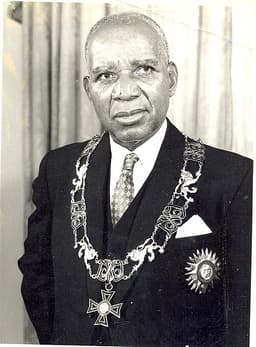
Hastings Banda
Politician · Modern
49.3Total

Julius Caesar
General · Ancient
82.8Total
Basic Information
Born
1898
-100
Died
1997
-44
Era
Modern
Ancient
Nationality
Malawi
Roman Republic
Occupation
Politician
General
Civilization
Other
Western
Score Comparison
Military (10%)
13.4
88.0
Political (20%)
48.0
78.0
Influence (20%)
54.9
85.0
Legacy (20%)
45.0
82.0
Leadership (15%)
74.0
80.0
Strategy (15%)
47.0
85.0
TOTAL
49.3
82.8
Hastings Banda — Complete Timeline
1958 AD
Returned to Malawi and led independence movementPolitical Action◆ Major
Banda returned to Nyasaland after decades abroad and assumed leadership of the Nyasaland African Congress. He led the push for independence from British colonial rule, becoming the central figure in the nationalist movement.
IndependenceNationalismDecolonization
Impact: nationalconstructive
1963 AD
Became first Prime Minister of independent MalawiPolitical Action
Following constitutional changes and elections, Banda became Prime Minister of self-governing Nyasaland. On July 6, 1964, Malawi achieved full independence from Britain, with Banda as its first Prime Minister.
IndependenceGovernment Formation
Impact: nationalconstructive
1966 AD
Declared Malawi a one-party statePolitical Action◆ Major
Banda declared Malawi a republic and himself President. He consolidated power by making the Malawi Congress Party the sole legal party, banning all opposition and establishing an authoritarian regime that lasted for three decades.
AuthoritarianismOne-Party StateRepression
Impact: nationaldestructive
1967 AD
Established diplomatic relations with apartheid South AfricaPolitical Action◆ Major
Banda became the first African leader to establish formal diplomatic relations with apartheid South Africa. This controversial decision provided Malawi with economic aid and trade benefits but drew sharp criticism from other African nations.
Foreign PolicyApartheidDiplomacy
Impact: regional
1994 AD
Lost power in multi-party electionsPolitical Action◆ Major
After decades of authoritarian rule, Banda was defeated in Malawi's first multi-party elections since independence. Bakili Muluzi of the United Democratic Front won the presidency, ending Banda's 31-year rule.
ElectionTransitionDemocracy
Impact: national
Julius Caesar — Complete Timeline
58 BC
Gallic WarsWar◆ Major
Caesar, as proconsul of Gaul, launched a series of campaigns that conquered all of Gaul (modern France, Belgium, and parts of Switzerland). He fought numerous battles, including against the Helvetii, the Belgae, and the Gallic chieftain Vercingetorix. The wars brought immense wealth and a loyal army to Caesar.
Gallic WarsConquestRoman Expansion
Impact: regional
49 BC
Crossing the RubiconPolitical Action◆ Major
Caesar led Legio XIII across the Rubicon River into Italy, defying the Roman Senate's order to disband his army. This act triggered a civil war against Pompey and the Optimates, ultimately leading to Caesar's dictatorship and the end of the Roman Republic.
Roman Civil WarEnd of RepublicPower Struggle
Impact: global
48 BC
Battle of PharsalusWar◆ Major
Caesar's outnumbered army defeated the larger forces of Pompey the Great at Pharsalus in Greece. Caesar's tactical use of a reserve line to counter Pompey's cavalry charge proved decisive. Pompey fled to Egypt, where he was assassinated, leaving Caesar as the undisputed master of the Roman world.
Roman Civil WarBattleDecisive Victory
Impact: regional
44 BC
Appointment as Dictator for LifePolitical Action◆ Major
The Roman Senate appointed Caesar dictator perpetuo (dictator for life), granting him unprecedented personal power. This move concentrated military, legislative, and judicial authority in one person, effectively ending the Roman Republic's traditional system of checks and balances and alarming many senators.
DictatorshipEnd of RepublicPower Consolidation
Impact: regionaldestructive
Assassination on the Ides of MarchPolitical Action◆ Major
A group of Roman senators, led by Marcus Junius Brutus and Gaius Cassius Longinus, stabbed Caesar to death at a meeting of the Senate in the Theatre of Pompey. The assassination was intended to restore the Republic, but instead triggered another civil war that led to the rise of the Roman Empire.
AssassinationRoman PoliticsEnd of Republic
Impact: globaldestructive
Expert Analysis
hastings-banda-vs-julius-caesar
# The Dictator's Mirror: Julius Caesar and Hastings Banda
On the Ides of March in 44 BCE, a Roman dictator fell to twenty-three dagger wounds in the Senate chamber. Two thousand years later, in 1994, another dictator—this one in the dusty capital of a small African nation—quietly conceded defeat in a free election and retired to his mansion. Julius Caesar and Hastings Banda lived worlds apart, yet their stories orbit the same dark sun: the seduction of absolute power. Why did one end in blood-soaked marble and the other in a peaceful retirement? The answer lies not in their eras, but in their souls.
Origins
Caesar was born into the patrician Julian clan in 100 BCE, a time when Rome's Republic was rotting from within. His family was ancient but impoverished, and young Gaius learned early that in a world of backroom deals and civil wars, survival meant audacity. He fled the dictator Sulla's proscriptions, served as a priest of Jupiter, and was captured by pirates—whom he promised to crucify, then did. His Rome was a crucible of ambition, where a man could rise by charm, debt, and military glory.
Hastings Banda was born in 1898 in a mud hut in Nyasaland, a British protectorate in southeastern Africa. His world was one of colonial subjugation, where a black man's ceiling was a white man's floor. Banda escaped—walking barefoot to South Africa, then to the United States and Britain, where he earned medical degrees. He practiced medicine in London for decades, a quiet doctor far from the drums of African nationalism. When he returned to Nyasaland in 1958 at age sixty, he was an outsider in his own land, a man who had spent more years in Western suits than in African soil.
Rise to Power
Caesar's ascent was a masterpiece of strategic accumulation. He married well, bribed better, and formed the First Triumvirate with Pompey and Crassus in 60 BCE. His command in Gaul from 58 to 50 BCE was not just conquest—it was a self-financed army, a propaganda machine, and a personal treasury. When the Senate ordered him to disband his legions, Caesar crossed the Rubicon River in 49 BCE, uttering "the die is cast." He gambled everything on civil war, and he won.
Banda's rise was slower, more careful. He returned to Nyasaland in 1958 to lead the Nyasaland African Congress, a movement demanding independence from Britain. He was arrested, imprisoned, but the tide of decolonization was rising. In 1963, he became Prime Minister of self-governing Nyasaland, and on July 6, 1964, he led the country to independence as Malawi. He was hailed as the father of the nation—a black Moses who had led his people from colonial bondage.
Leadership & Governance
Caesar governed with a blend of clemency and ruthlessness. He pardoned former enemies, reformed the calendar, extended citizenship to provincials, and launched public works. But he also centralized power, packed the Senate with loyalists, and accepted the title "dictator for life." His military genius was unmatched—Alesia, Pharsalus, Thapsus—but his political wisdom was poisoned by his own ambition. He treated the Republic as a stage, not a sacred trust.
Banda's rule was a paradox. He built schools, hospitals, and infrastructure, and maintained one of Africa's most stable economies. His pro-Western foreign policy—including establishing diplomatic relations with apartheid South Africa in 1967—was controversial but pragmatic. Yet domestically, he was a tyrant. In 1966, he declared Malawi a one-party state, with himself as President for Life. Dissent was crushed, opponents imprisoned or killed, and a cult of personality surrounded him. He was "Ngwazi"—the conqueror—and his word was law.
Triumph & Tragedy
Caesar's triumph was his conquest of Gaul, which added a vast province to Rome and made him the richest man in the world. His tragedy was his blindness to the hatred he inspired. When he dismissed his bodyguard and walked into the Senate on March 15, 44 BCE, he was a man who believed his own myth. The Ides of March was not just assassination—it was the Republic's final convulsion, a desperate act that only hastened its death.
Banda's triumph was independence—a quiet, dignified achievement that gave Malawians pride. His tragedy was the decades of authoritarian rule that followed. He grew old, paranoid, and isolated. By the early 1990s, international pressure and internal dissent forced him to hold a referendum on multi-party rule. In 1994, at age ninety-six, he lost the election and stepped down. He died three years later, in 1997, in a South African hospital—not by a blade, but by time.
Character & Destiny
Caesar was driven by an insatiable hunger for glory. He wrote his own commentaries, controlled his own narrative, and believed that his genius justified his ambition. His character was magnetic, reckless, and ultimately fatal. He could not imagine a world where he was not the center.
Banda was driven by fear—fear of losing power, fear of the chaos he saw in other African nations. His character was cautious, controlling, and deeply insecure. He had spent too long abroad to trust his own people, and too long in the colonial system to imagine a different way. He ruled not with Caesar's flair, but with a doctor's cold precision.
Legacy
Caesar's legacy is the Roman Empire itself. His name became synonymous with imperial power—"Kaiser" and "Tsar" both derive from "Caesar." His reforms outlived him, and his assassination made him a martyr. He is remembered as both a hero and a tyrant, a man who broke a republic and built an empire.
Banda's legacy is more ambiguous. He is remembered as the father of Malawian independence, but also as a dictator who stifled democracy for three decades. His peaceful exit set a precedent for African transitions, but his authoritarian model was copied by others with less grace. In Malawi, his name is spoken with a mix of respect and regret.
Conclusion
Two dictators, two millennia apart. Caesar fell because he could not imagine sharing power; Banda surrendered because he finally understood he had no choice. One died by the sword, the other by the ballot box. Their stories are mirrors of each other—reflections of how power corrupts, but also of how times change. Caesar's Rome had no mechanism for peaceful transition; Banda's Malawi, however imperfectly, found one. In the end, the difference between a tragic death and a quiet retirement is not just character—it is history itself, slowly learning its own lessons.
Rankings
🥇
Julius CaesarLeader
Mil: 88.0Pol: 78.0Inf: 85.0
82.8
🥈
Hastings Banda
Mil: 13.4Pol: 48.0Inf: 54.9
49.3
+33.5 behind
How This Comparison Works
Algorithm
Each figure is scored on 6 dimensions (0—100 scale) based on structured historical data: Military (10%), Political (20%), Influence (20%), Legacy (20%), Leadership (15%), Strategy (15%). The weighted total produces the final ranking.
Data Sources
Scores are computed from structured sub-indicators in the database. Scale factors adjust for era (Ancient ×0.85, Modern ×1.0) and civilization size (Eastern ×1.05, Other ×0.80) to account for differences in population and military scale.
Maximum 3 Figures
Comparisons are limited to 2—3 figures to ensure readability and statistical meaningfulness.
Error Margins
±5 points per dimension — Sub-scores are derived from historical records with inherent uncertainty. Two figures within 5 points on a dimension should be considered roughly equivalent in that area.
Total Score Accuracy
±3 points overall — The weighted combination of 6 dimensions produces a total score with approximately ±3 points of uncertainty. Differences of less than 3 points are not statistically significant— the figures are effectively tied.
Known Limitations
- Historical records are incomplete and uneven across civilizations
- Figures from oral-tradition societies may be underrepresented
- Occupation labels can misclassify multi-role figures
- Scores measure capability and impact, not moral character
- Quantitative scoring is a comparison tool, not absolute truth
Capability Radar
Military (10%) — Battles & Warfare
Battles
27
95
Win Rate
29
92
Expansion
31
97
Political (20%) — Governance & Reform
Reform
50
90
Diplomacy
40
85
Economy
30
82
Influence (20%) — Cultural & Global Reach
Cultural
40
88
Global
30
94
Legacy (20%) — Historical Impact
Historical
50
95
Longevity
30
96
Leadership (15%) — Power & Stability
Tenure
70
75
Stability
20
60
Strategy (15%) — Tactics & Innovation
Strategy
36
94
Tactics
36
96
Reform
42
88
Similar Comparisons
Comments & Discussion
CenturionCodex6/17/2026
Caesar died because he never learned how to delegate actual power to the Senate. Banda outlived his tyranny precisely because he understood the art of the quiet exit. The Gaul conquered Gaul, but at home he refused to play the political long game. Banda, for all his brutality, knew when to fold. Caesar's fatal flaw wasn't ambition—it was believing his own myth.
古罗马烽火6/17/2026
拿凯撒和班达比?班达连个罗马元老院都混不进去。凯撒死于背叛,班达死于平庸。凯撒的征服塑造了西方文明,班达的统治除了让马拉维更穷外一无是处。历史的审判从不公平:神祇死于23刀,小丑却安享晚年。
DataScribe2.06/17/2026
What's the statistical basis for calling them mirrors? Caesar ran a war economy for 15 years. Banda ran a tobacco export monopoly for 30. That's like comparing a Formula 1 crash to a fender bender. The only shared variable is "absolute power" but that's so vague it's meaningless. Let's look at their actual governance metrics before we get poetic.
穿越时空的史官6/17/2026
他们共同的敌人根本不是权力,而是时间。凯撒死于公元前44年,班达活到了2004年。这相差两千多年的人文演变中,权力终结的方式早就变了。凯撒不知道什么是民主选举,班达却不得不面对它。不是灵魂差异,是时代逼他们走不同的死亡之路。
RevisionistLens6/17/2026
You call Banda "quiet"? The man built a police state reminiscent of Caesar's secret police but with zero legacy. He banned miniskirts, controlled newspapers, and had enemies locked up until they died. The only difference is Banda's victims had no Plutarch to write their epitaphs. History's amnesia is the real dictator here.
帝国余晖吟游诗人6/17/2026
他们共享的黑暗核心不是权力,而是孤独。凯撒把权力穿在身上,像战袍般耀眼;班达把权力吞进肚里,消化成沉默。一个死于万众面前,一个消失在无人问津。权力的终点不是死亡或退休,而是被遗忘。凯撒成了传说,班达成了注脚。这才是终极讽刺:暴君最怕的不是反抗,而是被历史忽视。