Loading...
Hatshepsut vs Libius Severus
Hatshepsut leads by 11.2 pts · 2 figures compared
…
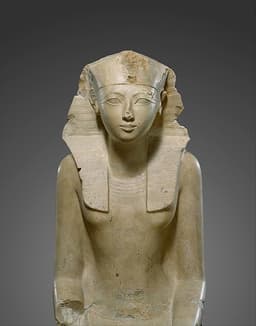
Hatshepsut
Emperor · Ancient
54.9Total

Libius Severus
Emperor · Ancient
43.7Total
Basic Information
Born
-1507
420
Died
-1458
465
Era
Ancient
Ancient
Nationality
Egypt
Western Roman Empire
Occupation
Emperor
Emperor
Civilization
Middle Eastern
Western
Score Comparison
Military (10%)
50.0
29.6
Political (20%)
59.3
39.4
Influence (20%)
61.0
54.9
Legacy (20%)
50.0
39.2
Leadership (15%)
72.0
49.9
Strategy (15%)
25.0
38.6
TOTAL
54.9
43.7
Hatshepsut — Complete Timeline
1479 BC
Coronation as PharaohPolitical Action
Hatshepsut assumed the throne as pharaoh after the death of her husband Thutmose II, initially as regent for her stepson Thutmose III. She later declared herself king, adopting full royal titulary and male iconography to legitimize her rule.
SuccessionFemale PharaohLegitimacy
Impact: national
1470 BC
Expedition to the Land of PuntCultural◆ Major
Hatshepsut dispatched a trading expedition to the Land of Punt, likely located in the Horn of Africa. The mission returned with myrrh trees, gold, ivory, and exotic animals, which were depicted in reliefs at her mortuary temple at Deir el-Bahri.
TradePuntDeir el-Bahri
Impact: regionalconstructive
1460 BC
Construction of Mortuary Temple at Deir el-BahriCultural◆ Major
Hatshepsut commissioned a terraced mortuary temple at Deir el-Bahri, designed by her architect Senenmut. The temple featured colonnades, reliefs of her divine birth and the Punt expedition, and became a masterpiece of Egyptian architecture.
ArchitectureSenenmutMortuary Temple
Impact: nationalconstructive
1458 BC
Damnation of Hatshepsut's MemoryPolitical Action◆ Major
After Hatshepsut's death, Thutmose III ordered the systematic erasure of her name and images from monuments and temples. Her cartouches were chiseled out, and her statues were smashed, likely to consolidate his own legitimacy and remove her from official records.
Damnatio MemoriaeThutmose IIIIconoclasm
Impact: nationaldestructive
1457 BC
Obelisk Erection at KarnakCultural
Hatshepsut erected two massive obelisks at the Karnak temple, one of which still stands. The obelisks were carved from single blocks of granite and inscribed with texts proclaiming her devotion to the god Amun and her right to rule.
MonumentObeliskAmun
Impact: nationalconstructive
Libius Severus — Complete Timeline
461 AD
Proclaimed Western Roman Emperor by RicimerPolitical Action◆ Major
After the death of Majorian, the magister militum Ricimer proclaimed Libius Severus as Western Roman Emperor. Severus was a senator with no significant military or political experience, and his reign was entirely controlled by Ricimer.
Imperial SuccessionPuppet Emperor
Impact: regional
462 AD
Reign marked by loss of control over provincesPolitical Action◆ Major
During Severus's reign, the Western Roman Empire lost effective control over several provinces. The Eastern Emperor Leo I refused to recognize him, and the general Aegidius established an independent domain in Gaul, further fragmenting imperial authority.
Loss of TerritoryImperial Decline
Impact: regionaldestructive
465 AD
Died under suspicious circumstancesOther◆ Major
Libius Severus died, possibly poisoned by Ricimer, after a reign of four years. His death left the Western imperial throne vacant for two years, as Ricimer did not immediately appoint a successor, highlighting the powerlessness of the emperor.
DeathImperial Succession
Impact: regionaltragic
Expert Analysis
Origins
Hatshepsut was born around 1507 BCE, the daughter of Pharaoh Thutmose I and his Great Royal Wife Ahmose. She received a thorough education in statecraft, religion, and administration, typical of royal women. Upon her father's death, she married her half-brother Thutmose II, becoming queen consort. After Thutmose II's death, she served as regent for her stepson Thutmose III, but eventually assumed full pharaonic power.
Libius Severus was a Roman senator of obscure origins, born in the early 5th century CE. Little is known of his early life. He rose to prominence in the Western Roman Empire's senatorial class, but lacked military or administrative experience. His background was unremarkable, making him a pliable candidate for the barbarian general Ricimer.
Rise to Power
Hatshepsut's rise was gradual and strategic. As regent for Thutmose III (c. 1479 BCE), she initially acted on his behalf. Within a few years, she took the unprecedented step of declaring herself pharaoh, adopting the full royal titulary including the throne name Maatkare. She justified her rule through divine birth narratives and by emphasizing her role as the rightful heir. Her supporters included key officials like Senenmut, her architect and advisor.
Libius Severus was proclaimed Western Roman Emperor in 461 CE by Ricimer, the powerful magister militum, after the murder of Majorian. Severus was a puppet with no independent power base. The Eastern Emperor Leo I refused to recognize him, and Severus's authority was limited to Italy. His rise was entirely dependent on Ricimer's backing, and he never commanded the loyalty of the army or provinces.
Leadership & Governance
Hatshepsut governed as a traditional pharaoh, emphasizing stability, trade, and monumental construction. She restored trade routes disrupted by Hyksos, notably the expedition to Punt (c. 1493 BCE) which brought back myrrh trees, gold, ivory, and exotic animals. She initiated extensive building projects, including her mortuary temple at Deir el-Bahri, obelisks at Karnak, and restorations of temples damaged by invaders. Her governance was effective, maintaining peace and prosperity for over two decades.
Libius Severus was a figurehead. Real power rested with Ricimer, who controlled the army and made key decisions. Severus's reign saw the loss of control over provinces: Gaul, Spain, and Africa were effectively independent under local rulers or barbarian kingdoms. The Eastern Empire refused to recognize him, and he could not prevent the Vandals from raiding Italy. His governance was nonexistent; he was merely a placeholder.
Triumph & Tragedy
Hatshepsut's greatest triumph was her successful expedition to Punt, which brought wealth and prestige. Her building program, especially Deir el-Bahri, stood as a testament to her reign. She also maintained a stable, prosperous Egypt. Her tragedy was the systematic erasure of her memory after her death. Thutmose III ordered her images and cartouches chiseled off monuments, and her name omitted from king lists, an attempt to damn her legacy. However, this act inadvertently preserved evidence of her rule for modern archaeologists.
Libius Severus's 'triumphs' were minimal: he survived four years as emperor, longer than some. His tragedy was his utter lack of agency. He died under suspicious circumstances in 465 CE, likely poisoned by Ricimer. His reign was a failure by any measure: he lost provinces, was unrecognized by the east, and accomplished nothing lasting. His death left the throne vacant for two years, highlighting his irrelevance.
Character & Destiny
Hatshepsut was ambitious, intelligent, and politically astute. She understood the need to legitimize her rule through propaganda and building. Her character combined traditional pharaonic authority with innovative statecraft. Her destiny was to rule successfully but be posthumously attacked by her successor, reflecting the gender tensions of ancient Egypt.
Libius Severus was likely weak-willed or at least powerless. He accepted the role of puppet, perhaps hoping to wield influence, but was outmaneuvered by Ricimer. His character was passive, and his destiny was to be a footnote in Roman history. Historical assessments view him as a nonentity, with his reign marking the continued decline of the Western Empire.
Legacy
Hatshepsut's legacy is complex. She scored 50.0 in military and 59.3 in political, reflecting her peaceful reign and effective governance. Her influence score of 61.0 and leadership of 72.0 indicate her impact on Egyptian history. Her temple and obelisks remain iconic, and her story challenges traditional narratives of female rulers. The erasure of her memory ironically ensured her fame in modern times.
Libius Severus scored 29.6 in military, 39.4 in political, and 54.9 in influence. His legacy is negligible; he is remembered only as a puppet emperor. His reign accelerated the fragmentation of the Western Empire. He is a symbol of the empire's terminal decline, with no lasting achievements.
Conclusion
Hatshepsut had a far greater impact than Libius Severus. Her total score of 54.9 versus Severus's 43.7 reflects this. Hatshepsut actively ruled for over 20 years, expanding trade, building monuments, and maintaining stability. Severus was a passive placeholder whose reign marked further disintegration. Hatshepsut's legacy endures through her architecture and story, while Severus is a mere historical curiosity. The female pharaoh's innovative leadership and lasting influence clearly outweigh the puppet emperor's failed tenure. Hatshepsut is the more significant historical figure.
Rankings
🥇
HatshepsutLeader
Mil: 50.0Pol: 59.3Inf: 61.0
54.9
🥈
Libius Severus
Mil: 29.6Pol: 39.4Inf: 54.9
43.7
+11.2 behind
How This Comparison Works
Algorithm
Each figure is scored on 6 dimensions (0—100 scale) based on structured historical data: Military (10%), Political (20%), Influence (20%), Legacy (20%), Leadership (15%), Strategy (15%). The weighted total produces the final ranking.
Data Sources
Scores are computed from structured sub-indicators in the database. Scale factors adjust for era (Ancient ×0.85, Modern ×1.0) and civilization size (Eastern ×1.05, Other ×0.80) to account for differences in population and military scale.
Maximum 3 Figures
Comparisons are limited to 2—3 figures to ensure readability and statistical meaningfulness.
Error Margins
±5 points per dimension — Sub-scores are derived from historical records with inherent uncertainty. Two figures within 5 points on a dimension should be considered roughly equivalent in that area.
Total Score Accuracy
±3 points overall — The weighted combination of 6 dimensions produces a total score with approximately ±3 points of uncertainty. Differences of less than 3 points are not statistically significant— the figures are effectively tied.
Known Limitations
- Historical records are incomplete and uneven across civilizations
- Figures from oral-tradition societies may be underrepresented
- Occupation labels can misclassify multi-role figures
- Scores measure capability and impact, not moral character
- Quantitative scoring is a comparison tool, not absolute truth
Capability Radar
Military (10%) — Battles & Warfare
Battles
10
7
Win Rate
10
7
Expansion
20
11
Political (20%) — Governance & Reform
Reform
75
0
Diplomacy
70
5
Economy
80
0
Influence (20%) — Cultural & Global Reach
Cultural
70
0
Global
55
0
Legacy (20%) — Historical Impact
Historical
65
5
Longevity
60
0
Leadership (15%) — Power & Stability
Tenure
70
10
Stability
75
5
Strategy (15%) — Tactics & Innovation
Strategy
15
16
Tactics
10
15
Reform
10
17
Similar Comparisons
Comments & Discussion
No comments yet. Be the first to share your thoughts!