Loading...
Hayato Ikeda vs Yan Xishan
Hayato Ikeda leads by 0.0 pts · 2 figures compared
…
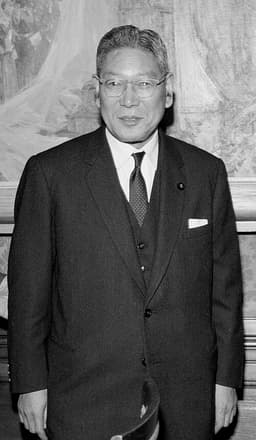
Hayato Ikeda
Politician · Modern
56.3Total

Yan Xishan
Politician · Modern
56.3Total
Basic Information
Born
1899
1883
Died
1965
1960
Era
Modern
Modern
Nationality
Japan
China
Occupation
Politician
Politician
Civilization
Eastern
Eastern
Score Comparison
Military (10%)
12.5
45.0
Political (20%)
78.0
59.3
Influence (20%)
59.0
54.1
Legacy (20%)
52.0
46.7
Leadership (15%)
79.8
78.0
Strategy (15%)
35.9
60.0
TOTAL
56.3
56.3
Hayato Ikeda — Complete Timeline
1960 AD
Launch of the Income-Doubling PlanReform
Prime Minister Hayato Ikeda announced the 'Income-Doubling Plan' in December 1960, a ten-year economic program aiming to double the national income through rapid industrial growth, increased productivity, and expanded trade. The plan successfully guided Japan's high-growth era, achieving its target in seven years and transforming the country into an economic powerhouse.
Economic PolicyGrowthJapan
Impact: nationalconstructive
Liberalization of Trade and CapitalReform◆ Major
Ikeda's government pursued gradual liberalization of trade and capital flows, aligning Japan with international economic norms. This included joining the General Agreement on Tariffs and Trade (GATT) and the International Monetary Fund (IMF) Article VIII, which required removing restrictions on current account transactions, boosting foreign trade.
Trade PolicyLiberalizationEconomic Integration
Impact: nationalconstructive
Political Reconciliation with the OppositionPolitical Action
After the violent protests against the US-Japan Security Treaty in 1960, Ikeda adopted a 'low posture' approach, seeking dialogue with the opposition Socialist Party. He focused on economic growth and social welfare to reduce political polarization, successfully stabilizing Japanese politics during his tenure.
Political StrategyStabilityJapan
Impact: nationalconstructive
Yan Xishan — Complete Timeline
1912 AD
Establishment of Control over Shanxi ProvincePolitical Action◆ Major
Yan Xishan became the military governor of Shanxi Province after the Xinhai Revolution. He consolidated control over the province and implemented a series of reforms. His rule lasted for decades, making him one of the longest-serving warlords in China.
Warlord EraShanxiGovernance
Impact: regionalconstructive
1917 AD
Implementation of the 'Model Province' ReformsReform◆ Major
Yan Xishan implemented a series of reforms in Shanxi, including land redistribution, education, and infrastructure development. He promoted modern agriculture and industry, earning the nickname 'The Model Governor'. These reforms improved living standards but were authoritarian in nature.
ReformShanxiModernization
Impact: regionalconstructive
1926 AD
Participation in the Northern ExpeditionWar
Yan Xishan initially remained neutral during the Northern Expedition but later allied with the Nationalist government. He allowed Nationalist forces to pass through Shanxi and provided support. This decision helped him maintain his power after the Nationalists unified China.
WarAllianceNationalist
Impact: national
1930 AD
Defeat in the Central Plains WarWar◆ Major
Yan Xishan joined the anti-Chiang Kai-shek coalition in the Central Plains War. His forces were defeated by Chiang's National Revolutionary Army. The defeat forced Yan to flee to Dalian, but he later returned to Shanxi after negotiations with the Nationalist government.
WarDefeatWarlord
Impact: nationaldestructive
1949 AD
Surrender to the Communist PartyPolitical Action◆ Major
As the Chinese Civil War ended, Yan Xishan surrendered Shanxi to the Communist Party. He fled to Taiwan with the Nationalist government. His surrender marked the end of his long rule over Shanxi and the final defeat of the warlord era.
SurrenderCivil WarEnd of Rule
Impact: nationaltragic
Expert Analysis
Origins
**Hayato Ikeda** (1899–1965) was born in Takehara, Hiroshima, into a sake-brewing family. He graduated from Kyoto Imperial University in 1925 with a law degree and entered the Ministry of Finance. His early career focused on tax policy and wartime economic planning, giving him technical expertise but no military background.
**Yan Xishan** (1883–1960) was born in Shanxi, China, to a wealthy landowning family. He studied at the Taiyuan Military Academy and later at the Imperial Japanese Army Academy (1907–1909). Returning to China, he participated in the 1911 Xinhai Revolution and quickly rose as a military commander.
Rise to Power
Ikeda entered politics in 1949, winning a seat in the Diet. He served as Finance Minister under Prime Minister Shigeru Yoshida (1949–1952), implementing the Dodge Line austerity. In 1960, after the resignation of Nobusuke Kishi amid the Anpo protests, Ikeda became prime minister. His 'low posture' approach and focus on economic growth contrasted with Kishi's confrontational style.
Yan Xishan became military governor of Shanxi in 1912, leveraging his Japanese-trained troops. He maintained autonomy through the Warlord Era, switching allegiances as needed. In 1926, he joined the Northern Expedition, later allying with Chiang Kai-shek. His power peaked in the 1920s–30s as the 'Model Governor' of Shanxi.
Leadership & Governance
Ikeda's governance centered on the 'Income-Doubling Plan' (1960), a ten-year program targeting 7.2% annual growth (actual growth averaged 10%). He liberalized trade and capital, joining the OECD in 1964. His 'low posture' sought consensus with the opposition, reducing political violence. Ikeda's leadership score is 79.8, reflecting his pragmatic, technocratic style.
Yan Xishan implemented 'Model Province' reforms: land redistribution, compulsory education, railway construction, and industrialization. He established a provincial bank, factories, and a military industrial complex. However, his rule was autocratic and relied on a secret police. His political score (59.3) and military score (45.0) reflect a mixed record of reform and repression.
Triumph & Tragedy
Ikeda's triumph: The Income-Doubling Plan succeeded beyond expectations, transforming Japan into the world's second-largest economy. His low posture stabilized politics after the Anpo crisis. Tragedy: He died of cancer in 1965 before seeing the plan's full fruition. His strategy score (35.9) indicates limited foreign policy vision; he prioritized economics over diplomacy.
Yan's triumph: Shanxi became a model of modernization with rising literacy and infrastructure. He maintained independence for decades. Tragedy: His defeat in the Central Plains War (1930) and surrender to the Communists in 1949 ended his rule. He fled to Taiwan, dying in obscurity. His total score ties Ikeda at 56.3, but his impact was more localized.
Character & Destiny
Ikeda was methodical, cautious, and consensus-driven. His background as a bureaucrat shaped his incremental approach. Destiny: He died at the peak of his success, leaving a legacy of growth. Yan was ambitious, pragmatic, and ruthless. He adapted to survive but ultimately couldn't overcome the tide of civil war. His destiny: a warlord whose reforms were overshadowed by national conflict.
Legacy
Ikeda's legacy is Japan's post-war economic miracle. The Income-Doubling Plan set a template for state-led growth. His approach influenced later Japanese leaders and development economists. Today, he is remembered as a key architect of modern Japan.
Yan's legacy is mixed. In Shanxi, his reforms are noted but his authoritarianism criticized. His model influenced other Chinese warlords but was eclipsed by the CCP's land reforms. He is a footnote in Chinese history, compared to Ikeda's national significance.
Conclusion
Hayato Ikeda had greater impact. His policies reshaped Japan's economy and society, with global influence. Yan Xishan's reforms, while innovative, were confined to one province and undone by war. Ikeda's total score (56.3) matches Yan's, but his political (78.0 vs 59.3) and leadership (79.8 vs 78.0) scores reflect more effective governance. Ikeda's legacy endures in Japan's prosperity; Yan's remains regional.
Rankings
🥇
Hayato IkedaLeader
Mil: 12.5Pol: 78.0Inf: 59.0
56.3
🥈
Yan Xishan
Mil: 45.0Pol: 59.3Inf: 54.1
56.3
How This Comparison Works
Algorithm
Each figure is scored on 6 dimensions (0—100 scale) based on structured historical data: Military (10%), Political (20%), Influence (20%), Legacy (20%), Leadership (15%), Strategy (15%). The weighted total produces the final ranking.
Data Sources
Scores are computed from structured sub-indicators in the database. Scale factors adjust for era (Ancient ×0.85, Modern ×1.0) and civilization size (Eastern ×1.05, Other ×0.80) to account for differences in population and military scale.
Maximum 3 Figures
Comparisons are limited to 2—3 figures to ensure readability and statistical meaningfulness.
Error Margins
±5 points per dimension — Sub-scores are derived from historical records with inherent uncertainty. Two figures within 5 points on a dimension should be considered roughly equivalent in that area.
Total Score Accuracy
±3 points overall — The weighted combination of 6 dimensions produces a total score with approximately ±3 points of uncertainty. Differences of less than 3 points are not statistically significant— the figures are effectively tied.
Known Limitations
- Historical records are incomplete and uneven across civilizations
- Figures from oral-tradition societies may be underrepresented
- Occupation labels can misclassify multi-role figures
- Scores measure capability and impact, not moral character
- Quantitative scoring is a comparison tool, not absolute truth
Capability Radar
Military (10%) — Battles & Warfare
Battles
16
45
Win Rate
16
40
Expansion
21
30
Political (20%) — Governance & Reform
Reform
75
75
Diplomacy
70
65
Economy
85
70
Influence (20%) — Cultural & Global Reach
Cultural
30
40
Global
55
25
Legacy (20%) — Historical Impact
Historical
65
45
Longevity
55
35
Leadership (15%) — Power & Stability
Tenure
60
85
Stability
70
60
Strategy (15%) — Tactics & Innovation
Strategy
23
55
Tactics
26
50
Reform
28
60
Similar Comparisons
Comments & Discussion
No comments yet. Be the first to share your thoughts!